Nebraska DMV Cheat Sheet + Study Guide
Two free artifacts: the printable 3-page PDF cheat sheet and the full written study guide for the Nebraska permit test. Read both below, and download the PDF — no signup required.
1. Printable cheat sheet
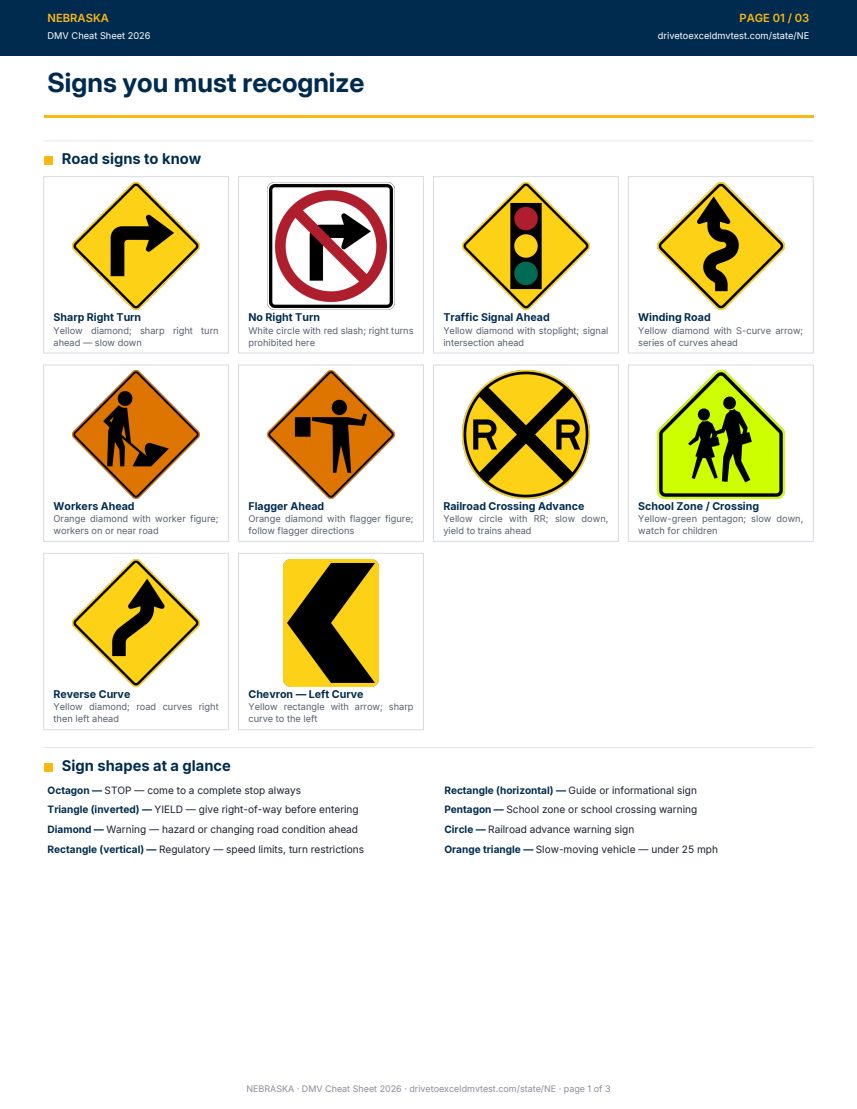
The 3-page PDF below is built to be printed and re-read the morning of your test. Use the Download button to save a copy.
2. Full Nebraska study guide
The long-form companion to the cheat sheet: the rules, road signs and key numbers for the knowledge test, explained in plain English.
Nebraska DMV-style practice questions, the 2026 passing rules, and a 40-question practice exam you can take right now — no signup, no paywall.
01What you're walking into
The Nebraska DMV knowledge test is the first checkpoint between you and a Learner's Permit. Study the Nebraska Driver's Manual before you go. Walk in cold and you're guessing. Walk in prepared and the 25-question test is very passable.
- Under-18 exam25 questions. Pass with 20 correct (80%). Same format and pass threshold as the adult test — Nebraska doesn't make it harder for minors.
- Adult exam25 questions. Pass with 20 correct (80%). Straightforward once you know the rules around right-of-way, signs, and alcohol limits.
- Application fee$13 for the original Learner's Permit (LPD). Take the vision and written tests in person at a Nebraska driver licensing office, and check dmv.nebraska.gov for where to pay the fee.
- Bring with youProof of identity, proof of Nebraska residency, and your Social Security number. Check dmv.nebraska.gov for the current accepted document list before you go.
- Under 16?You must complete an approved driver education course — or log 50 supervised hours (10 at night) — before you can upgrade to a Provisional Operator Permit (POP) at age 16.
- Details worth knowingNebraska has different BAC limits for adults and under-21 drivers, hill-parking wheel directions, and right-of-way rules for uncontrolled intersections. With a pass mark of 20 of 25, a few missed rules can put you below the cutoff, so cover every category.
02What to study
Traffic laws, safety, and road signs are core topics in the Nebraska handbook. Know your signs, know your right-of-way rules, and know the alcohol limits cold.
- Road signsShape and color are everything. A round sign means railroad crossing — slow down, look, listen, stop if needed. A pentagon is a school zone. Yellow-green warning signs flag pedestrians, bikes, and school buses.
- Right-of-way at four-way stopsWhoever arrives first goes first. If it's a tie, the left-hand driver gives way to the one on the right.
- Signal distanceSignal at least 100 feet before your intended turn. Know this one cold.
- Railroad crossingsWhen lights flash or the gate drops, stop 15 to 50 feet from the nearest track. Never go around a lowered gate. If stopped at a multi-track crossing, wait for a clear view of all tracks before proceeding.
- Following distanceMinimum 3 seconds under normal conditions. Increase the gap behind motorcycles, large vehicles, in rain, ice, or darkness.
- BAC limit — 21 and older0.08 percent or higher is DUI. Impairment begins well below that number, so know the difference between legal and safe.
- BAC limit — under 210.02 percent. Nebraska's zero-tolerance threshold is 0.02, not a single drop — know the exact number.
- Chemical test refusalNebraska's Implied Consent Law means you agreed to chemical testing the moment you drove in the state. Refuse a chemical test of blood, breath, or urine and you lose your license for one year automatically.
- Speed limits — business district20 mph unless otherwise posted. The posted maximum applies under ideal conditions only — adverse weather or road conditions require lower speed.
- Passing a bicycleNebraska law requires at least 3 feet of clearance when overtaking a cyclist. Slow down and hold that gap until you are fully past.
03Rules that are easy to mix up
These rules are easy to mix up. A few of them look obvious until you read every option carefully and realize a specific rule applies, not general common sense.
- Three-car right-of-way at a four-way stopWhen two vehicles arrive at the same time, left yields to right. When three arrive simultaneously, each driver must work out who is to whose right. Know the tie-breaker rule, not just 'first come, first served'.
- School bus — when to stopStop in BOTH directions when the bus shows flashing red lights and its stop arm is extended, except when you are on the other roadway of a road divided by a median. Don't move until the lights stop flashing and the arm retracts. After stopping, watch for children walking along the roadside — know what to do after the stop, not just when to stop.
- Hill parking — uphill with curbTurn wheels sharply AWAY from the curb. If the vehicle rolls, the curb stops it.
- Hill parking — uphill without a curb, or downhillTurn wheels TOWARD the edge of the road. If the vehicle rolls, it moves off the road rather than into traffic.
- Impairment vs. legal limit0.08% is the legal limit for drivers 21+. Impairment starts at much lower BAC levels. Don't confuse 'legal' with 'safe'.
- 'Always' and 'never' — when they're actually rightBe careful with 'always' and 'never' answers. Some rules are genuine absolutes: always yield to a pedestrian even if they're jaywalking, and always yield to oncoming traffic when turning left. Read each option before assuming 'always' is wrong.
- Passing a bicycle — 3-foot ruleThe rule has a specific number: 3 feet of clearance, not just 'as much space as possible.' Know the statute.
04How to prepare (the 3-loop method)
Reading the handbook alone may not be enough. Try three loops: read once, drill once, listen once.
- Loop 1 — read the handbookDownload the Nebraska Driver's Manual free from dmv.nebraska.gov. Read it once without trying to memorize. The manual covers signs, right-of-way, GDL rules, and alcohol law. This guide compresses the key content into bullets.
- Loop 2 — drill the practice examsTake the free 40-Q exam below cold. Score under 32? Identify which categories you missed and drill those first. Then retake and keep drilling until every rule in the handbook feels familiar.
- Loop 3 — listen along on YouTubePlay the Nebraska Full Practice Test video in the background a day or two before your appointment. Hearing the questions and correct answers out loud is a different way to lock in the numbers.
- Sleep beats crammingMemory consolidates overnight. A full night's sleep before the test is worth more than two extra hours of late-night reading.
- Study signs visuallyDon't just read sign descriptions — look at the actual shape and color. Signs appear as images on the road, not text descriptions. A round yellow railroad warning sign looks very different from an octagon.
- Read every option before pickingThe first option often looks right until you notice a later one is more precise. If you see 'All of the above,' pick it only when every option is true.
05After you pass
Nebraska's Graduated Driver Licensing (GDL) system adds restrictions in phases. Passing the knowledge test earns you a Learner's Permit, not the freedom to drive solo. Each phase has its own minimum age and holding time, so plan accordingly.
- Permit supervisor ruleWhile on a Learner's Permit, a licensed driver who is at least 21 years old must sit in the front passenger seat at all times. No exceptions for short trips.
- Permit minimum hold timeYou must hold the Learner's Permit for at least 6 months before you can upgrade to a Provisional Operator Permit (POP). You also must not have accumulated 3 or more points on your driving record.
- Supervised driving hours50 total hours of supervised practice, including at least 10 hours at night (sunset to sunrise). These must be completed with a parent, guardian, or licensed driver 21+ before POP eligibility — unless you completed an approved driver safety course.
- Night curfew (POP)No unsupervised driving between 12:00 AM and 6:00 AM. Exceptions: driving to or from work, or school activities. A licensed adult 21+ in the car lets you drive any hour.
- Passenger restriction — first 6 months of POPOnly 1 passenger who is both under 19 years old AND not an immediate family member. All passengers must be buckled.
- When restrictions liftPassenger restriction lifts at 6 months. The curfew and other POP restrictions end when you move up to a Class O license — at age 17 or older after holding the POP for 12 months with fewer than 3 points in that period — or, at the latest, when the POP expires on your 18th birthday.
- Instant upgrade at 18At age 18 you are immediately eligible for an unrestricted standard Class O license regardless of how long you've held the POP. Because you hold a POP, the written and drive tests are waived.
Lock it in — you've read it, now test yourself
Reading the Nebraska handbook once is rarely enough to pass. A simple plan: go over the cheat sheet, take the free 40-question practice exams until the rules stick, then review anything you missed the night before.
Note: this is a study tool, not an official DMV resource. Always confirm requirements with your state's DMV before scheduling your test.