Montana DMV Cheat Sheet + Study Guide
Two free artifacts: the printable 3-page PDF cheat sheet and the full written study guide for the Montana permit test. Read both below, and download the PDF — no signup required.
1. Printable cheat sheet
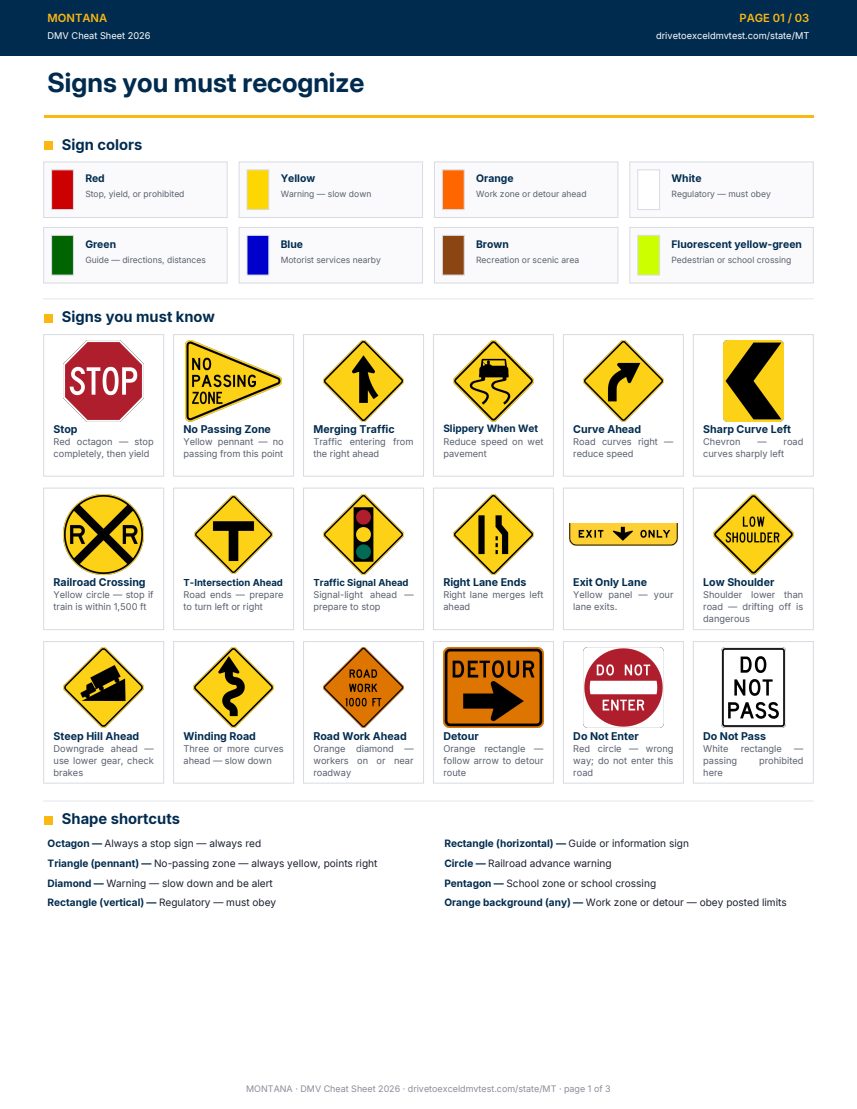
The 3-page PDF below is built to be printed and re-read the morning of your test. Use the Download button to save a copy.
2. Full Montana study guide
The long-form companion to the cheat sheet: the rules, road signs and key numbers for the knowledge test, explained in plain English.
Montana MVD-style practice questions, the 2026 passing rules, and a 40-question practice exam you can take right now — no signup, no paywall.
01What you're walking into
The Montana MVD knowledge test is the gateway between you and a learner's license. The MVD sets the number of questions and the passing score, so confirm both before test day.
- Test formatCheck with the Montana MVD for the current number of questions and the passing score. On our practice exams, aim to score well above that mark before you book the real test.
- One test formatThe same knowledge test applies to both under-18 applicants and first-time adult drivers — Montana uses one test format.
- Permit feeThe permit fee depends on your age — check the current amount at mvdmt.gov/licensing-fees. Bring proof of identity and Montana residency to your MVD office.
- Driver educationDriver's education (Traffic Education) is required if you are younger than 15. Teens age 14.5 or older who are enrolled in an approved Traffic Education course can apply for a learner's license before turning 15.
- Supervisor requirementSupervisor requirement is 18+ — if you are under 18, your supervisor must be a parent or legal guardian or, with their permission, a licensed driver who is at least 18.
- Study sourceOur practice questions are based on the Montana Driver Manual, available free at mvdmt.gov.
02What to study
The handbook covers traffic laws, road signs and safety in detail. Know these three areas well.
- Road signsKnow signs by sight: what a diamond-shaped yellow sign means, what an octagon guarantees, and what orange signs always indicate.
- Traffic lawsRight-of-way, turning, passing, lane use, and school bus rules are the main areas to study.
- Right-of-way at intersectionsAt a four-way stop, first-to-arrive goes first; at a yield sign, slow and yield to all traffic including pedestrians. A driver entering from a driveway or private road yields to all traffic already on the public road.
- Turn signalSignal before every turn or lane change. For turns, keep your signal on for at least the last 100 feet in town and at least the last 300 feet on rural roads.
- Railroad crossingsAt a railroad crossing, you must stop for any train that is no more than 1,500 feet from the crossing, or that is plainly visible and in hazardous proximity. At 50 mph, that leaves you only 20 seconds.
- Following distanceUse the three-second rule for a safe following distance. In less-than-ideal conditions — slippery roads, bad weather, large vehicles — increase it; you may need about four seconds.
- BAC limit0.08% or higher is the legal DUI threshold for drivers age 21 or older.
- Impairment starts earlyEven the smallest amount of alcohol reduces your concentration, perception, judgment, and memory — impairment begins below the legal limit.
- Speed in work zonesMontana has no default 50-mph work-zone speed. Posted limits are set by the organization running the project — always obey the posted sign.
- Bicycle passingOn a two-lane road, Montana law allows passing a cyclist only when you can do it safely, without endangering them. If no one is coming, cross the center line to leave the recommended 5 feet; if there is oncoming traffic, slow to the cyclist's speed and wait. Cyclists often ride in groups, so allow extra time to pass them all.
03Common mistakes that cost the test
These points are easy to mix up, so review them before test day. A single category you glossed over can flip a pass into a fail.
- Simultaneous arrivalAt an uncontrolled intersection, when two cars arrive simultaneously, the car on the right has the right-of-way — not the car moving faster or the driver who flashes their lights.
- School bus — two-lane roadWhen a school bus stops with its red lights flashing on a two-lane highway, all traffic in both directions must stop before reaching the bus and must not move until the red lights stop flashing.
- Hill parking, downhillWhen parking downhill, point your front wheels at the curb or the road's edge so that, if the brakes fail, the vehicle rolls away from traffic.
- Hill parking — uphill with curbWhen parking uphill with a curb, turn your wheels away from the curb (to the left). If the brakes fail, the tire catches the curb before the car rolls into traffic.
- Impairment vs. legal limitThe only thing that reduces BAC is time — not coffee, food, or a cold shower. Feeling 'okay to drive' is not a defense once BAC hits 0.08%.
- 'Always' / 'never' heuristicPay close attention to absolute wording in answer choices. For example, you must always yield to pedestrians in school crosswalks — even when there is no crossing guard present.
- Bicycle lane parking banYou may not park in a marked bicycle lane, on a crosswalk, or within a fire hydrant zone.
04How to prepare (the 3-loop method)
Reading the handbook once may not be enough. A simple routine is three loops: read once, drill once, listen once. That's it.
- Loop 1 — Read the handbookWork through the Montana Driver Manual cover to cover. It's the official source for Montana's rules of the road. Download the current edition free at mvdmt.gov.
- Loop 2 — Drill practice examsUse the free 40-question practice exams on this site, then review what you missed. Spend extra time on traffic laws and safety.
- Loop 3 — Listen along on YouTubeQueue up our Montana MVD full practice test video for a commute or evening session. Hearing the questions and answers out loud is a different way to review than reading.
- Sleep beats crammingYour recall on test day is highest after a full night of sleep. Reviewing the handbook for 30 minutes the morning of the test beats staying up until 2 AM with flashcards.
- Study signs visuallyLearn signs as pictures, not names. Practice recognizing diamond shapes, octagons, orange backgrounds, and pentagon shapes without reading a label.
- Read all four optionsWrong answers can sound reasonable. Read all four before committing — partial reading is an easy way to lose a correct answer you already know.
05After you pass
Passing the knowledge test gets you a learner's license — not the freedom to drive alone. Montana's GDL rules for under-18 drivers include a night curfew and passenger limits, and the restrictions lift after one year or on your 18th birthday, whichever comes first.
- Permit supervisorIf you are under 18, you must be accompanied by a parent or legal guardian or, with their permission, a licensed driver who is at least 18 years old. That person must sit beside you in the front passenger seat.
- Minimum permit holdHold your permit for at least 6 months before you can apply for a provisional license.
- Supervised driving hoursLog at least 50 total hours of supervised driving, including at least 10 hours at night, before the road test.
- Night curfewFor the first year of the provisional license, no driving alone between 11 PM and 5 AM. An adult supervisor (18+) can override the curfew.
- Passenger restriction — first 6 monthsNo more than 1 non-family passenger under 18 in the vehicle.
- Passenger restriction — months 7–12The limit increases to 3 non-family passengers under 18.
- Restrictions liftAll provisional restrictions end after 1 year from your license issue date OR when you turn 18 — whichever comes FIRST. If you get your license at 17 years and 4 months, you're fully unrestricted at 18, not after a full year.
Lock it in — you've read it, now test yourself
Reading the Montana handbook once is rarely enough to pass. A simple plan: go over the cheat sheet, take the free 40-question practice exams until the rules stick, then review anything you missed the night before.
Note: this is a study tool, not an official MVD resource. Always confirm requirements with your state's DMV before scheduling your test.