West Virginia DMV Cheat Sheet + Study Guide
Two free artifacts: the printable 3-page PDF cheat sheet and the full written study guide for the West Virginia permit test. Read both below, and download the PDF — no signup required.
1. Printable cheat sheet
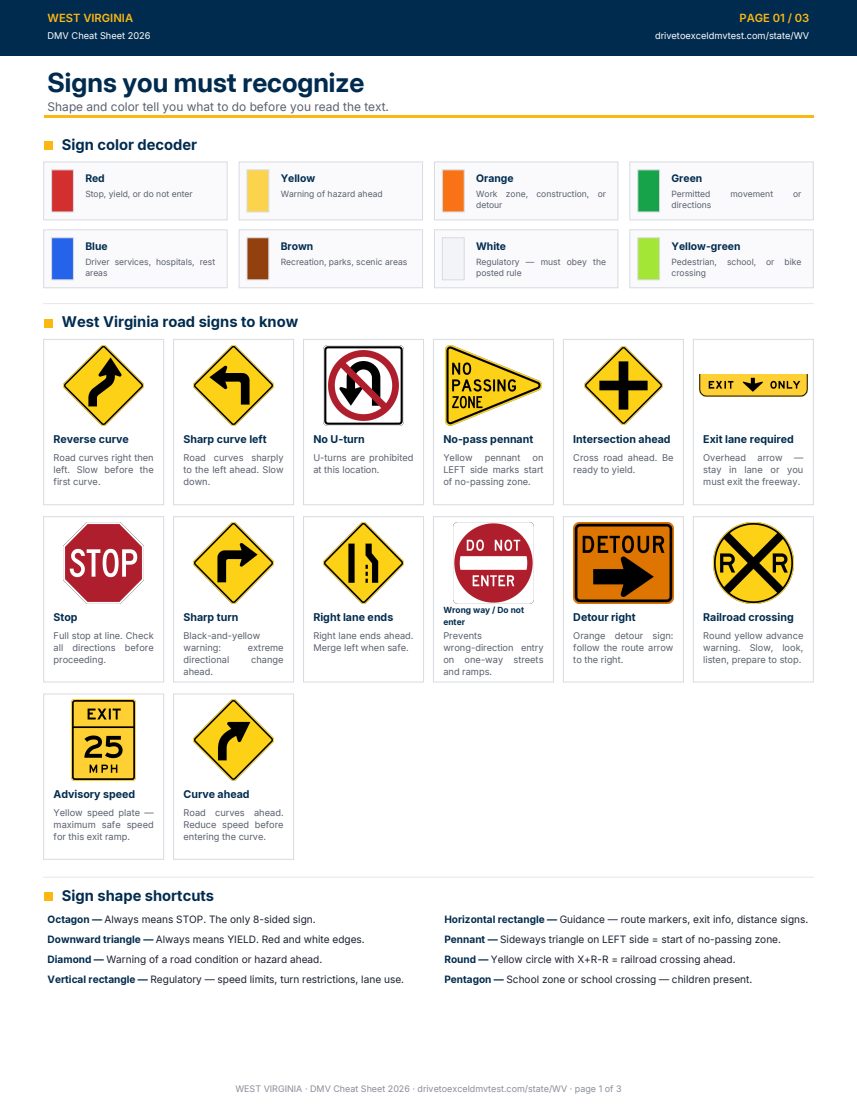
The 3-page PDF below is built to be printed and re-read the morning of your test. Use the Download button to save a copy.
2. Full West Virginia study guide
The long-form companion to the cheat sheet: the rules, road signs and key numbers for the knowledge test, explained in plain English.
West Virginia DMV-style practice questions, the 2026 passing rules, and a 40-question practice exam you can take right now — no signup, no paywall.
01What you're walking into
The West Virginia DMV knowledge test is the gateway between you and a learner's permit. Study the West Virginia Driver's Licensing Handbook before you go. The 76% passing threshold means you can only miss 6 questions out of 25.
- Under-18 exam25 questions. Pass at 19 correct (76%).
- Adult exam25 questions. Pass at 19 correct (76%).
- Test fee$7.50 per knowledge test attempt. The permit itself has a separate fee, so check the DMV for the current amount. You can take the knowledge test online or at a DMV office, but you must still visit a DMV regional office to be issued the permit.
- Bring with youProof of identity, proof of Social Security number, and two proofs of West Virginia residency. Check the DMV's acceptable documents list before you go.
- Under 18?Driver education is not required to get the Level 1 permit. To move up to Level 2 you need either an approved driver ed course OR 50 hours of supervised behind-the-wheel practice (including 10 hours at night), certified by a parent or guardian.
- Passing score: 76%West Virginia uses 76%, which means you pass at 19 correct. Every question counts, even when you're on question 24.
- Where to focus your studyThe practice exams cover the handbook's main topics. Traffic laws and safety are worth extra practice time, so start with those two.
02What to know for the test
Traffic laws, safety, and road signs are key topics to study for West Virginia. If you know your right-of-way rules, stopping distances, and BAC thresholds cold, you're well prepared.
- Road signsSign shapes, colors, and meanings. A flashing red light is treated as a stop sign. Crossbuck signs at railroad crossings mean yield to trains.
- Traffic lawsKnow the right-of-way, turning, passing, and lane-change rules. At a four-way stop, the driver who arrived first goes first; if two arrive simultaneously, yield to the right.
- SafetyHazardous conditions, emergency situations, and defensive driving. Study fog, wet roads, skid recovery, and fatigue — WV's hilly terrain makes these especially important.
- Signal distanceSignal at least 100 feet before you turn, and signal every time you change lanes or enter or leave an interstate.
- Railroad crossingsStop no closer than 15 feet from the nearest rail when signals are flashing or a gate is lowered. Parking within 50 feet of a railroad crossing is also prohibited.
- Following distanceUnder ideal conditions, maintain at least 3 to 4 seconds of following distance. If it is dark or raining, leave at least 4 seconds; on ice or snow, at least 6 seconds.
- BAC limit (21+)0.08% — driving at or above this level is illegal. Know the exact number; don't round up to 0.1%.
- Impairment starts below 0.08%Even a small amount of alcohol impairs vision, judgment, concentration, and coordination. The legal limit is not a safety threshold — impairment begins with the first drink.
- DUI penalties — first offenseA first-offense DUI carries up to 6 months in jail, a fine of $100 to $500 and license revocation. At a BAC of 0.15 or higher, the fine is $200 to $1,000 and the jail term is 2 days to 6 months. Higher penalties apply when a child is endangered or an injury results.
- Drugs and alcohol combinedMixing alcohol with any drug — prescription, OTC, or illegal — multiplies impairment. One drink with a cold remedy can affect you like several drinks.
03Rules that are easy to mix up
These rules are easy to mix up. If you only have time to drill a few topics, start here.
- Four-way stop orderFirst to arrive goes first. Tie goes to the driver on the right. It is easy to remember the tie rule and forget that arrival order overrides it.
- School bus rules — both directionsOn all public and private roads, traffic in BOTH directions must stop before reaching a school bus with flashing red lights. The only exception is an Interstate or other controlled-access highway, where traffic on the other side of the median does not have to stop.
- Hill parking — downhillTurn front wheels TOWARD the curb (into the road edge). If brakes fail, the car rolls away from traffic.
- Hill parking — uphill with a curbTurn front wheels AWAY from the curb (toward traffic). The curb catches the wheel if brakes fail.
- Impairment vs. the legal limit0.08% is the legal threshold, not the point where you become impaired. Any amount of alcohol can cause impairment, so don't confuse the two.
- Crosswalk parking and passing on the rightParking on a crosswalk is not allowed. When a vehicle ahead is turning left and a passing lane is available, you may go around it on the right, but only when it is safe.
04How to prepare (the 3-loop method)
Reading the handbook once may not be enough. A simple routine is three loops: read once, drill once, listen once. That's it.
- Loop 1 — read the handbookDownload the West Virginia Driver's Licensing Handbook free from the WV DMV website. Read it once — don't memorize, just build familiarity. This guide pulls the key points into bullets.
- Loop 2 — drill the practice examsTake the free 40-Q exam below cold. Anything under 30/40 → focus on the categories you missed, then retake.
- Loop 3 — listen along on YouTubePlay the West Virginia DMV Full Practice Test video in the background while you do chores. It makes a useful last review.
- Sleep beats crammingMemory consolidates overnight. A full sleep the night before is worth more than two extra hours of late-night reading.
- Study signs visuallyNever read sign descriptions as text only. Look at the actual shape and color — a yellow diamond, an orange work-zone diamond, a red octagon — because on the road you recognize signs by sight.
- Read every option before pickingIf 'All of the above' is offered, it can be the correct answer. The first option can sound right until you see that the others are also correct. Don't lock in early.
05After you pass
Passing the knowledge test earns you a Level 1 instruction permit — not a full license. West Virginia uses a 3-level Graduated Driver Licensing system, and the rules are strict about supervision, curfew, and passenger limits at Levels 1 and 2.
- Supervisor requirement (Level 1)A licensed driver at least 21 years old must sit in the front passenger seat and be the only other occupant allowed there. The supervisor must be fully alert and unimpaired at all times.
- Permit hold timeAt least 6 months with no traffic violations before you can apply for the Level 2 intermediate license.
- Supervised practice hours50 hours total (certified by parent or guardian), including at least 10 hours of night driving — unless you complete an approved driver education course instead.
- Curfew — Level 1Level 1 permit holders may drive only from 5:00 AM to 10:00 PM, even with a 21+ supervisor in the car.
- Curfew — Level 2 (intermediate)Level 2 drivers may drive unsupervised between 5:00 AM and 10:00 PM. From 10:00 PM to 5:00 AM you need a licensed supervising driver age 21 or older, except when going to or returning from work, a school activity, a religious event, or an emergency.
- Passenger restrictionLevel 1: no more than 2 additional passengers (unlimited if family). Level 2: no passengers under 20 years old for the first 6 months, then no more than 1 passenger under 20 for the second 6 months — family members are exempt.
- When restrictions lift — LATER ruleYou can move up to the Level 3 full license when you are BOTH age 17 AND have held the Level 2 intermediate license for at least 1 year with no convictions — and you must apply for it. Whichever comes later is the controlling date.
Lock it in — you've read it, now test yourself
Reading the West Virginia handbook once is rarely enough to pass. A simple plan: go over the cheat sheet, take the free 40-question practice exams until the rules stick, then review anything you missed the night before.
Note: this is a study tool, not an official DMV resource. Always confirm requirements with your state's DMV before scheduling your test.