Wisconsin DMV Cheat Sheet + Study Guide
Two free artifacts: the printable 3-page PDF cheat sheet and the full written study guide for the Wisconsin permit test. Read both below, and download the PDF — no signup required.
1. Printable cheat sheet
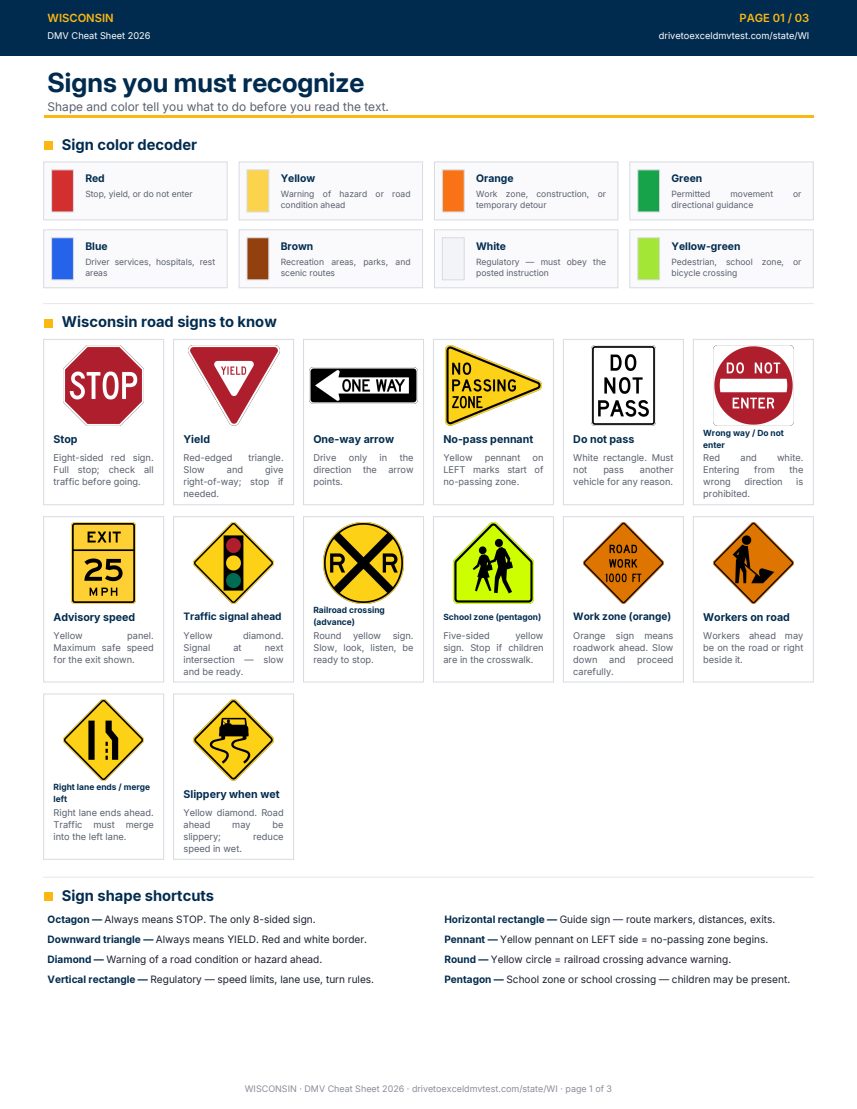
The 3-page PDF below is built to be printed and re-read the morning of your test. Use the Download button to save a copy.
2. Full Wisconsin study guide
The long-form companion to the cheat sheet: the rules, road signs and key numbers for the knowledge test, explained in plain English.
Wisconsin DMV-style practice questions, the 2026 passing rules, and a 40-question practice exam you can take right now — no signup, no paywall.
01What you're walking into
The Wisconsin DMV knowledge test is your entry point to an instruction permit. Study the Wisconsin Motorists' Handbook, then use practice questions to find the gaps that rereading alone won't show.
- The test (all ages)50 questions — you must answer at least 40 correctly (80% pass). Wisconsin uses the same 50-question format for first-time drivers of any age.
- Application fee$35 for the Class D instruction permit (valid 18 months). Pay at your local DMV service center when you apply.
- Bring with youProof of identity, Social Security number, and Wisconsin residency documentation. Originals or certified copies only — photocopies are not accepted.
- Driver education requirementRequired for all drivers under 18. You must be enrolled in a certified driver education program — your MV3001 application must be signed by your instructor.
- Beyond the road signsThe handbook covers traffic laws and general driving rules in detail. Over-focusing on road signs can leave you caught off guard by right-of-way scenarios, speed limits, and school bus rules.
- 7 categories to studyStudy every category: traffic laws, safety, road signs, drugs & alcohol, vehicle rules, parking, and general driving rules. Don't skip any before you sit the 50-question test.
02What to know for the test
Traffic laws, safety, and road signs are major parts of the Wisconsin handbook, alongside general driving rules. Start your study with these.
- Road signsRoad signs are learned by sight, not by text description. Diamond-shaped yellow signs warn of hazards. Orange diamond signs mark construction zones. Downward-facing triangles mean yield. Don't study signs as words — study them as shapes and colors.
- Turn signal distanceIn Wisconsin, your signal must be on at least 100 feet ahead of a turn, and you should signal before changing lanes or leaving a curb as well. Switch it on before you get to the intersection, not after you have entered the turn lane.
- Following distanceMaintain at least a 4-second gap under ideal driving conditions. Don't mix it up with the 3-second rule. Increase the gap in rain, snow, or when following a motorcycle or large truck.
- Railroad crossingsWhen crossing signals flash or a gate is lowered, stop before the tracks. Do not cross until the train has fully cleared the tracks and the signals stop.
- Right-of-way at uncontrolled intersectionsIf two vehicles arrive together, the driver on the right goes first and the driver on the left must wait. At a four-way stop, whoever arrives first goes first. Pedestrians and cyclists in crosswalks always have the right-of-way.
- Prima-facie speed limitsUnless a sign says otherwise, the limit is 25 mph in residential and business districts and 35 mph in semi-urban districts outside cities. 15 mph applies in alleys, and also in school zones while children are present.
- BAC limit — 21 and olderIt is illegal to drive with a BAC of 0.08% or higher. The legal limit is not the safe limit — impairment starts at lower levels.
- Under-21 BAC ruleZero tolerance — any detectable amount of alcohol suspends your license. Remember it as 'any amount.'
- Chemical test refusalWisconsin's Implied Consent Law means you must submit to alcohol testing when requested by an officer. Refusal results in arrest and loss of driving privileges for at least one year — plus additional penalties.
03Rules that are easy to mix up
These rules are easy to mix up. If you only have time to drill a few, drill these.
- Four-way stop right-of-wayWhoever arrives first goes first. When two cars arrive together, the car on the left gives way to the car on the right. Situations with three cars can get confusing, so apply that same rule to one pair at a time.
- School bus rulesStop when a school bus ahead has its red lights flashing, and stay stopped until the lights stop. A divided highway is the exception: drivers on the far side from the bus do not need to stop. On undivided roads, traffic on both sides must stop.
- Hill parking — uphill with curbTurn your front wheels LEFT (away from the curb). The curb acts as a stopper if the brake fails.
- Hill parking — downhill or no curbTurn your front wheels RIGHT (toward the road edge). The car rolls away from traffic, not into it.
- Impairment vs. legal limit0.08% is the legal per se limit, NOT the safety threshold. Any amount of alcohol affects judgment and coordination. Know the difference — impairment begins below the legal limit.
- Passing a bicyclistSlow down and wait for a clear gap, then pass leaving sufficient space — never less than 3 feet of clearance. You pass a cyclist the same way you'd pass any vehicle.
04How to prepare (the 3-loop method)
Reading the handbook once may not be enough. A simple routine is three loops: read once, drill once, listen once. That's it.
- Loop 1 — read the handbook (or this guide)Download the Wisconsin Motorists' Handbook free from wisconsindot.gov. Read once, don't memorize. This guide pulls the key points into bullets.
- Loop 2 — drill the practice examsTake the free 40-Q exam below cold. Anything under 32/40 — focus on the categories you missed and retake.
- Loop 3 — listen along on YouTubePlay the Wisconsin Cheat Sheet video the day or two before your test. It makes a useful last review.
- Sleep beats crammingMemory consolidates overnight. A full sleep the night before is worth more than two extra hours of late-night reading.
- Study signs visuallyNever read sign descriptions in text only. Look at the actual shape and color, because on the road you recognize signs by sight, not by a written description.
- Read every option before pickingRead all the choices, including 'All of the above' when it is offered. The first option can look correct until you read the rest. Don't lock in early.
05After you pass
Passing the knowledge test gets you an instruction permit — not a license. Wisconsin's graduated driver licensing (GDL) rules include a supervisor requirement and a 50-hour practice mandate.
- Permit supervision — 2-year licensed requirementYour accompanying supervisor must have at least 2 years of licensed driving experience and hold a valid regular license. A parent or guardian must be 19+; any other licensed adult must be 21+.
- Minimum permit hold timeAt least 6 months violation-free before you can apply for the probationary (road test) license.
- Supervised hours50 total hours of behind-the-wheel practice — 10 of those hours must be at night. Log them carefully; the DMV expects these hours to be certified.
- Night curfew (probationary, under 18)Midnight to 5 a.m.: you may only drive alone when traveling directly between home, school, and/or work. All other trips during that window require a qualified supervisor in the front passenger seat.
- Passenger restriction (probationary, under 18)During daytime hours (5 a.m. to midnight): drive alone or with one peer passenger. Family members are unlimited at any time.
- When restrictions liftAfter 9 months of violation-free probationary driving OR when you turn 18 — whichever comes FIRST. You don't need to wait for your 18th birthday if the 9-month window closes earlier.
Lock it in — you've read it, now test yourself
Reading the Wisconsin handbook once is rarely enough to pass. A simple plan: go over the cheat sheet, take the free 40-question practice exams until the rules stick, then review anything you missed the night before.
Note: this is a study tool, not an official DMV resource. Always confirm requirements with your state's DMV before scheduling your test.