Utah DMV Cheat Sheet + Study Guide
Two free artifacts: the printable 3-page PDF cheat sheet and the full written study guide for the Utah permit test. Read both below, and download the PDF — no signup required.
1. Printable cheat sheet
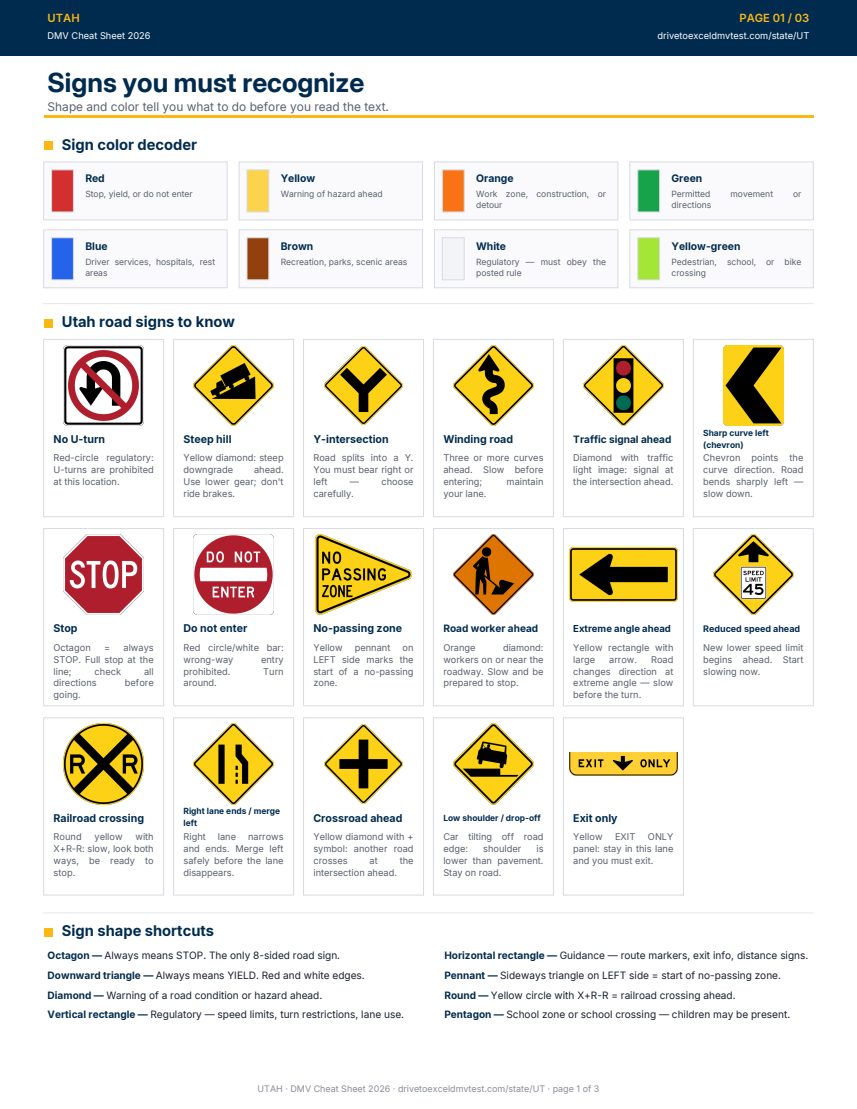
The 3-page PDF below is built to be printed and re-read the morning of your test. Use the Download button to save a copy.
2. Full Utah study guide
The long-form companion to the cheat sheet: the rules, road signs and key numbers for the knowledge test, explained in plain English.
Utah DLD-style practice questions, the 2026 passing rules, and a 40-question practice exam you can take right now — no signup, no paywall.
01What you're walking into
The Utah Driver License Division (DLD) — part of the Department of Public Safety — runs the knowledge test that stands between you and your learner permit. Utah's test is 50 questions, and you need 40 correct (80%) to pass.
- Test length — both under-18 and adults new to driving50 questions, closed-book. You need 40 correct (80%) to pass. This is the same threshold whether you are 15 or 45 — Utah does not run an easier adult test for first-time applicants.
- Previously licensed driversIf you are transferring a license from another state, Utah offers a shorter open-book 25-question test. If you have never been licensed anywhere, you take the full 50-question closed-book exam.
- Application fee$19 for a learner permit (DLD fees page). The DLD says fees are subject to change, so confirm the amount at dld.utah.gov before your appointment.
- What to bringProof of identity (passport or birth certificate), proof of Social Security number, and proof of Utah residency. Out-of-state applicants must also show their current license.
- Ages 15-18: driver education is requiredYou must complete a state-approved driver education course before you can apply for a license if you are between 15 and 18. There is no way around this — driver ed is a prerequisite, not optional.
- Why every category mattersWith a 50-question test and an 80% pass mark, a single weak area can cost you the pass. Weak spots in right-of-way, speed law, or alcohol add up quickly. Study the Utah Driver Handbook closely.
02What to study
Know the traffic laws and safety rules well, and learn the road signs. Don't skip alcohol or parking either.
- Traffic laws — know them wellRight-of-way, turns, lane changes, passing, railroad crossings, and speed limits. The handbook covers traffic laws in detail.
- Road signsShape, color, and meaning of every standard sign. Yellow diamonds = warnings. Orange = work zones. Green = guide/destination signs. Pentagonal = school zone.
- Signal timingUtah law requires a turn signal for at least the last two seconds before turning or changing lanes.
- Railroad crossings — stop no closer than 15 feetIf signals are flashing or the gate is down, stop at least 15 feet from the nearest rail. After stopping, look both ways and proceed only when it is safe.
- Following distance — 2 secondsThe Utah Driver Handbook recommends at least a 2-second following distance behind the vehicle ahead. Increase this at night or in hazardous conditions.
- BAC limit in UtahIn Utah, it is illegal to drive with a BAC of 0.05% or higher — not the 0.08% used elsewhere. Know Utah's limit.
- Impairment below 0.05%Utah law also prohibits driving while impaired even if your BAC is below 0.05%. Alcohol affects judgment, vision, and reaction time at any measurable level.
- Speed limits — key defaultsBusiness and residential areas: 25 mph. School zones during recess or while children are going to or leaving school (lights flashing): 20 mph. These apply unless another limit is posted.
- Right-of-way at uncontrolled intersectionsAt an uncontrolled intersection, if two vehicles get there together, the vehicle on the right has priority and the vehicle on the left must give way. At a four-way stop, whoever arrives first goes first, and if arrivals are simultaneous, yield to the vehicle on your right.
03Rules that are easy to mix up
These rules are easy to mix up. Knowing the exception matters as much as knowing the rule.
- Three-car right-of-way at four-way stopsYield to the right when two cars arrive at the same time. Three-car situations are easier to get wrong. The rule is still: first to arrive goes first, then yield to the right when simultaneous.
- School bus — both directions must stop on two-lane roadsOn a two-lane highway, both directions of traffic must stop when a school bus displays flashing red lights. Do not proceed until the flashing red lights stop.
- Hill parking — uphill with a curbTurn wheels AWAY from the curb (to the left). If brakes fail, the front tire catches on the curb and stops the car.
- Hill parking — uphill without a curbTurn wheels TOWARD the right edge of the road. Without a curb to catch the tire, you want the car to roll away from traffic, not into it.
- Utah's BAC limit is 0.05%, not 0.08%Utah's limit is 0.05%, lower than the 0.08% used elsewhere. Know this one cold.
- Absolute rules — blind pedestriansSome rules have no exceptions: you must ALWAYS yield to a blind pedestrian carrying a white cane or using a guide dog, regardless of the light or crosswalk status.
- Passing a bicyclistSlow down and give the cyclist as much space as possible. The cyclist may need to swerve to avoid road debris — you need to anticipate that, not just wait for it.
04How to prepare (the 3-loop method)
Reading the handbook once may not be enough. Try three loops: read once, drill once, listen once.
- Loop 1 — read the handbookDownload the Utah Driver Handbook free from dld.utah.gov. Read it once without trying to memorize. This guide compresses the key content into bullets — use it alongside the handbook, not instead of it.
- Loop 2 — drill the practice examsTake the free 40-question exam below cold. Anything under 32/40 means you have weak categories — identify them and drill those specifically.
- Loop 3 — listen along on YouTubePlay the Utah Cheat Sheet video the night before your test. Hearing the numbers out loud — BAC 0.05%, following distance 2 seconds, signal 2 seconds — can help them stick.
- Sleep beats crammingMemory consolidates overnight. A full sleep before your test is worth more than two hours of late-night re-reading.
- Study signs visually — not in wordsPractice recognizing sign shapes and colors at a glance, not just their descriptions. A red octagon is a stop sign before you even read it.
- Read every option before pickingRead every choice before you answer — the first option can sound right until you read the last one. If 'All of the above' is offered, check that every option is individually true.
05After you pass
Passing the knowledge test gives you a learner permit — not a license. Utah's graduated driver license (GDL) rules for teenagers include 40 hours of supervised driving and a midnight–5 AM curfew.
- Permit supervision ruleA licensed driver must sit in the front seat beside you at all times while you drive on a permit. If you are under 18, that means a licensed parent, stepparent, foster parent or legal guardian, an approved driving instructor, or the responsible adult who signed for you. If you are 18 or older, it must be a licensed driver at least 21 years old.
- Permit hold timeUnder 18: must hold the permit for at least 6 months before getting a license. Age 18: no holding period, but you must complete driver education. Age 19 and older: hold the permit for 90 days, or complete driver education instead.
- Supervised driving hoursComplete at least 40 hours of supervised driving, including a minimum of 10 hours after sunset.
- Night driving curfewNo driving between midnight and 5 AM until you turn 17, unless a licensed driver 21+ is in the front seat, or you are driving to or from work or a school-sponsored activity, on agricultural operations, or in an emergency. The Utah Driver Handbook applies this curfew to a driver license, not to a learner permit.
- Passenger restriction — first 6 monthsFor the first 6 months after getting your license, you cannot drive with non-immediate family members unless a licensed adult 21+ is also present. Friends do not count as immediate family.
- When restrictions liftThe passenger restriction ends after the first 6 months. The midnight–5 AM curfew lasts until you turn 17 — they do not end at the same time.
Lock it in — you've read it, now test yourself
Reading the Utah handbook once is rarely enough to pass. A simple plan: go over the cheat sheet, take the free 40-question practice exams until the rules stick, then review anything you missed the night before.
Note: this is a study tool, not an official DMV resource. Always confirm requirements with your state's DMV before scheduling your test.