Texas DMV Cheat Sheet + Study Guide
Two free artifacts: the printable 3-page PDF cheat sheet and the full written study guide for the Texas permit test. Read both below, and download the PDF — no signup required.
1. Printable cheat sheet
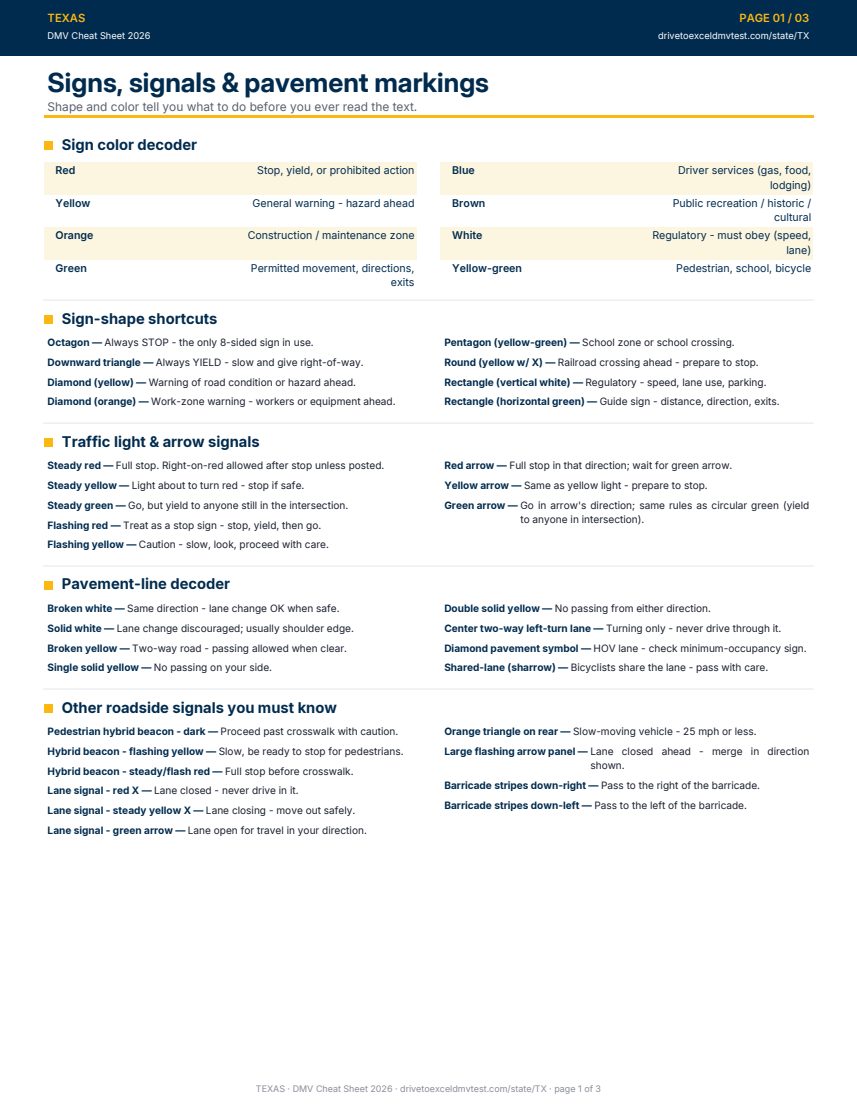
The 3-page PDF below is built to be printed and re-read the morning of your test. Use the Download button to save a copy.
2. Full Texas study guide
The long-form companion to the cheat sheet: the rules, road signs and key numbers for the knowledge test, explained in plain English.
Texas DPS-style practice questions, the 2026 passing rules, and a 40-question practice exam you can take right now — no signup, no paywall.
01What you're walking into
The Texas DPS knowledge test is the gate between you and a learner license. The test is based on the 2026 Texas Driver Handbook (DL-7). If you don't pass, your application is held for 90 days; after 90 days or three failed exams you need a new application and fee, so come prepared the first time.
- Under-18 examPass at 70% or better. Same exam format the teen and adult tests use.
- Adult first-time examPass at 70% or better. Adults 18-24 must also complete the 6-hour Adult Driver Education course before testing.
- Application fee$16 for a learner license if you're under 18. That covers the permit application, the knowledge test, and your card. The teen learner permit is valid until the 18th birthday. Applicants 18 and older pay $33 and receive a standard-term license that carries the same restrictions as a learner license.
- Bring with youProof of identity, U.S. citizenship or lawful presence, Texas residency, and your Social Security number. Teens 15-17 also need a certificate showing they completed the classroom portion of a state-approved driver-ed course (the first 6 hours with the concurrent method, all 24 hours with the block method), and a parent or legal guardian must come with them.
- Driver education requirementRequired for every first-time applicant under 25. Teens 15-17 take a 24-hour classroom course; adults 18-24 take the 6-hour adult course. Adults 25+ can skip the classroom course. Some applicants are also required to complete the Impact Texas Drivers (ITD) video module — check the current DPS rules for your age group.
- Where you take the testDepending on your driver education course, you may pass the knowledge test with your course provider. If you haven't taken it there, you take it in person at a DPS driver license office.
- Numbers to memorizeWatch the numbers: parking distances (fire hydrants, crosswalks, railroad tracks), turn-signal feet, and a two-tier following-distance rule that flips at 30 mph. These are easy to confuse.
02What to study
The DPS Driver Handbook covers traffic laws, road signs, and safety, among other topics. Get those three categories locked down first.
- Road signs & signalsShapes, colors, and meanings. Octagonal signs are always stop signs. When you meet a flashing red light, treat it like a stop sign: come to a complete stop, yield, then proceed.
- Signal distance before a turnSignal at least 100 feet before a turn, and signal before every lane change. Know this number cold; 50 feet is not enough.
- Railroad crossingsWhen signals warn of an approaching train (flashing red lights or a lowered gate), stop no closer than 15 feet from the nearest rail. Never drive around lowered gates. Separate rule: never park within 50 feet of a railroad crossing.
- Following distance — two-tier ruleUnder 30 mph: keep at least 2 seconds. Over 30 mph: keep at least 4 seconds. This rule is easy to mix up.
- BAC limit for 21+ drivers0.08% or higher is per-se DUI. Texas calls it DWI — Driving While Intoxicated.
- Chemical-test refusalRefusing the breath or blood test results in automatic license suspension. You consent to the test the moment you operate a vehicle in Texas under the implied-consent law.
- Parking distances to memorize15 ft from a fire hydrant. 20 ft from a crosswalk. 30 ft from a traffic-control signal. 50 ft from a railroad crossing. If you must park on a highway outside a business or residential district, your vehicle must be visible for 200 ft in each direction.
- Passing restrictionsPassing is illegal within 100 feet of a bridge, viaduct, or tunnel. Also illegal on hills, curves, intersections, and at railroad crossings.
- Alley speed limit15 mph in any alley unless posted otherwise. Know this one cold.
- Fire-truck following distanceDon't follow a fire truck responding to a fire alarm within 500 feet. Treat it as a hard line.
03Common mistakes that cost the test
These are rules that are easy to mix up. If you only have time to drill a few topics, drill these.
- The two-tier following-distance flipTexas uses 4 seconds over 30 mph, not 3. Memorize: under 30 → 2 sec, over 30 → 4 sec.
- Parallel parking distanceWheels must be within 18 inches of the curb. Anything wider, even 24 inches, is too far.
- Railroad crossings vs other stopsStop 15 to 50 feet from the nearest rail when signals are warning. Don't confuse this with the 15-foot fire-hydrant or 20-foot crosswalk distances.
- Liability insurance is always requiredTexas's Motor Vehicle Safety Responsibility Act requires liability coverage at all times — not only on interstates or only when a minor is driving.
- Emergency vehicles stopped on the shoulderWhen passing a stopped emergency vehicle, you must vacate the lane closest to it. If you can't move over safely, you must slow down — never increase your speed.
- Reversible-lane red XNever drive in a lane with a red X above it. There is no 'if traffic is light' exception.
- 'Always' / 'never' answer optionsAbsolute words deserve a second look, but some rules really are absolute: never drive around a lowered railroad gate; never leave a vehicle unattended with the engine running; never text while driving.
04How to prepare (the 3-loop method)
Here is a simple plan with three loops: read once, drill once, listen once. That's it.
- Loop 1 — read the handbook (or this guide)Download the 2026 Texas Driver Handbook (DL-7) free from dps.texas.gov. Read once, don't memorize. This guide pulls the key points into bullets.
- Loop 2 — drill the practice examsTake the free 40-question exam below cold. Anything under 28/40 → focus on the categories you missed and retake.
- Loop 3 — listen along on YouTubePlay the Texas Cheat Sheet video the day or two before your test. Hearing the key points out loud is a good complement to re-reading.
- Sleep beats crammingMemory consolidates overnight. A full sleep the night before is worth more than two extra hours of late-night reading.
- Study signs visually, not in textNever read sign descriptions in words only. Look at the actual shape and color — on the road you recognize signs by sight, not by description.
- Read every option before pickingDon't lock in on the first option that looks right — read every choice before committing, including any 'All of the above'.
05After you pass
Passing the knowledge test gets you a Texas learner license — not a full license. Texas's graduated driver license (GDL) rules kick in immediately and they stay strict until you turn 18.
- Permit supervision (under 18)A licensed adult 21 or older must sit in the front passenger seat any time you're driving on a learner license. No solo driving, ever, on the permit.
- Minimum permit holdYou must hold the learner license (or a Minor Restricted Driver License) for at least 6 months before you can take the road test for a provisional license.
- Supervised practice hours30 total hours of behind-the-wheel practice, at least 10 of which must be at night with a licensed driver 21+.
- Night-driving restriction (provisional, under 18)No driving between midnight and 5:00 a.m. — exceptions for work, school activities, or emergencies. The restriction runs for the entire provisional period.
- Passenger restriction (provisional, under 18)No more than one passenger under 21 in the vehicle who isn't a family member. Family members don't count toward the limit.
- Wireless device — zero useProvisional drivers may not use any wireless communication device while driving — not even hands-free — except in an emergency.
- When restrictions liftAll GDL restrictions remain in effect until you turn 18. There's no separate '12-month' clock — the provisional license expires on your 18th birthday, and the curfew, passenger, and phone restrictions end then.
Lock it in — you've read it, now test yourself
Reading the Texas handbook once is rarely enough to pass. A simple plan: go over the cheat sheet, take the free 40-question practice exams until the rules stick, then review anything you missed the night before.
Note: this is a study tool, not an official DPS resource. Always confirm requirements with your state's DMV before scheduling your test.