South Carolina DMV Cheat Sheet + Study Guide
Two free artifacts: the printable 3-page PDF cheat sheet and the full written study guide for the South Carolina permit test. Read both below, and download the PDF — no signup required.
1. Printable cheat sheet
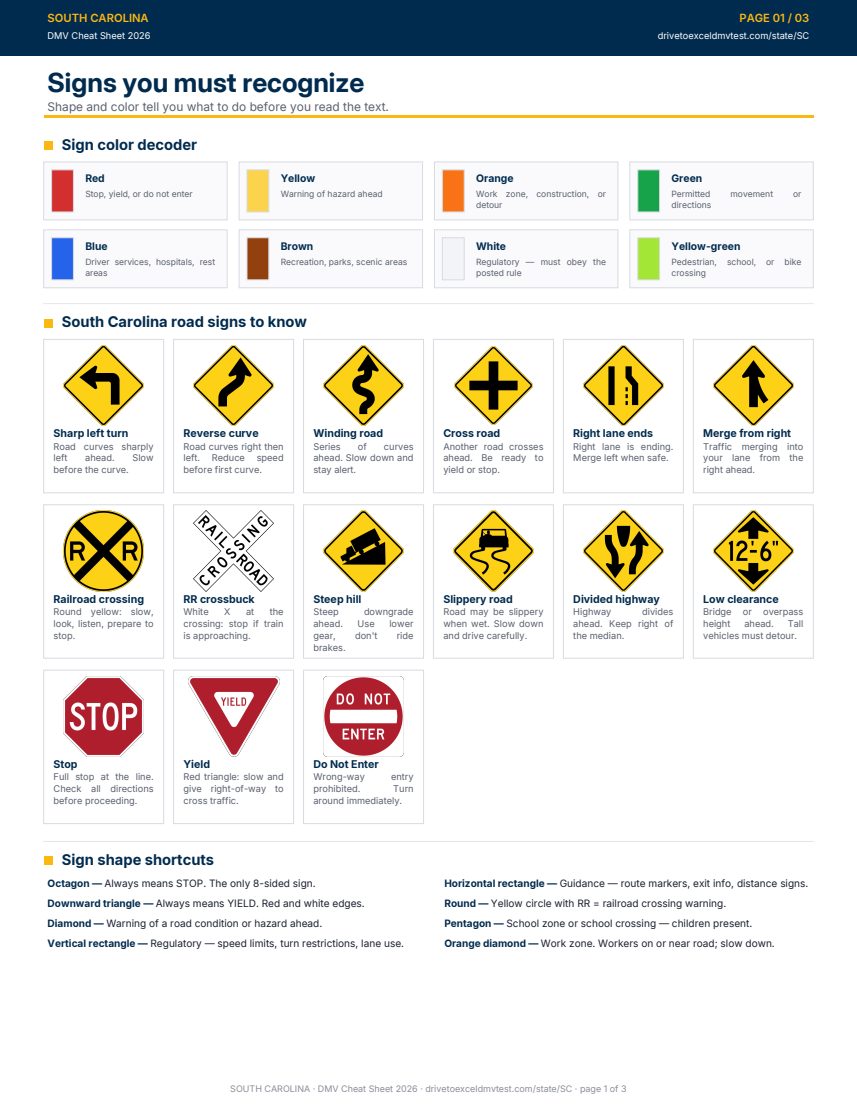
The 3-page PDF below is built to be printed and re-read the morning of your test. Use the Download button to save a copy.
2. Full South Carolina study guide
The long-form companion to the cheat sheet: the rules, road signs and key numbers for the knowledge test, explained in plain English.
South Carolina SCDMV-style practice questions, the 2026 passing rules, and a 40-question practice exam you can take right now — no signup, no paywall.
01What you're walking into
The South Carolina SCDMV knowledge test is the gateway between you and a beginner's permit. The test is based on the South Carolina Driver's Manual. Know the exact passing bar before you walk in.
- Knowledge test (all applicants)You must pass a vision test and a knowledge test at an SCDMV branch to get a beginner's permit. Check with the SCDMV for the current number of questions and the passing score.
- Application fee$2.50 for the beginner's permit after you pass the knowledge test. Bring exact change or a card.
- Bring with youProof of identity (birth certificate or passport), Social Security number, and proof of South Carolina residency. All documents must be originals or certified copies — photocopies are not accepted.
- Age 15 or 16? Driver education is requiredSouth Carolina requires applicants age 15 or 16 to complete a state-approved driver's education course — 8 hours of classroom instruction plus 6 hours of behind-the-wheel driving — before they can get a license. Applicants 17 and older are not required to take it.
- Minimum age to apply15 years old for a beginner's permit. You must hold that permit through the supervised phase before the permit can advance to a conditional (provisional) license.
- Where to focus your studyStudy traffic laws, right-of-way, and procedural rules closely. Studying only sign shapes isn't enough. Budget extra time for intersection rules and school bus scenarios.
02What to know for the test
Study traffic laws, road signs, and safety. Master intersection rules, signal distances, and the state's BAC limits.
- Road signsWarning signs are yellow with black markings and prepare you for upcoming hazards. Pentagonal signs mean school zone. Round signs flag railroad crossings. Know each shape-color combination, not just the words.
- Right-of-way and turningAt an uncontrolled intersection, yield to the driver on your right. When two cars arrive simultaneously and one is on your right, that driver goes first. Emergency vehicles always get right-of-way — pull to the right and stop.
- Signal distance — 100 feetBefore any turn or lane change in South Carolina, your signal has to come on at least 100 feet ahead. Memorize that exact figure rather than guessing.
- Following distance — 4 secondsSC recommends at least 4 seconds of following distance behind the vehicle ahead. One second is tailgating. Add more in rain, fog, or when following large trucks.
- Railroad crossings — always stop when requiredStop when gates are down, red lights flash, a flagger signals, or a stop sign is posted. Never drive around lowered gates under any circumstances. Not all crossings have active warning devices — slow down at all crossings.
- Speed limits — rural vs. urbanMaximum 55 mph in rural areas unless a higher limit is posted. Maximum 30 mph in urban districts and residential areas. The posted limit applies only under ideal conditions — reduce speed for weather, traffic, and curves.
- BAC limit (21+) — 0.08%It is illegal to drive with a BAC of 0.08% or higher if you are 21 or older. This is the per-se limit — you can be arrested at exactly 0.08%, not just above it.
- Under-21 BAC limit — 0.02%If you are under 21 and drive with a BAC of 0.02% or more in South Carolina, your license is suspended for 3 months (6 months with a prior offense).
- Chemical test refusal — 6 monthsSouth Carolina has an implied consent law. Refusing a chemical test costs you your license for 6 months, regardless of whether you were actually impaired. Refusal is not a legal escape.
- Only time lowers BACCoffee, exercise, cold showers, and food do nothing to lower your BAC. Only the passage of time removes alcohol from the body. Memorize it.
03Easy-to-confuse rules
These topics are easy to mix up. They share a pattern: the wrong answer is close enough to feel right on a quick read. Slow down on every one of these.
- Three-car right-of-way scenariosWhen multiple vehicles arrive simultaneously at an uncontrolled intersection, yield to the driver on your right. Each driver yields to the one on their right — work through the chain. Don't just yield to whichever car looks closest.
- School bus rules — four-lane highway exceptionA bus with flashing red lights on a two-lane road stops traffic coming from both directions. On a four-lane highway, only drivers coming up behind the bus have to stop; drivers on the other side of the road do NOT have to stop.
- Hill parking — downhillParking downhill: turn your front wheels to the right, toward the edge of the road or curb. If brakes fail, the car rolls away from traffic. A road with no curb uses the same rule — wheels right, toward the road edge.
- Hill parking — uphill with a curbParking uphill with a curb: turn wheels sharply away from the curb, to the left. The back of the front tire rests against the curb as the backstop. Uphill with NO curb: wheels right, toward the road edge.
- Impairment vs. legal limit0.08% is the arrest threshold — not the point where impairment begins. Any amount of alcohol can impair judgment and coordination, so impairment starts at the first drink, not at the legal limit.
- 'Always' and 'never' rulesBe careful with absolute wording, but some rules truly are absolute. Always stop for a blind pedestrian using a white cane. Never drive around lowered railroad crossing gates.
- Bicycle sharing — give spaceLeave a cyclist the widest gap you can when you go by, and reduce your speed first. The law treats a bicycle as a vehicle, with the same rights and duties as a car. If a cyclist is turning left, expect to see them in the left lane.
04How to prepare (the 3-loop method)
Reading the handbook once may not be enough. Here is a simple three-loop routine: read once, drill once, listen once. That's the whole system.
- Loop 1 — read the handbookDownload the South Carolina Driver's Manual free from dmv.sc.gov. Read through once without stopping to memorize. You're building a mental map of the categories, not trying to absorb every number on the first pass.
- Loop 2 — drill the practice examsTake the free 40-Q exam on this page cold. Anything under 32/40 — identify the weak categories and retake. Review traffic laws, road signs, and safety until each feels solid.
- Loop 3 — listen along on YouTubePlay the South Carolina DMV practice video the night before your test. It makes a useful last review.
- Sleep beats crammingMemory consolidates overnight. A full night's sleep before the test is worth more than two extra hours of late-night reading. Stop studying by 10pm the night before.
- Study signs visually, not verballyDon't just read sign descriptions. Look at the actual shape and color, because a sign on the road comes without a label. If you've only read descriptions, you may hesitate when you see the real sign.
- Read every option before you answerDon't stop at option B — always read all the choices before selecting.
05After you pass
Passing the knowledge test gets you a South Carolina beginner's permit — not a full license. SC's GDL system includes a 180-day hold for under-18 applicants, a 40-hour practice requirement for ages 15–16, and a three-window curfew for conditional license holders. Full privileges arrive at 17 or after one clean year, whichever comes first.
- Permit supervisionA licensed adult age 21 or older with at least one year of driving experience must be in the front seat with you from 6 a.m. to midnight while you hold a beginner's permit. From midnight to 6 a.m., a licensed parent, guardian or other qualified adult must supervise you. No exceptions for short trips.
- Permit hold time — 180 days (under 18) / 30 days (18+)If you are under 18, you must hold your beginner's permit for at least 180 days before the road test. Adults 18 and older need only 30 days.
- Supervised practice hours — 40 total, 10 at night (ages 15–16)If you are 15 or 16, you must log at least 40 hours of supervised driving, including 10 hours of night driving, before you can get a license. Log every session — the SCDMV may ask for documentation.
- Conditional license curfew — three windowsSouth Carolina's curfew for conditional (provisional) license holders has three time windows: (1) 6am–6pm: unsupervised driving is allowed (8pm during Daylight Saving Time); (2) 6pm–midnight: a licensed adult age 21+ must be present; (3) midnight–6am: a parent, guardian, or other qualified adult must be in the vehicle. Know all three time slots.
- Passenger restrictionYou cannot carry more than 2 passengers under age 21 unless a licensed adult who is at least 21 is also in the vehicle. Family exceptions may apply — check with SCDMV for your specific situation.
- Restrictions lift — age 17 OR 1 year, whichever comes FIRSTFull driving privileges arrive at age 17, OR after holding your conditional license for 1 year with no traffic offenses and no at-fault collisions — whichever milestone you hit first. One violation resets the clock.
Lock it in — you've read it, now test yourself
Reading the South Carolina handbook once is rarely enough to pass. A simple plan: go over the cheat sheet, take the free 40-question practice exams until the rules stick, then review anything you missed the night before.
Note: this is a study tool, not an official SCDMV resource. Always confirm requirements with your state's DMV before scheduling your test.