Rhode Island DMV Cheat Sheet + Study Guide
Two free artifacts: the printable 3-page PDF cheat sheet and the full written study guide for the Rhode Island permit test. Read both below, and download the PDF — no signup required.
1. Printable cheat sheet
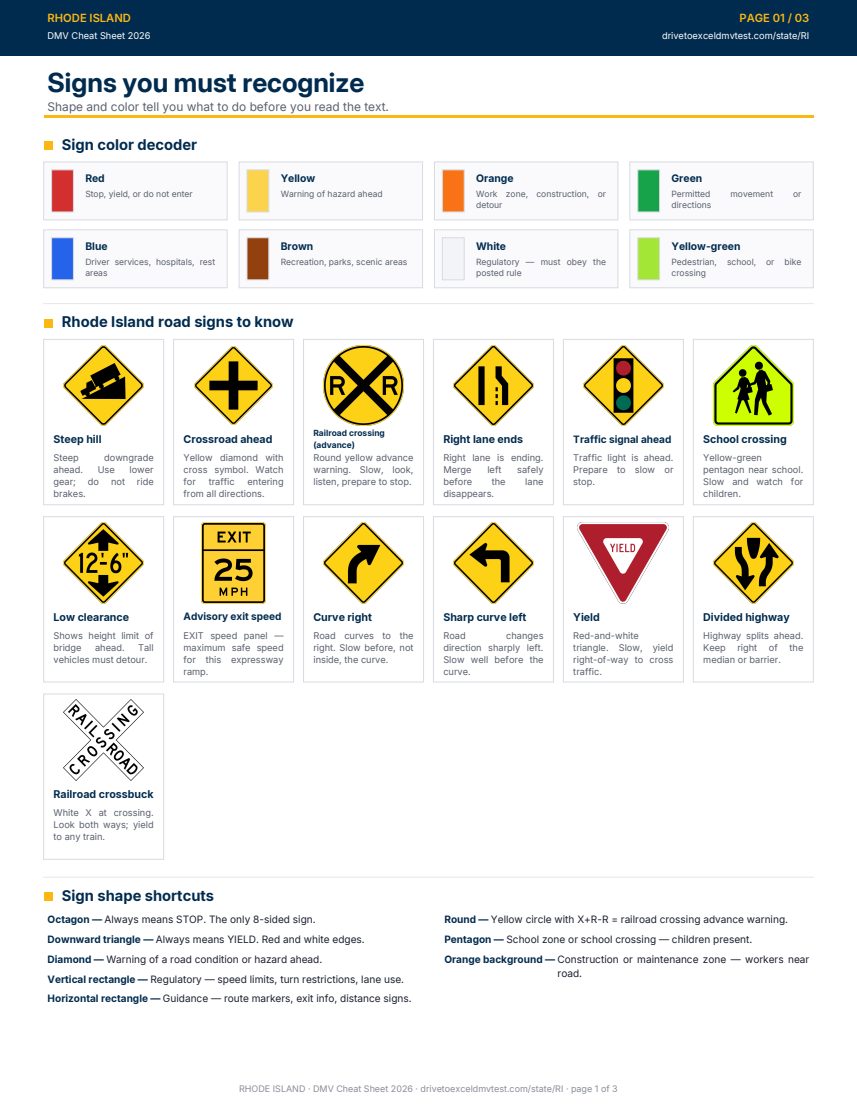
The 3-page PDF below is built to be printed and re-read the morning of your test. Use the Download button to save a copy.
2. Full Rhode Island study guide
The long-form companion to the cheat sheet: the rules, road signs and key numbers for the knowledge test, explained in plain English.
Rhode Island DMV-style practice questions, the 2026 passing rules, and a 40-question practice exam you can take right now — no signup, no paywall.
01What you're walking into
The Rhode Island DMV knowledge test is the gateway to your learner's permit. Fail and you walk out without it. The computerized exam is 40 multiple-choice questions for every applicant, whatever your age. Know the format before you walk in.
- Under-18 test: 40 questions, 70% to passIf you're under 18, you'll answer 40 multiple-choice questions. You need 28 correct to pass. The questions cover traffic laws, road signs, and safe driving practices.
- Adults (18+): same 40-question examAdults 18 and older take the same computerized knowledge exam at the DMV in Cranston: 40 multiple-choice questions, by reservation. Study until you're consistently scoring 34/40 or better on the practice exams before you go in.
- Permit fee: $13.50 (under 18) or $8.50 (18+)Bring payment for the learner's permit fee to your DMV reservation: $13.50 if you are under 18, or $8.50 if you are 18 or older. Fees can change, so check the DMV's permit fee table before you go.
- What to bringBring proof of identity (birth certificate or passport), two proofs of Rhode Island residency (such as a utility bill or bank statement), and your Social Security number. Under-18 applicants also need a parent or guardian signature.
- Driver education required starting at 15 years 10 monthsRhode Island requires a 33-hour certified classroom driver education course before you can get a learner's permit if you are under 18. You must be at least 15 years and 10 months old on the first day of class to enroll. Skipping driver ed means waiting longer.
- Know road signs by sightLearn each sign's actual shape and color, not just its name. You can't just memorize names; you need to recognize the sign on sight.
- Traffic laws and safetyTraffic laws and safe-driving practices are core topics in the handbook. If your practice scores are weak in either, fix them before your appointment.
02Key rules to know
Traffic laws, road safety, and road signs are core topics to study. Here are the key rules and numbers worth knowing.
- Road signsKnow signs by shape and color — pentagonal signs mean school zones, triangular signs mean yield. If you can't identify a sign by shape and color alone, practice more before you go in.
- Turn signal: activate at least 100 feet before the moveIn Rhode Island, drivers must signal a minimum of 100 feet ahead of a turn or lane change. Signaling during the maneuver rather than before it is not enough.
- Following distance: 3 seconds minimum under normal conditionsKeep at least a 3-second gap between you and the car ahead. On slippery roads or at night, increase that distance further. A 2-second gap is not enough — the minimum is three seconds.
- Railroad crossing: no parking within 50 feetYou cannot park within 50 feet of a railroad crossing. When approaching an active crossing, slow down, look, listen, and be ready to stop.
- BAC limit: 0.08% for drivers 21 and olderDrivers 21+ are legally impaired at 0.08% BAC. This is a per-se limit — you can be charged without a field sobriety test if the breathalyzer hits this number.
- Any amount of alcohol impairsThe key message is that any amount of alcohol impairs driving, and impairment worsens as BAC climbs.
- Residential speed limit: 25 mph unless posted otherwiseThe default speed limit in a Rhode Island residential area is 25 mph. If a different limit is posted, follow the sign.
- Right-of-way at simultaneous arrivals: yield to the rightWhen two vehicles reach an uncontrolled intersection or four-way stop at the same time, yield to the driver on your right. This applies whether there are stop signs on all corners or no control at all.
03Rules that are easy to mix up
These rules are easy to mix up — not because they are obscure, but because the wrong choice can feel right. Give each one a second look.
- School bus: stop from either direction, unless the road is dividedWhen a school bus's red lights are flashing, Rhode Island drivers approaching from either direction must come to a full stop and stay stopped until the red lights stop flashing. The exception is a divided highway (with a barrier, median or similar divider), where you do not stop for a bus on the opposite side.
- Hill parking downhill: turn wheels toward the curbIf you are parked facing downhill beside a curb, angle your front wheels in toward the curb. Then, should the brakes fail, the curb keeps the vehicle from rolling into traffic.
- Hill parking uphill with a curb: turn wheels away from the curbUphill with a curb is the opposite — turn wheels sharply away from the curb. If the vehicle rolls, it rolls into the curb, not into traffic. Know both directions — get both right.
- Four-way stop: first to arrive, first to go — tie goes to the rightVehicles proceed through four-way stops in arrival order. If you arrive simultaneously, the vehicle on the right goes first.
- Alcohol: "just one drink" still countsAny amount of alcohol can affect driving — there is no safe threshold, and no specific number of drinks is safe.
- Passing a bicycle: slow down and give as much space as possibleWhen passing a cyclist on a road without a bike lane, slow down and wait until there is no oncoming traffic, then pass with maximum clearance. Do not honk or rush ahead.
- Always signal, every timeYou must always signal before changing lanes or turning — even at slow speeds or when no one appears to be around. Signaling only when other traffic is present is not enough. The law requires it unconditionally.
04How to prepare (the 3-loop method)
Three passes through the material, each with a different goal, make a simple study plan.
- Loop 1: Read the Rhode Island Driver's Manual cover to coverThe Rhode Island Driver's Manual is the official source for the rules of the road. Read it once for familiarity — don't try to memorize, just build a mental map of what's covered. Pay attention to any section with specific numbers: distances, speeds, time limits.
- Loop 2: Drill practice exams until you're consistently at 34/40 or betterDrill every topic — traffic laws, safety, road signs, drugs and alcohol, vehicle rules, and parking — not just the ones that feel weak. Take the free 40-question exam, review what you missed, and retake it.
- Loop 3: Watch or listen to the YouTube Q&A videosRhode Island's Road Signs video and our other Q&A videos are free on the DriveToExcel channel. Listen during a commute or before bed — passive repetition reinforces what you've already studied.
- Study sign shapes and colors visually, not just by nameLook at the actual sign images, not just the names. A yellow diamond means warning, a red octagon means stop, a triangular sign means yield. If you've only read the names without seeing the shapes, you'll hesitate on sign questions.
- Sleep beats late-night crammingA well-rested brain retrieves information faster and more accurately than a tired one running on two hours of sleep after a cramming session. Finish your study the night before, then get a full night's rest.
- Read every option before pickingWrong answers can sound reasonable. Always read all options before committing — the first answer that seems right isn't always the best one.
05After you pass
If you're under 18, Rhode Island's GDL system has several steps — you'll spend at least 6 months on a permit, log 50 supervised hours, and then hold a provisional license for at least 12 months, under curfew and passenger restrictions, before you can apply for a full license.
- Permit supervisor: 21+ with at least 5 years of experienceWhile on your learner's permit, your supervising driver must be 21 or older and have at least 5 years of driving experience. They must sit in the front seat. Adults 18+ are not subject to this requirement.
- Under 18: hold the permit for at least 6 monthsIf you are under 18, Rhode Island requires a minimum 6-month permit hold before you can take the road test; adults 18 and older can test after holding the permit for 30 days. You can schedule the road test appointment at the same time you get the permit, but you cannot test until the hold period is up.
- 50 total supervised hours — 10 must be at nightBefore your road test, log 50 hours of supervised driving. At least 10 of those hours must happen at night, after sunset. Your parent or guardian certifies these hours, and falsifying them is a serious violation.
- Night curfew on the provisional license: no unsupervised driving 1:00 AM to 5:00 AMWhile you hold your Limited Provisional License, you may not drive unsupervised between 1:00 AM and 5:00 AM. Exceptions apply for driving to or from work, for activities of a volunteer fire, rescue or emergency medical service you belong to, and for driving between home and a school-sponsored athletic activity from 4:00 AM to 5:00 AM when the school provides no transportation. Outside those hours, you're free to drive.
- Passenger restriction: one non-household passenger under 21 for the first 12 monthsFor your first 12 months on the provisional license, you may carry no more than one passenger under 21 who is not an immediate family or household member. Siblings count as family — other friends do not.
- Passenger limit ends after 12 months — curfew and cell ban last longerThe one-passenger-under-21 limit applies only for the first 12 months of your Limited Provisional License. The 1:00 AM to 5:00 AM curfew stays in place until you get a full license, which you apply for after holding the provisional license for at least 12 months with no moving violation or seat belt infraction in the preceding 6 months. Under 18, you may not use a cell phone while driving, even hands-free, except in an emergency — and that stays in effect until you turn 18, regardless of when you get your full license.
Lock it in — you've read it, now test yourself
Reading the Rhode Island handbook once is rarely enough to pass. A simple plan: go over the cheat sheet, take the free 40-question practice exams until the rules stick, then review anything you missed the night before.
Note: this is a study tool, not an official DMV resource. Always confirm requirements with your state's DMV before scheduling your test.