Pennsylvania DMV Cheat Sheet + Study Guide
Two free artifacts: the printable 3-page PDF cheat sheet and the full written study guide for the Pennsylvania permit test. Read both below, and download the PDF — no signup required.
1. Printable cheat sheet
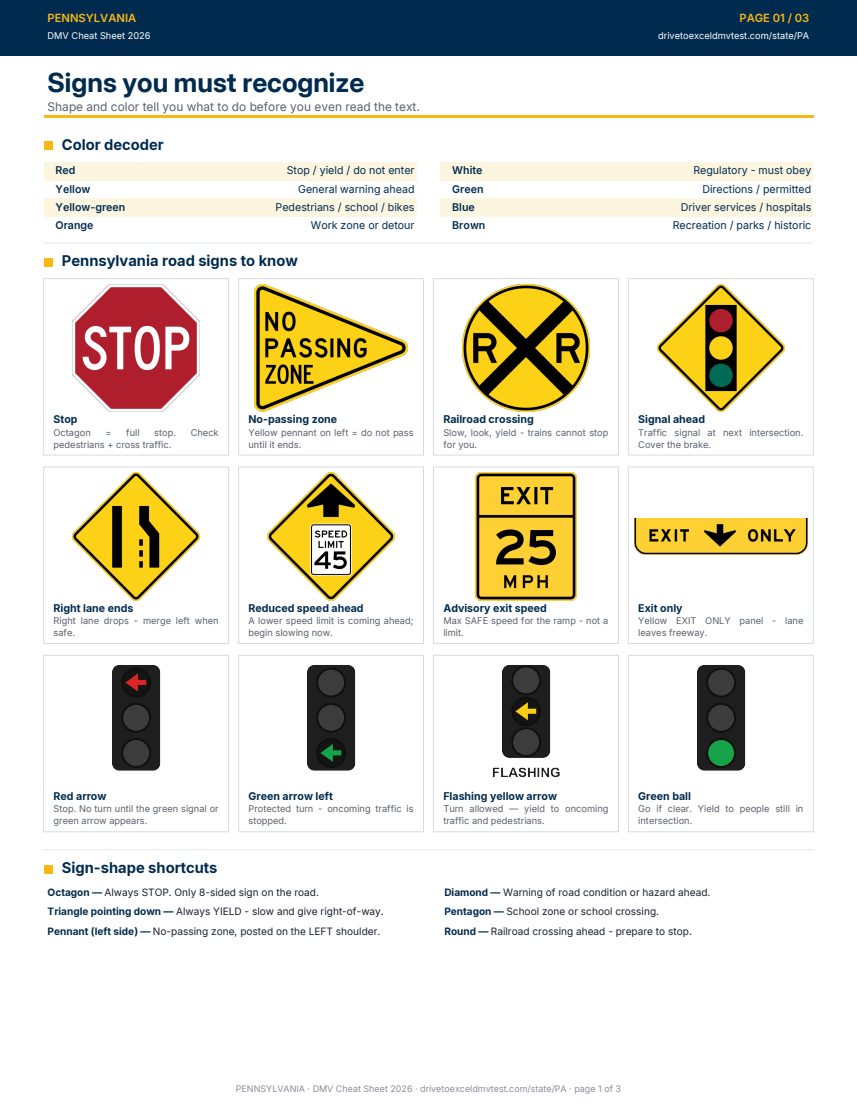
The 3-page PDF below is built to be printed and re-read the morning of your test. Use the Download button to save a copy.
2. Full Pennsylvania study guide
The long-form companion to the cheat sheet: the rules, road signs and key numbers for the knowledge test, explained in plain English.
Pennsylvania PennDOT-style practice questions, the 2026 passing rules, and a 40-question practice exam you can take right now — no signup, no paywall.
01What you're walking into
The Pennsylvania PennDOT knowledge test is the gateway between you and your learner's permit. The test is based on the Pennsylvania Driver's Manual (PUB 95). The good news: the exam is short, and every Pennsylvania first-timer takes the same one.
- Under-18 exam18 questions. Pass at 15 correct (≈83%). Same exam as adults — Pennsylvania doesn't run a separate minor version.
- Adult first-time exam18 questions. Pass at 15 correct. Identical to the under-18 test.
- Application fee$45.50 total: the $6.00 learner's permit fee plus the $39.50 four-year license fee, both paid on the permit application. The permit is valid one year. PennDOT Driver License Centers accept debit/credit cards, checks and money orders payable to PennDOT, but not cash.
- Bring with youOriginal proof of identity and date of birth, your Social Security card, and the completed DL-180 application (a health care provider completes the back). If you are under 18, also bring the DL-180TD parent or guardian consent form; if you are 18 or older, bring two proofs of PA residency.
- Under-18 driver-edIf you are under 18, you must complete 65 hours of supervised behind-the-wheel practice — at least 10 at night and 5 in bad weather — before the road test for a junior license. A driver-education course is not required for a junior license, but it is required to get a regular license before 18.
- If you failYou can retake the knowledge test the following business day, but only once per day, at any location.
- Short exam, little room for errorOnly 18 questions sounds short, but you can only miss 3, so there is little room for careless errors on signs or BAC. The manual has dense GDL and DUI sections that are easy to skim past.
02Key rules to know
Traffic laws make up a large part of the Driver's Manual. Safe-driving practices and road signs are also core topics, so start with the key points below.
- Road signs & signalsShapes, colors, route markers, work-zone orange diamonds, white regulatory rectangles. A flashing red light means stop completely; a flashing yellow light means slow down and proceed with care.
- Right-of-way at four-way stopsThe driver who arrives first has the right-of-way. If two arrive at the same time, the driver on the right goes first.
- Signal before turningActivate your turn signal three to four seconds before you reach the intersection.
- Railroad-crossing stop distanceStop no closer than 15 feet from the nearest rail when signals warn of an approaching train. A flashing red light at a crossing means stop and do not proceed until signals deactivate.
- Following distanceFour seconds at highway speeds on a dry road; increase to five or six seconds on wet roads. Allow at least four seconds when following a motorcycle.
- BAC limit (21+)0.08%. At or above this you are legally driving under the influence in Pennsylvania.
- Under-21 BAC rule0.02% or higher — drivers under 21 are considered DUI at this level.
- Chemical-test refusalRefusing a blood, breath, or urine test when an officer requires it triggers automatic license suspension. Pennsylvania is an implied-consent state.
- School zone speed limit15 mph when the yellow lights on a school-zone sign are flashing or during the posted school-zone time period.
- Near emergency vehiclesAfter an emergency vehicle passes you with siren on, stay at least 500 feet behind it. When approaching one stopped with lights flashing, change lanes if possible.
03Rules that are easy to mix up
These rules are easy to mix up, so they are worth a second look. If you only have time to drill a few, start here.
- Stopped school bus — the divided-highway exceptionWhen a school bus stops with red lights flashing and stop arm extended, you MUST stop and remain stopped — at least 10 feet away — in both directions, UNLESS you're driving on the opposite side of a divided highway. That single exception is easy to mix up.
- Hill parking — uphill with a curbTurn your front wheels AWAY from the curb. The curb itself becomes the backstop if your brake fails.
- Hill parking — downhill (or no curb)Turn your front wheels TOWARD the curb (or toward the side of the road if no curb). The car rolls off the roadway, not into traffic.
- Passing on the rightLegal only in specific situations — for example, when the vehicle ahead is making a left turn. It is neither always allowed nor never allowed.
- Impairment vs. legal limit0.08% is the legal BAC, NOT a safety threshold. Alcohol can impair your driving at lower levels too. Know the distinction.
- Four-second following rulePennsylvania uses four seconds of following distance on a dry highway. Memorize the PennDOT number.
- Passing a bicyclistGive at least four feet of space when passing a bicyclist. On a two-lane road, slow down and wait until oncoming traffic clears before passing.
- Watch absolute wordingStatements with 'always' or 'never' are only correct when the rule is genuinely absolute — you may NEVER drive around lowered crossing gates at a railroad crossing, for example.
04How to prepare (the 3-loop method)
Reading the handbook once may not be enough. Try three loops: read once, drill once, listen once. That's it.
- Loop 1 — read the handbookDownload the Pennsylvania Driver's Manual (PUB 95) free from the PennDOT site. Read it once cover-to-cover. Don't try to memorize — this guide pulls the key points into bullets.
- Loop 2 — drill the practice examsTake the free 40-question exam below cold. Anything under 34/40 → focus on the categories you missed and retake.
- Loop 3 — listen along on YouTubePlay the Pennsylvania Cheat Sheet video the day or two before your test. Hearing the key facts out loud is a useful change of pace from re-reading the manual.
- Sleep beats crammingMemory consolidates overnight. A full night's sleep before your test is worth more than two extra hours of late-night reading.
- Study signs visuallyNever read sign descriptions in text only. Look at the actual shape and color — on the road you recognize signs by sight, not by reading a description.
- Read every option before pickingWrong answers can sound plausible. The first option can look right until you read every other one and realize a later one is more precise.
05After you pass
Passing the knowledge test gets you a learner's permit — not a license. Pennsylvania's graduated-license rules for under-18 drivers kick in the moment you upgrade from permit to junior license.
- Permit supervisionYou must always be accompanied by a licensed driver 21 or older — OR a parent, guardian, person in loco parentis, or spouse 18 or older who holds a driver's license. The supervisor must sit in the front passenger seat at all times.
- Minimum permit hold (under 18)Six months minimum before you can take the road test. Adults 18+ have no statutory waiting period — sign up for the road test once you feel ready.
- Supervised practice (under 18)65 total behind-the-wheel hours, including at least 10 hours at night and 5 hours in bad weather. A parent or guardian certifies them on form DL-180C before the road test.
- Night curfew (junior license, under 18)No driving between 11 PM and 5 AM unless a parent, guardian, or spouse 18 or older is in the car. Exceptions for work, public or charitable service, or volunteer firefighting — carry a notarized affidavit or certificate of authorization.
- Passenger restriction (junior license)For your first 6 months, you may not carry more than one passenger under 18 who is not an immediate family member. After 6 months crash-and-conviction-free, the limit rises to three.
- Restrictions liftJunior license restrictions (curfew + passenger limits) lift automatically when you turn 18. You may apply for an unrestricted license BEFORE 18 only if you have held your junior license for 12 months crash-and-conviction-free AND completed approved driver's ed — submit form DL-59 with parental consent. PA's logic is 'whichever comes FIRST' — turning 18 OR clean 12 months plus driver's ed.
Lock it in — you've read it, now test yourself
Reading the Pennsylvania handbook once is rarely enough to pass. A simple plan: go over the cheat sheet, take the free 40-question practice exams until the rules stick, then review anything you missed the night before.
Note: this is a study tool, not an official PennDOT resource. Always confirm requirements with your state's DMV before scheduling your test.