New York DMV Cheat Sheet + Study Guide
Two free artifacts: the printable 3-page PDF cheat sheet and the full written study guide for the New York permit test. Read both below, and download the PDF — no signup required.
1. Printable cheat sheet
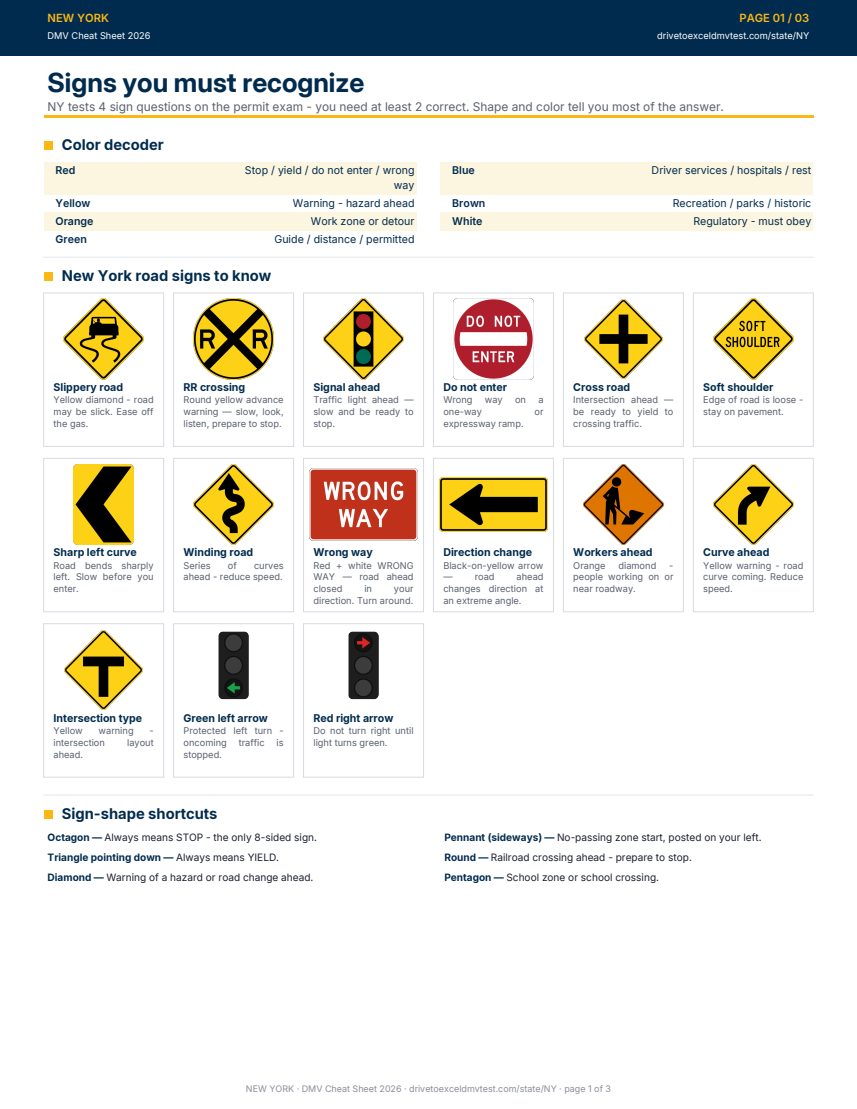
The 3-page PDF below is built to be printed and re-read the morning of your test. Use the Download button to save a copy.
2. Full New York study guide
The long-form companion to the cheat sheet: the rules, road signs and key numbers for the knowledge test, explained in plain English.
New York DMV-style practice questions, the 2026 passing rules, and a 40-question practice exam you can take right now — no signup, no paywall.
01What you're walking into
The New York DMV knowledge test is the gateway between you and a learner permit. The test is based on the New York State Driver's Manual, and you need to get 14 right out of 20 to pass. That's a 70% bar, but with one twist: at least 2 of the 4 road-sign questions must be correct, or you fail no matter how the rest went.
- The test at a DMV office20 multiple-choice questions. You need at least 14 correct (70%) to pass. At a DMV office, teens and adults take the same exam. Applicants under 18 may also have the option to take the permit test online, so check the DMV site for how that version works.
- The sign-section trap4 of the 20 questions are road signs. You must get at least 2 of those 4 right as a separate gate — miss 3 of the 4 sign questions and you fail even if you ace everything else.
- Application fee$64.25–$67.50 for adults 21+ (Class D); $76.75–$80.00 at ages 18½–21 and $80.00 at 18–18½. Under 18 the fee is $76.75–$92.50 depending on age bracket. Residents of NYC and some downstate counties also pay an MCTD fee of $1.00 for every 6 months the permit or license is in effect.
- What to bringCompleted MV-44 application, proof of identity and date of birth (use the DMV's 6-point ID system), Social Security number, and proof of NY residency. Schedule the test online through dmv.ny.gov.
- Pre-licensing course is mandatoryBefore scheduling the road test, every applicant must complete an approved 5-Hour Pre-Licensing Course OR a state-approved high school/college driver education course. The knowledge test itself does not require this — the road test does.
- Why one read isn't enoughNew York's manual is dense (NYC has its own rules layered on top, junior license restrictions cover all of upstate). Reading once is rarely enough — the sign section and right-of-way rules are easy to mix up.
- If you failIf you fail, review the manual sections on the categories you felt weakest on before you retest. Your application fee covers a limited number of tests, so check the DMV's current retest rules first.
02What to know for the test
The New York handbook covers a range of topics, including road signs, traffic laws, and safety. If you are short on time, focus first on three areas: signs, right-of-way / turning rules, and DUI / impairment.
- Road signs (the 4-question gate)Learn the shapes, colors, and route markers. A steady yellow light means a steady red is coming — be prepared to stop. Double solid yellow lines mean no passing from either direction. Broken yellow centerline allows passing on the left when clear.
- Right-of-way & turningSignal at least 100 feet before any turn or lane change. At a stop sign without a stop line, stop before the crosswalk. You have right-of-way already inside a traffic circle — entering drivers must yield to you.
- Following distance — the two-second ruleUnder ideal driving conditions, maintain at least a two-second following distance. In bad weather and when following large trucks, increase it to at least three or four seconds.
- BAC — 0.08% is intoxicatedIn New York, a BAC of 0.08% or higher is evidence of intoxication. The breathalyzer is the chemical test used to measure BAC. A BAC of more than 0.05% can still result in impaired-driving charges per the manual, but 0.08% is the number to know.
- Chemical-test refusal — automatic license lossNew York's Implied Consent Law: by driving in the state, you have already consented to a chemical test. Refuse and your license will be taken away, separately from any DUI conviction.
- School bus rulesWhen a school bus is stopped with red lights flashing, you may not pass — from any direction, including on a divided highway. Know this one cold: flashing red lights mean stop, period.
- Passing rulesNever pass a vehicle stopped at a crosswalk for a pedestrian. After passing, return to the right lane only when you can see the front bumper of the passed car in your rearview mirror. Cross a single solid white line only when traffic conditions require it.
- Hazard responseWhen your vehicle starts to slip, skid, or hydroplane, steer gently toward your target, ease up on the accelerator, and avoid abrupt steering or hard braking. Never use high beams in fog, because the light bounces back into your eyes.
- Alcohol biologyThe human body processes about one 12-ounce beer (or one 5-oz wine, or one 1.5-oz shot) per hour. Coffee, cold air, and exercise do NOT speed this up — only time does.
03Easy-to-mix-up rules
These rules look obvious but are easy to mix up. If you only have time to drill a few, drill these.
- The 'I may pass' school bus mistakeFlashing red lights on a stopped school bus mean STOP. Stop from every direction, including across a median and on a divided highway. 'Pass with caution' is never correct.
- Hill parking — direction mattersUphill with a curb: front wheels point AWAY from the curb. The rule reverses on a downhill — point wheels toward the curb.
- Yellow light = prepare to stop, not 'speed up'A steady yellow means caution — the red is coming. Best action: be prepared to stop safely before the intersection. Speeding up to clear the intersection before the red is the wrong move.
- Know the 0.08% lineKnow the exact number: 0.08% is the line for intoxication in New York. Vague phrases like 'over the legal limit' are no substitute for knowing it.
- Right-of-way inside a traffic circleDrivers ALREADY in a traffic circle (roundabout) have right-of-way over drivers entering. It is easy to get this backward — entering drivers yield.
- Bicycles on the road = same rules as carsBicyclists must obey the same traffic laws as motorists; the one thing they aren't required to do is insure the bicycle. Treat a bicyclist like a slow-moving car, give space, and reduce speed when passing.
- Single solid white line = caution, not 'forbidden'You MAY cross a single solid white line when traffic conditions require it. The line is a caution mark, not an absolute ban.
04How to prepare (the 3-loop method)
Reading the handbook once usually isn't enough. Use three loops: read once, drill questions until you score 90%+ (36/40), then listen along the night before. That last loop is a low-effort way to lock in facts you almost remember.
- Loop 1 — read the handbookDownload the current New York State Driver's Manual free from dmv.ny.gov. Read once. Don't memorize. Pay close attention to the chapters on traffic laws, safety, and road signs.
- Loop 2 — drill practice examsOur New York practice exams are free, untimed, and 40 questions each. Take one cold, note the topics you missed, review those handbook sections, then try the next until you are scoring 36/40 or better.
- Loop 3 — listen alongThe night before, play the New York DMV Cheat Sheet video in the background. It walks through the key facts — great for passive review during dinner or before bed.
- Sleep beats crammingAim for quick recognition rather than deep recall. A full night of sleep before the exam is better than a 3am cram session. Schedule the test for late morning, not 8am.
- Study signs visuallySigns are easiest to learn as images, not words. Learn to recognize shape and color FIRST (octagon = stop, yellow diamond = warning, orange diamond = work zone), then read the symbol.
- Read every optionDon't pick the first option just because it sounds right — a later one may be more specifically correct. Read every option every time.
05After you pass
Passing the knowledge test gets you a New York learner permit — not a full license. New York's graduated licensing system includes a supervisor rule, a 50-hour practice requirement for under-18 applicants, and junior-license restrictions that stay in place until age 18 (or 17 with driver-ed) — there is no 12-month timer.
- Permit supervisionYou may not drive on a learner permit unless accompanied by a licensed driver age 21 or older who has a license valid for the vehicle you are driving. The supervisor must be able to take control — in practice, that means front passenger seat.
- No fixed permit-hold for adultsNew York does NOT impose a minimum permit-hold time for adults 18+. You may schedule the road test as soon as you've completed the 5-Hour Pre-Licensing Course. Under-18 applicants must hold the permit at least 6 months and complete supervised practice hours first.
- 50 hours of supervised practice (under 18)At least 50 hours of supervised driving practice are required before the road test, with at least 15 of those hours after sunset (night driving). Track these honestly — the road test examiner can ask.
- Junior license night curfewJunior license (Class DJ/MJ) holders in upstate New York may drive unsupervised only between 5 AM and 9 PM. Between 9 PM and 5 AM, a supervising parent, guardian, driver-ed teacher or driving school instructor age 21+ is required, except when driving directly between home and work or an approved school course. NYC is stricter — junior license holders may not drive in NYC at all.
- Junior license passenger restrictionNo more than ONE passenger under age 21 unless they are immediate family. Exception: if your supervising driver is your licensed parent, guardian, driver-ed teacher, or driving school instructor, the limit doesn't apply.
- When junior-license restrictions ENDJunior restrictions lift when you upgrade to a senior Class D license. This happens automatically on your 18th birthday — no paperwork, no retest. You can upgrade EARLY at 17 by completing a state-approved high school or college driver-ed course and bringing the MV-285 certificate to any DMV office. There is no '12-month' rule in New York; the lift is tied to age, not time held.
- Phone & seatbelt enforcementNew York is a primary-enforcement state for both seatbelts and handheld phone use. Police can pull you over for either alone. Texting while driving is a 5-point violation for everyone; for junior/probationary drivers, it triggers an automatic 120-day suspension.
Lock it in — you've read it, now test yourself
Reading the New York handbook once is rarely enough to pass. A simple plan: go over the cheat sheet, take the free 40-question practice exams until the rules stick, then review anything you missed the night before.
Note: this is a study tool, not an official DMV resource. Always confirm requirements with your state's DMV before scheduling your test.