New Mexico DMV Cheat Sheet + Study Guide
Two free artifacts: the printable 3-page PDF cheat sheet and the full written study guide for the New Mexico permit test. Read both below, and download the PDF — no signup required.
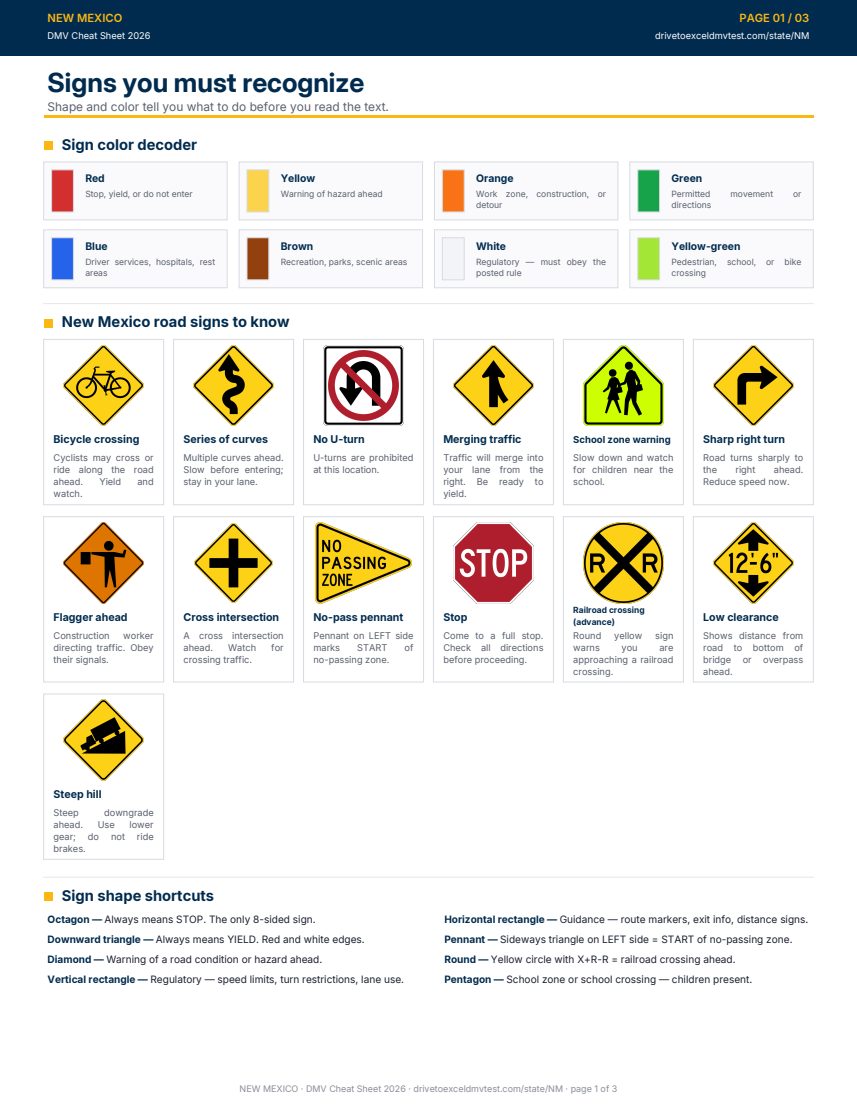
1. Printable cheat sheet
The 3-page PDF below is built to be printed and re-read the morning of your test. Use the Download button to save a copy.
2. Full New Mexico study guide
The long-form companion to the cheat sheet: the rules, road signs and key numbers for the knowledge test, explained in plain English.
New Mexico MVD-style practice questions, the 2026 passing rules, and a 40-question practice exam you can take right now — no signup, no paywall.
01What you're walking into
The New Mexico MVD knowledge test is the gateway between you and a learner's permit. Study the New Mexico Driver's Manual for the rules you need to know. The good news: New Mexico sets its pass threshold at 70%, which gives you some margin.
- The exam (all ages)You need a score of 70% or better to pass. Check with the MVD for the current number of questions before your test.
- Some room for errorNew Mexico's pass mark is 70%, so a few mistakes won't sink you — but don't rely on that margin; sign and traffic-law details are easy to mix up.
- Application fee$10 permit fee. Pay at any MVD field office.
- Bring with youProof of identity and age, two proofs of New Mexico residency, and proof that you have completed or are enrolled in driver education. A REAL ID also needs proof of an identification number (such as your Social Security number) and lawful status. Book an appointment at mvd.newmexico.gov to avoid long walk-in waits.
- Under 18? Driver ed is requiredApplicants under 18 must show proof that they have completed or are enrolled in an approved driver education course, including a DWI prevention component, to get a permit. The course must be completed before you can apply for a provisional license.
02What to study
The handbook covers traffic laws, safety and road signs in detail. Know them cold.
- Road signsSign shapes, colors, warning diamonds, regulatory rectangles, and pavement markings. A round sign means railroad crossing ahead — not a yield, not a stop.
- Right-of-way at intersectionsWhen two vehicles reach a four-way stop together, the right-of-way belongs to the driver on the right. Always yield to pedestrians in crosswalks, whether or not the crossing is marked.
- Signal distanceSignal at least 100 feet before you make a turn, and signal before every lane change.
- Railroad crossing stop distanceWhen signals are flashing, stop no closer than 15 feet from the nearest rail.
- Space cushionMaintain a cushion of space on all four sides of your vehicle. Allow extra space when stopped on an uphill slope — the vehicle in front may roll back.
- BAC limit (21 and older)0.08% BAC is the legal threshold. At or above it, you are driving under the influence — period.
- Impairment starts below the legal limitEven the smallest amount of alcohol limits your concentration, perception, judgment, and memory. No one can drink and drive safely.
- Speed limitsBusiness and residential areas: 30 mph unless posted otherwise. School zones: 15 mph. Public highways: 55 mph unless posted otherwise.
03Common mistakes that cost the test
These topics are easy to get wrong. If you only have time to drill a few, drill these.
- Four-way stop right-of-wayThe first car to arrive goes first. If two cars arrive at the same time, the driver on the right goes first. Three cars? Same rule — keep applying it clockwise. Going straight does not give you priority.
- School bus rules — and the divided-highway exceptionStop in both directions when a school bus flashes red and extends its stop arm. Exception: if you are on the OPPOSITE side of a divided highway (with a physical median), you may continue.
- Hill parking — downhillTurn front wheels toward the curb or road edge. If the brake fails, the car rolls into the curb, not into traffic.
- Hill parking — uphill with a curbTurn front wheels AWAY from the curb. The curb acts as the stopper if the car rolls back.
- Impairment vs. legal limit0.08% is the legal limit, not the line between safe and unsafe. Any amount of alcohol impairs judgment and coordination.
- Reading 'All of the above''All of the above' can be the correct answer when every listed option is actually true (e.g., alcohol slows reactions AND distorts judgment AND reduces alertness). Check each option before you choose.
- Passing a bicyclePass a cyclist slowly and leave as much space as you can. Because a cyclist may swerve to avoid road debris, crowding them at speed is dangerous.
04How to prepare (the 3-loop method)
Reading the handbook once may not be enough. A simple plan is three loops: read once, drill once, listen once. That's it.
- Loop 1 — read the manualDownload the New Mexico Driver's Manual free from mvd.newmexico.gov. Read it once — don't memorize. This guide compresses the key points into bullets so you know what to focus on.
- Loop 2 — drill the practice examsTake the free 40-Q exam below cold. Anything under 28/40 → go back to the categories you missed and retake.
- Loop 3 — listen along on YouTubePlay the New Mexico Full Practice Test on YouTube the day or two before your test. It makes a useful last review.
- Sleep beats crammingMemory consolidates overnight. A full night's sleep before the test is worth more than two extra hours of late-night reading.
- Study signs visuallyNever read sign descriptions in text only. Look at the actual shape and color, because that is what you will see on the road.
- Read every option before you pickRead every option before you answer. Wrong answers can sound plausible, and the first option can look right until you read the rest.
05After you pass
Passing the knowledge test gets you an instructional permit — not a full license. If you are under 18, New Mexico's graduated-license rules are firm: you move up one stage at a time, and each stage has a minimum holding time before you can apply for the next.
- Permit supervisionA licensed adult 21 or older with at least 3 years of driving experience must sit in the seat immediately beside you at all times. No exceptions, no driving alone.
- Permit minimum hold timeYou must hold the permit for at least 6 months before applying for a provisional license.
- Supervised practice hours50 hours total, with at least 10 of those hours driven at night. A parent or guardian must log and certify these hours.
- Night-driving curfew (provisional license)Cannot drive between midnight and 5:00 a.m. Exceptions require a signed statement: work (from employer), school or religious activity (from school/religious official or parent), medical necessity (from medical personnel), or family necessity (from parent/guardian). A licensed 21+ driver accompanying you also lifts the curfew.
- Passenger restriction (provisional license)Maximum 1 passenger under 21 years old. Immediate family members are exempt from this limit.
- When restrictions lift — the 12-month ruleYou can apply for a full, unrestricted license once you have held the provisional license for at least 12 months. Each traffic-violation conviction during that time adds 30 days, and you need a clean record for the 90 days before you apply.
Lock it in — you've read it, now test yourself
Reading the New Mexico handbook once is rarely enough to pass. A simple plan: go over the cheat sheet, take the free 40-question practice exams until the rules stick, then review anything you missed the night before.
Note: this is a study tool, not an official MVD resource. Always confirm requirements with your state's DMV before scheduling your test.