North Dakota DMV Cheat Sheet + Study Guide
Two free artifacts: the printable 3-page PDF cheat sheet and the full written study guide for the North Dakota permit test. Read both below, and download the PDF — no signup required.
1. Printable cheat sheet
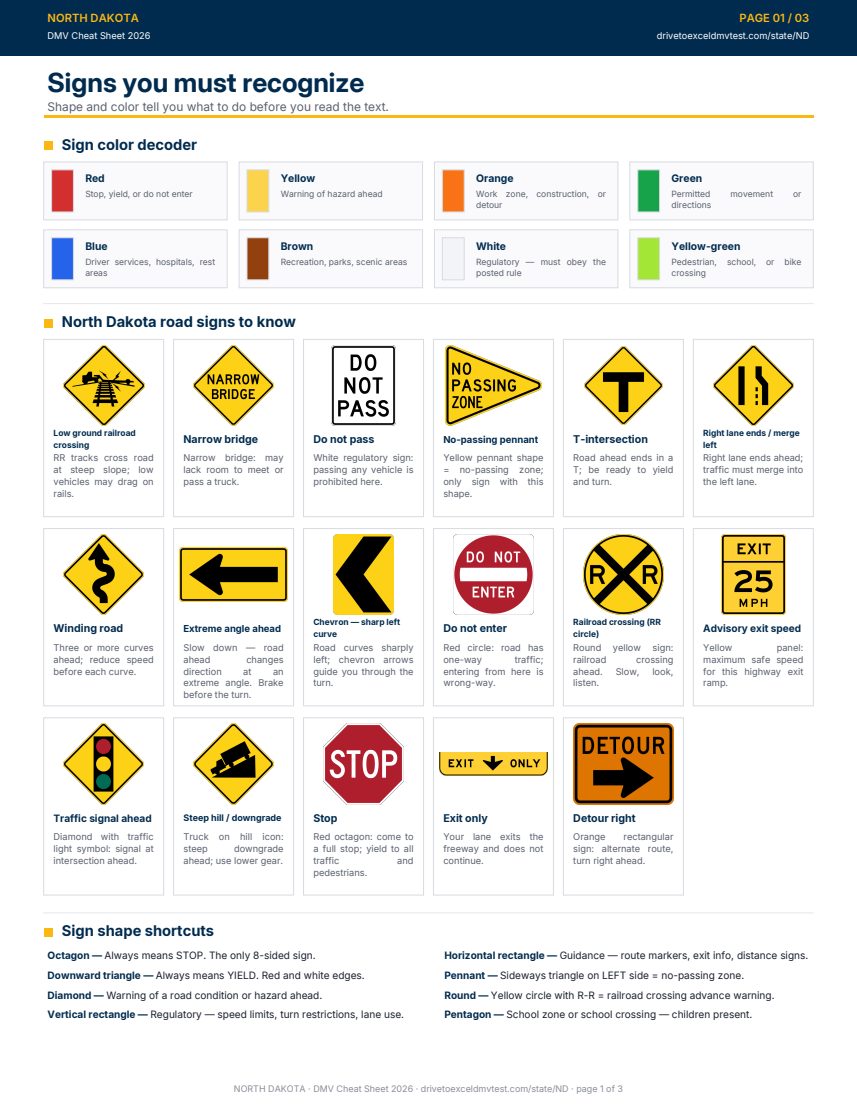
The 3-page PDF below is built to be printed and re-read the morning of your test. Use the Download button to save a copy.
2. Full North Dakota study guide
The long-form companion to the cheat sheet: the rules, road signs and key numbers for the knowledge test, explained in plain English.
North Dakota NDDOT-style practice questions, the 2026 passing rules, and a 40-question practice exam you can take right now — no signup, no paywall.
01What you're walking into
The North Dakota NDDOT knowledge test is the gateway between you and a learner's permit. The North Dakota Noncommercial Driver Manual is the book to study.
- Under-18 examApplicants under 18 take the same Class D knowledge test as adults, whether you're 14 or 17. Check the NDDOT website for the current number of questions and passing score.
- Adult first-time examAdults take the same Class D knowledge test as teens. Check the NDDOT website for the current number of questions and passing score before your appointment.
- Application fee$15 instruction permit fee. The written knowledge test costs an additional $5 and the road test costs another $5. Bring the exact fees and all required documents to a driver's license site.
- Bring with youProof of identity and lawful presence, proof of North Dakota residency, and your Social Security number. Check the NDDOT website for the full acceptable-document list before your appointment.
- Under 16? Driver ed is mandatoryAnyone under 16 must complete approved driver education before the road test: 30 hours of classroom instruction plus 6 hours of behind-the-wheel training through a school program, or 6 hours of behind-the-wheel training at an NDDOT-approved driving school.
- Why ND is manageable — but don't skip traffic lawsSpeed limit rules, right-of-way, and lane behavior deserve extra attention.
- Read every optionRead every option before you answer. A wrong answer can look plausible — the first option often looks right until you have read them all.
02What to study
Traffic laws, safety, and road signs are core topics in the North Dakota handbook. Know your speed limits, right-of-way rules, and sign shapes cold before test day.
- Road signs & signalsSign shapes, colors, and meanings. Diamond = warning (hazard ahead). Pennant = no-passing zone. Orange = construction. A flashing red light means stop and yield, just like a stop sign.
- Right-of-way at four-way stopsFirst to arrive has the right-of-way. Tie at the same time? The vehicle on the LEFT yields to the vehicle on the RIGHT. Treat a non-working traffic signal as a four-way stop.
- Signal distanceSignal at least 100 feet before beginning any turn or lane change. The law requires it even when no visible traffic is present.
- Following distanceKeep a minimum 3-second following distance under ideal weather and traffic conditions. Add more time in rain, snow, fog, or when carrying a heavy load.
- Speed limits — prima facie rules25 mph in business and residential districts. 20 mph in school zones unless otherwise posted. 70 mph on paved divided highways unless posted otherwise.
- School bus — when you must stopStop in both directions on a two-lane road when a school bus displays flashing red lights and its stop arm is extended. Do not move until the arm is withdrawn.
- BAC limit (21+)0.08% BAC or higher is illegal for drivers 21 and older. That is the per se DUI threshold under North Dakota law.
- Alcohol impairment vs. legal limitKnow the distinction: even the smallest amount of alcohol limits concentration, perception, judgment, and memory — impairment starts well below 0.08%.
- Bicycle passingSlow down and leave at least 3 feet of clearance when passing a bicyclist, and keep that clearance until you are safely past. Crowding a cyclist or passing too quickly can shift them off course.
03Rules that are easy to mix up
These rules are easy to mix up. If you only have time to drill a few topics, drill these.
- Four-way stop tie-breakersKnow more than 'first to arrive wins.' When two cars arrive at exactly the same time, the one on the LEFT yields to the one on the RIGHT. This rule is easy to mix up.
- School bus rules — what triggers the stopThe stop arm extended plus flashing red lights is the trigger — not just any stopped school bus. A bus parked on the shoulder with no one in it and no lights flashing does not require you to stop. Know the difference.
- Hill parking — downhillWhen parking downhill (or anywhere without a curb), turn your wheels TOWARD the road edge. If the brake fails, the car rolls away from traffic, not into it.
- Hill parking — uphill with a curbWhen parking uphill next to a curb, turn your wheels AWAY from the curb. The curb stops the car if it rolls; the wheels pointing outward push it into the curb. Always set the parking brake too.
- Impairment vs. legal limit0.08% is the legal BAC threshold — not the safety threshold. Impairment begins at much lower levels. Don't confuse the two.
- Watch 'always' and 'never'Be careful with absolute answer options. Some rules genuinely have no exceptions — traffic signs and pavement markings must always be obeyed, for example. When you see 'always,' ask whether the subject really has zero exceptions.
- Bicycle passing — leave at least 3 feetThe rule to remember: slow down and leave at least 3 feet of clearance when passing a cyclist. North Dakota law sets 3 feet as the minimum safe distance.
04How to prepare (the 3-loop method)
Reading the handbook once may not be enough. Try three loops: read once, drill once, listen once.
- Loop 1 — read the handbookDownload the North Dakota Noncommercial Driver Manual free from dot.nd.gov. Read it once without trying to memorize — you're just building familiarity with the structure. Pay extra attention to the traffic laws and safety chapters.
- Loop 2 — drill the practice examsTake the free 40-question exam below cold. Anything under 32/40 → identify the categories you missed and retake. Keep drilling until you've covered every topic.
- Loop 3 — listen along on YouTubePlay our North Dakota Road Signs and Traffic Laws Q&A videos the day before your test. Hearing questions and answers out loud gives you a different way to review than re-reading the same text.
- Sleep beats crammingMemory consolidates overnight. A full night of sleep before the test is worth more than two extra hours of late-night reading.
- Study signs visuallyNever study sign descriptions in text only. Look at the actual shape and color. Signs appear as images on the road, so know what a diamond vs. a pennant vs. an octagon looks like at a glance.
- Read every option before pickingRead every option before you answer. A wrong answer can look plausible, and the first option often looks correct until you read them all and find the more precise one.
05After you pass
Passing the knowledge test gets you an instruction permit — not a full license. North Dakota has no teen passenger limit beyond the vehicle's seating capacity, and a restricted license becomes unrestricted at age 16. But the permit-phase rules still apply until you hit that milestone.
- Permit supervisionWhile driving on a permit, you must be accompanied by a licensed adult who is 18 or older and has held a license for at least 3 years. They must be seated with you in the vehicle.
- Permit minimum hold timeAges 14–15: hold the permit for 12 months or until age 16, whichever comes first, but no less than 6 months. Ages 16–17: hold the permit for 6 months or until age 18, whichever comes first.
- Supervised hoursPermit holders under 16 must complete at least 50 hours of supervised driving in varied conditions — including nighttime, winter weather, rural roads, and urban roads — before the road test.
- Night curfew (restricted license, age 15)Permit holders must always have a qualified supervising driver beside them. A 15-year-old with a restricted Class D license cannot drive between the later of sunset or 9 p.m. and 5 a.m. unless a parent, guardian, or someone 18 or older is in the front seat, or the trip is directly to or from work, an official school activity, or a religious activity.
- Passenger restrictionsNorth Dakota has no teen-specific passenger limit — you just can't carry more passengers than the vehicle is designed for. Once your license is unrestricted at 16, you can carry passengers of any age with no GDL restriction.
- When restrictions liftRestrictions lift at age 16. When you turn 16 and complete your permit requirements, you receive a full Class D operator license with no further GDL conditions.
Lock it in — you've read it, now test yourself
Reading the North Dakota handbook once is rarely enough to pass. A simple plan: go over the cheat sheet, take the free 40-question practice exams until the rules stick, then review anything you missed the night before.
Note: this is a study tool, not an official DOT resource. Always confirm requirements with your state's DMV before scheduling your test.