Mississippi DMV Cheat Sheet + Study Guide
Two free artifacts: the printable 3-page PDF cheat sheet and the full written study guide for the Mississippi permit test. Read both below, and download the PDF — no signup required.
1. Printable cheat sheet
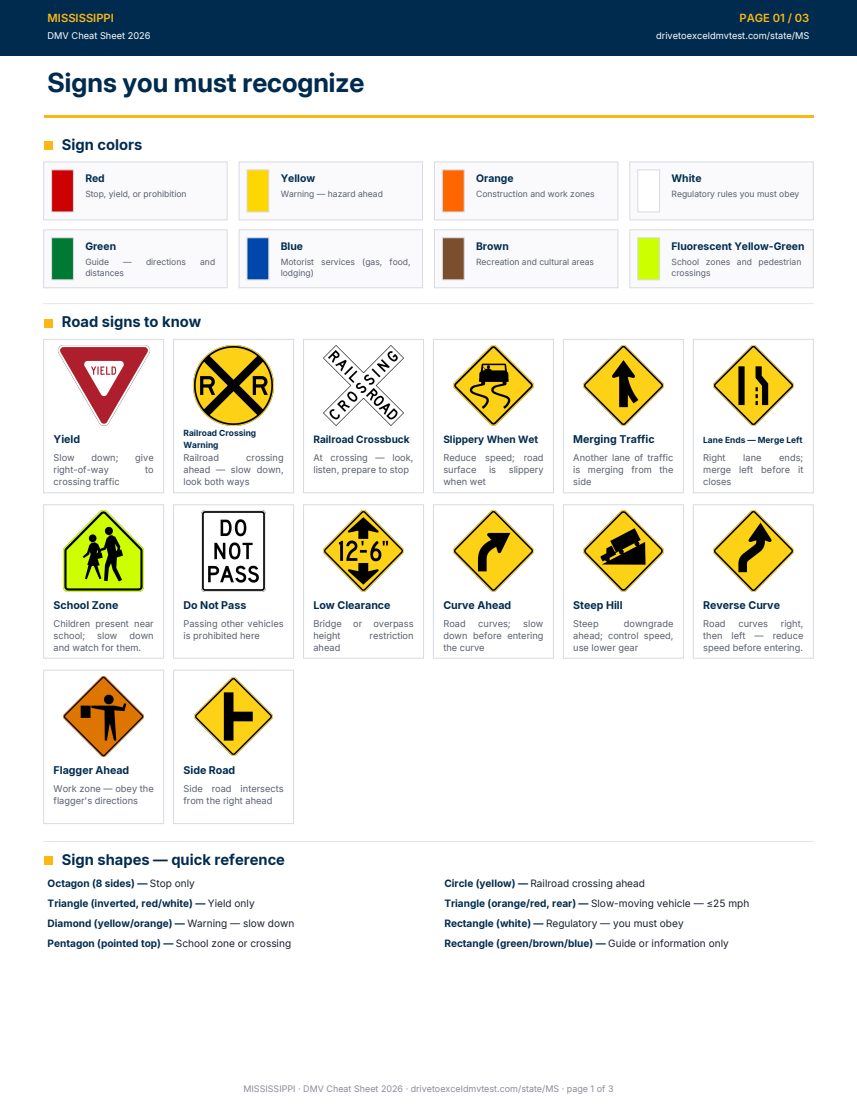
The 3-page PDF below is built to be printed and re-read the morning of your test. Use the Download button to save a copy.
2. Full Mississippi study guide
The long-form companion to the cheat sheet: the rules, road signs and key numbers for the knowledge test, explained in plain English.
Mississippi DPS-style practice questions, the 2026 passing rules, and a 40-question practice exam you can take right now — no signup, no paywall.
01What you're walking into
Your Mississippi DPS permit test is the first checkpoint on the road to a learner's permit. You need 80% to pass, or you'll be back at the counter.
- Under-18 examYou need 80% to pass. The DPS manual describes a single Computerized Exam for permit and license applicants.
- Adult examYou need 80% to pass. The DPS applies the same standard regardless of age.
- Application fee$7 for a 2-year learner's permit. Pay by cash, debit or credit card (Visa or MasterCard) at your local DPS Driver Service Bureau office; personal checks are not accepted.
- What to bringOriginal or certified birth certificate (no photocopies), Social Security card, and two proofs of Mississippi residency. Applicants under 18 also need a school attendance form, and those under 17 need a notarized parent or guardian signature.
- Driver education — required from July 1, 2027You do not need a driver education course to take the permit test. Beginning July 1, 2027, anyone applying for a first driver's license must have completed a course certified by the State Board of Education or DPS.
- Where it gets trickyTraffic laws and safety make up a large part of the Mississippi Driver's Manual. Cramming only road signs leaves you underprepared for the rules and safety material.
02What to study
Traffic laws and safety make up a large part of the Mississippi Driver's Manual, and road signs matter too. Get those three areas locked down and you will have covered a lot of ground.
- Road signsRound yellow sign = railroad crossing ahead. Yellow diamond = general warning. Pentagon = school zone. Orange = construction. White rectangle = regulatory. Memorize shapes first — you will recognize signs by sight on the road, not by reading their names.
- Right-of-way and four-way stopsAt an all-way stop, whoever gets there first goes first. If two cars pull up together, priority goes to the car on the right. For a pedestrian using a white cane or guide dog, take every precaution and come to a full stop if needed.
- Turn signal distance — 100 feetActivate your turn signal at least 100 feet before beginning a turn, and signal clearly before any lane change. Arm signals must also continue for at least 100 feet.
- Railroad crossingsNever go around lowered gates. When following a school bus, a vehicle for hire carrying passengers, or a vehicle carrying explosives or flammable liquids, always expect it to stop at every railroad crossing regardless of whether a train is visible.
- Following distance — one car length per 10 mphThe standard rule: one car length of space for every 10 mph of speed. Increase following distance in bad weather, construction zones, and behind large trucks.
- BAC limits — 0.08% for adultsDrivers 21 and older are legally impaired at 0.08% BAC. Under 21, the limit is 0.02%. Impairment starts below the legal limit, so even small amounts of alcohol can affect driving.
- Alcohol effects on drivingAlcohol impairs judgment, reaction time, coordination, and concentration at any BAC level. Even one drink affects your ability to drive safely. Only time removes alcohol from the body — coffee, food, and water do nothing.
- School bus rulesAny school bus showing flashing red lights or an extended stop arm requires you to stop. Stay stopped until the children have crossed, the red lights stop flashing, the stop arm is pulled in and the bus is moving again. If you are traveling the opposite direction on a divided highway with four or more lanes (at least two in each direction), you do not have to stop — know this exception.
- Bicycle rightsBicycles on the road have the same rights and responsibilities as motor vehicles. Give children on bikes extra space and expect unpredictable direction changes.
03Rules that are easy to mix up
These are rules that are easy to mix up. Skim these six before you walk in.
- Three-car right-of-way at a four-way stopArrive first, go first. Tie? Yield to the vehicle on your right. Know both rules.
- School bus stop-arm precision'When most kids are off' is not a point at which you may proceed. You must wait until the stop arm has been pulled in AND the bus is moving again — both conditions must be met.
- Hill parking directionDownhill — always turn wheels toward the curb or road edge. Uphill with no curb — wheels toward the road edge. Uphill with a curb — wheels away from the curb (toward traffic). Always set the parking brake on any hill.
- BAC vs. impairment framingBeing under 0.08% does not mean you're safe to drive. Alcohol affects judgment at any amount. Don't assume 'under the legal limit' means okay.
- Rules with no exceptionsSome rules really are absolute: never go around a lowered railroad gate and never pass at a railroad crossing. For a pedestrian using a white cane or guide dog, take every precaution and stop if needed.
- Bicycle signals and lane positionLeft arm straight out = left turn; left arm up = right turn. Bicycles have road rights equal to motor vehicles — they do not have to yield to cars by default.
04How to prepare (the 3-loop method)
Reading the handbook once is a good start but may not be enough. Two more loops help: drilling practice questions and doing a final listen-along the night before.
- Loop 1 — read the Mississippi Driver's ManualDownload the Mississippi Driver's Manual free from the DPS website. Read it once without pressure — you're building a mental map, not memorizing paragraphs. Pay special attention to the license requirements near the front.
- Loop 2 — drill the practice examsTake this site's free 40-question exam and drill until you can score 36/40 or better before you schedule your appointment. If you miss questions, review those topics first.
- Loop 3 — listen along on YouTubeOur Mississippi DPS videos walk through practice Q&As with both voices. Put them on during a commute or while doing dishes the night before the test — passive listening helps the material stick.
- Read every option on every questionRead every option before answering. Wrong options can sound plausible, so don't stop at the first answer that seems right.
- Study road signs visuallyOn the road you see the actual sign, not its name in text. Practice recognizing shapes and colors — round yellow = railroad, pentagon = school zone — so you can identify a sign at a glance.
- Sleep beats crammingThe night before, close the books by 10 PM. A full night of sleep improves recall more than two extra hours of reading. Use those hours for the listen-along instead of re-reading dense handbook chapters.
05After you pass
Mississippi has no separate intermediate license: after the learner's permit you move straight to a regular license. It requires a 12-month permit hold (or until you turn 17), a signed 50-hour driving affidavit if you are under 17, and a split weekday/weekend curfew for the first 6 months if you are under 18. There are no passenger restrictions.
- Learner's permit — who rides with youYou must be accompanied by a licensed driver who is at least 21 years old, seated in the front passenger seat beside you (not behind). All permit driving requires supervision regardless of the time of day.
- 12-month permit hold — or until you turn 17Mississippi requires you to hold your learner's permit for 12 months, or until your 17th birthday if that comes first, before you can get a regular driver's license. Plan accordingly — do not wait until month 11 to start gathering your paperwork, including the signed driving affidavit.
- 50 hours of supervised driving (under 17)Applicants under 17 must submit an affidavit from a parent, teacher or guardian certifying at least 50 hours of driving instruction. The permit hold is a separate requirement.
- New-driver curfew — split by day of week (first 6 months, under 18)For your first 6 months with a regular license, while you are under 18, you may drive unsupervised only from 6:00 AM to 10:00 PM Sunday through Thursday and from 6:00 AM to 11:30 PM Friday and Saturday. Driving directly to or from work or a school or extracurricular activity is allowed at any time. At other hours you must be supervised by a parent, guardian or licensed driver 21 or older in the seat beside you.
- No passenger restrictions on a new licenseMississippi does not limit how many or which passengers a license holder under 18 may carry. The licensing law has no passenger restriction clause.
- When restrictions liftThe curfew ends once you have held your regular license for 6 months, or when you turn 18 if that comes first.
- Extra restrictions noteThe DPS Commissioner may impose driving restrictions for up to 12 months after obtaining a full license for drivers under 18. These commissioner-level restrictions are possible — check with DPS at the time of your full-license application.
Lock it in — you've read it, now test yourself
Reading the Mississippi handbook once is rarely enough to pass. A simple plan: go over the cheat sheet, take the free 40-question practice exams until the rules stick, then review anything you missed the night before.
Note: this is a study tool, not an official DPS resource. Always confirm requirements with your state's DMV before scheduling your test.