Maine DMV Cheat Sheet + Study Guide
Two free artifacts: the printable 3-page PDF cheat sheet and the full written study guide for the Maine permit test. Read both below, and download the PDF — no signup required.
1. Printable cheat sheet
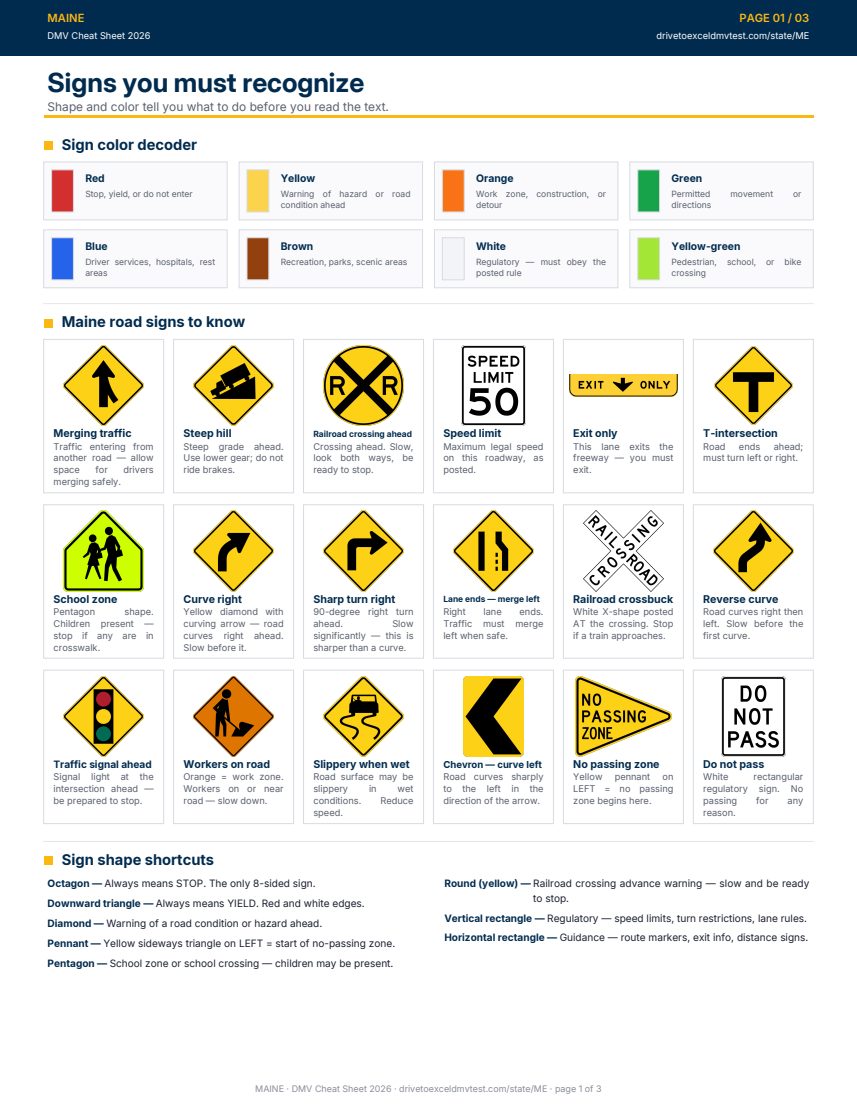
The 3-page PDF below is built to be printed and re-read the morning of your test. Use the Download button to save a copy.
2. Full Maine study guide
The long-form companion to the cheat sheet: the rules, road signs and key numbers for the knowledge test, explained in plain English.
Maine BMV-style practice questions, the 2026 passing rules, and a 40-question practice exam you can take right now — no signup, no paywall.
01What you're walking into
Maine's knowledge test is 30 questions at the Bureau of Motor Vehicles (BMV), and you need 24 correct (80%) to pass. Walking in underprepared means paying the $35 fee again and coming back. Free practice exams on this site help you practice the key topics.
- Knowledge test (under 18)30 questions. Pass at 24 correct (80%). Same format as the adult test — Maine doesn't run a separate junior exam.
- Knowledge test (adult / first-time)30 questions. Pass at 24 correct (80%). Don't rush — each wrong answer counts against you.
- Application fee$35, included with your learner's permit application. Bring it to a BMV branch or mail it in; the BMV then schedules your written test and mails you the appointment notice.
- What to bringTwo forms of identification and proof of Maine residency, plus your Social Security number (required on the application if you are eligible for one). If you are younger than 23, add a birth certificate (a photocopy needs the issuing agency's embossed stamp; notarized copies are not accepted). If you are under 18, add your driver education completion certificate.
- Driver education (under 18)Required. You must present a driver education completion certificate before the BMV will let you sit the knowledge test. No certificate, no test.
- Take as many practice exams as you needThe Maine test is 30 questions, so work through several free practice exams, review every miss, and retake them until you pass comfortably.
- What the 80% pass mark meansYou can only miss 6 questions out of 30, so careless slips on sign meanings add up quickly.
02What to study
Traffic laws make up a large part of the Maine handbook, along with safety and road signs. Master those three categories first, then cover alcohol and drugs, parking, and vehicle rules.
- Traffic lawsRight-of-way, lane changes, passing rules, signal compliance, railroad crossings, and emergency vehicle behavior. This is a large category, so give it plenty of study time.
- SafetyHazard response: wet roads, night driving, skids, tire blowouts, following distance, distracted driving.
- Road signsSign shapes, colors, and meanings: red octagons (stop), orange diamonds (construction), white rectangles (regulatory). A flashing red is a stop sign; a flashing yellow means slow and proceed with caution.
- Following distance — 4 seconds minimumKeep at least 4 seconds between you and the vehicle ahead. Leave more on slippery roads, behind motorcycles or bicycles, and behind large vehicles whose drivers can't see you well.
- Speed limits — three tiersSchool zone during recess and school opening/closing hours (30 minutes before and after the school day starts and ends): 15 mph. Business or residential area: 25 mph. Outside business/residential unless otherwise posted: 45 mph.
- BAC limits — 0.08% for adults, any amount under 210.08% or above = OUI (Operating Under the Influence) charge. Under 21: any detectable alcohol = license suspension.
- Chemical test refusalRefusing a breathalyzer or blood test when requested by law enforcement results in automatic license suspension — regardless of actual impairment.
- Emergency vehicle bufferDo not follow within 500 feet of a fire truck responding to an alarm, or within 150 feet of any other emergency vehicle using its emergency lights. Pull to the right edge and stop when one approaches with lights and siren.
- Only time reduces BACCoffee, food, water, and exercise don't speed up alcohol metabolism. Only time removes alcohol from your blood.
03Easy-to-mix-up rules
These rules are easy to mix up. The wrong answer can sound right until you have studied the exact rule.
- Four-way stop tie-breakersFirst to arrive has the right-of-way. Tie at the same time? Yield to the driver on your right. Know both rules.
- School bus — divided highway exceptionOn a multilane highway divided by a median, vehicles traveling in the opposite direction from a stopped school bus MAY continue driving. On a two-lane road, everyone in both directions must stop. Don't get these two reversed.
- Hill parking — wheel directionDownhill with or without curb: turn wheels RIGHT toward curb/road edge. Uphill with curb: turn wheels LEFT away from curb. Uphill with no curb: turn wheels RIGHT toward road edge. Know the logic, not just one answer.
- Impairment vs. legal limit — they're not the sameMaine's OUI law triggers at 0.08% for drivers 21+, but alcohol impairs judgment and reaction time well below that. Don't confuse the legal threshold with the point where impairment begins.
- Under-21 limit — any amountUnder 21, there is no safe legal BAC. Any detectable alcohol = license suspension. The rule is 'any amount,' not a numeric limit like 0.02% or 0.04%.
- Bicyclists have full vehicle rightsBicycles are legally vehicles on Maine roads, with the same rights and responsibilities as motor cars. When passing, slow down and give as much space as possible.
- Passing on the rightYou may pass on the right only when the vehicle ahead is turning left and the road is wide enough for two lanes of traffic, or when the vehicle ahead is in the left lane of a road with two or more marked lanes going the same direction. The size of the vehicle ahead is irrelevant. Know this one.
04How to prepare (the 3-loop method)
Three passes through the material usually beat one marathon session. Here's a simple system for Maine's 30-question, 80%-pass test.
- Loop 1 — read the Maine Driver's License ManualDownload the Maine Driver's License Manual free from maine.gov/sos/bmv. Read it once, cover to cover. Don't memorize — just build a mental map. Pay extra attention to speed limits, following distance, and the GDL curfew rules.
- Loop 2 — drill the practice examsTake 3–4 of the free 40-question practice exams until you're consistently scoring 36 or more out of 40. Then target road signs and traffic laws specifically.
- Loop 3 — listen along on YouTubePut our Maine BMV Full Practice Test video on in the background during a commute or workout. Hearing the question read aloud cements the answer differently than reading it. Especially useful for sign questions — the verbal description forces you to visualize the sign.
- Sleep beats crammingThe night before the test, stop at 10 PM. Memory consolidates during sleep — a full night outperforms two extra hours of drilling. You already know the material.
- Study signs visually, not verballyDrivers recognize signs by sight, so study pictures, not just descriptions. Practice matching shapes and colors to their meanings without reading the words.
- Read every option on Maine's testEliminate wrong answers first, and read every option before choosing. Never skip the last option assuming it can't be right.
05After you pass
Maine's GDL system has real requirements — 70 supervised hours, a supervisor who is at least 20 years old, and a 270-day restriction window. Know these numbers before you hand your permit to a parent or older sibling.
- Permit supervisor — age 20, not 21Your supervising driver must be at least 20 years old and have held a valid license for at least 2 years. They must sit in the front seat beside you — not the back seat.
- Permit hold — 6 months minimum if under 21You cannot schedule your road test until you've held your learner's permit for at least 6 months. No exceptions for turning 18 or completing driver's ed early.
- Supervised hours — 70 total, 10 at nightMaine requires 70 hours of supervised practice driving if you are under 21. At least 10 of those hours must be at night. Log them accurately: a parent, guardian or spouse certifies the log, and applicants under 21 submit it to the BMV instead of the road test request card.
- Night curfew — midnight to 5 AM (under 18)If you're under 18 and hold an intermediate license, you may not drive between 12:00 AM and 5:00 AM. The curfew is midnight to 5 AM — not 11 PM, not 1 AM.
- Passenger restriction — immediate family onlyUnder-18 intermediate license holders may not carry any passengers except immediate family members — defined as parents, grandparents, siblings, spouses, and children. Friends, neighbors, and extended family do not qualify unless you have an approved supervising driver in the car.
- Restrictions lift at 270 days — then 2-year provisional continuesThe curfew and passenger restrictions end 270 days after your license is issued — not after 12 months. After 270 days you can drive freely on timing and passengers, but your license remains provisional for the full 2 years from original issuance. Any moving violation during that 2-year window can trigger suspension.
Lock it in — you've read it, now test yourself
Reading the Maine handbook once is rarely enough to pass. A simple plan: go over the cheat sheet, take the free 40-question practice exams until the rules stick, then review anything you missed the night before.
Note: this is a study tool, not an official BMV resource. Always confirm requirements with your state's DMV before scheduling your test.