Massachusetts DMV Cheat Sheet + Study Guide
Two free artifacts: the printable 3-page PDF cheat sheet and the full written study guide for the Massachusetts permit test. Read both below, and download the PDF — no signup required.
1. Printable cheat sheet
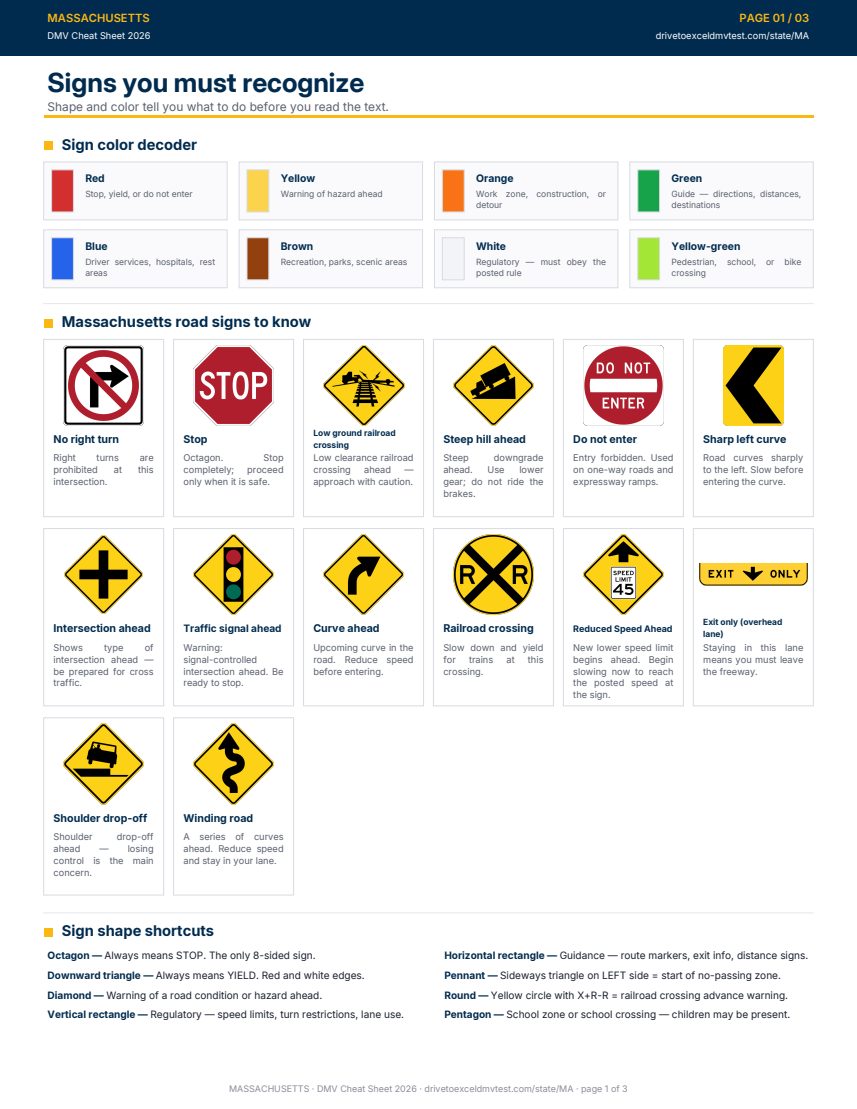
The 3-page PDF below is built to be printed and re-read the morning of your test. Use the Download button to save a copy.
2. Full Massachusetts study guide
The long-form companion to the cheat sheet: the rules, road signs and key numbers for the knowledge test, explained in plain English.
Massachusetts RMV-style practice questions, the 2026 passing rules, and a 40-question practice exam you can take right now — no signup, no paywall.
01What you're walking into
The Massachusetts RMV knowledge test is the gateway between you and a learner's permit. The study material is the 2026 handbook — 'Sharing the Road — A User's Manual for Public Ways'. The passing mark is 72%, so prepare well on signs, right-of-way, and drug/alcohol rules.
- Knowledge test (all ages)25 questions. Pass at 18 correct — that's 72%. Both under-18 and adult applicants sit the same 25-question exam.
- Application fee$30, paid at the RMV. Book your appointment online at mass.gov/RMV.
- What to bringProof of identity, Massachusetts residency, and your Social Security number. Have them ready before your appointment.
- Under 18? Driver ed is mandatoryMassachusetts requires a licensed driver education program: 30 hours of classroom instruction, 12 hours behind the wheel, and 6 hours of in-car observation. No exemptions.
- 72% pass scoreMassachusetts requires 72% (18/25). Know the rules well — don't walk in without studying.
- Official handbookDownload 'Sharing the Road — A User's Manual for Public Ways' free from mass.gov/RMV. Read every section, not only the ones you think you already know.
02What to know before the test
The handbook covers traffic laws, road signs, and safety scenarios in detail. Know your numbers cold: signal distance, following distance, railroad stop distance, speed limits, and BAC thresholds.
- Road signsShapes, colors, regulatory signs, warning signs, work-zone orange. A stop sign means a full stop and yield to all cross-traffic before entering.
- Right-of-way at four-way stopsFirst to arrive goes first. Tie? Yield to the vehicle on your right.
- Signal distance — 100 feetMassachusetts drivers should begin signaling at least 100 feet before a turn — and at least 500 feet before a turn on a highway. Always signal lane changes too. 'Well in advance' is vague — 100 feet is the minimum for a turn.
- Railroad crossing stop — 15 feetWhen signals flash or a gate lowers, stop no closer than 15 feet from the nearest rail.
- Following distance — 3 secondsKeep at least 3 seconds of following distance in normal conditions. Behind a motorcycle, increase to at least 4 seconds — a fallen rider is an obstacle you need extra space to avoid.
- BAC limit (21+) — 0.08%Operating a vehicle at or above 0.08% BAC is illegal for drivers 21 and older. The RMV framing is that any impairment is illegal.
- Chemical test refusalMassachusetts implied-consent law means driving is consent to a blood-alcohol test. Refusing results in automatic license suspension. Refusing is not an out.
- Prima facie speed limits20 mph in school zones; 30 mph in thickly settled areas and business districts; 40 mph outside those areas; 50 mph on a divided highway outside them. Obey posted signs over defaults.
03Rules that are easy to mix up
These rules are easy to mix up. If you only have time to drill a few areas, start here.
- Four-way stop tie-breakers'First to arrive goes first' is the easy part. The tie is harder: when two cars arrive simultaneously, the one on the left must yield to the one on the right.
- School bus rules — two-lane roadsOn a two-lane highway, ALL traffic in BOTH directions must stop when a school bus displays flashing red lights and extends its stop arm. Know this one cold.
- Hill parking — downhillTurn your wheels TOWARD the road edge (to the right). If the brakes fail, the car rolls away from traffic rather than into it.
- Hill parking — uphill with a curbTurn your wheels AWAY from the curb. The curb catches the tire if the car rolls backward. Know both — the two rules are opposites of each other.
- Impairment starts below the legal limit0.08% is the legal threshold for an OUI charge — NOT the point where impairment begins. Even small amounts of alcohol impair vision, judgment, and reaction time.
- When 'always' is correctSome 'always' rules are genuine: always yield to a blind pedestrian carrying a white cane or using a guide dog, even if they are not in a crosswalk.
- Passing a bicyclist — 4-foot minimumWhen passing a cyclist on a two-lane road without a bike lane, slow down, wait for a clear gap, then pass leaving at least 4 feet of clearance. Honking is wrong — it can startle the rider into crashing.
04How to prepare (the 3-loop method)
Reading the handbook once may not be enough. Try three loops: read once, drill once, listen once.
- Loop 1 — read the handbookDownload 'Sharing the Road — A User's Manual for Public Ways' free from mass.gov/RMV. Read it once — don't try to memorize every line. This guide compresses the key points into bullets.
- Loop 2 — drill the practice examsTake the free 40-Q exam below cold. Anything under 29/40 on a practice run → focus on the categories you missed and retake.
- Loop 3 — listen along on YouTubePlay the Massachusetts Cheat Sheet video the evening before your test. Hearing the material read aloud can help it stick.
- Sleep beats crammingMemory consolidates overnight. A full night's sleep before the test is better than cramming late.
- Study signs visuallyNever read sign descriptions in text only. Look at the actual shape and color. On the road you see the sign, not its name.
- Read every option before you pickRead all the options before you answer. The first option can look correct until you read the rest and realize a later one is more complete.
05After you pass
Passing the knowledge test gets you a Massachusetts learner's permit — not a full license. Massachusetts' Junior Operator License (JOL) program has hard curfews and passenger restrictions that carry real penalties if broken.
- Permit supervisionWhile on a learner's permit, you must always be accompanied by a licensed driver who is at least 21 years old with at least 1 year of driving experience, sitting beside you.
- Minimum permit hold (under 18)You must hold your permit for at least six consecutive months before you can take the road test. Adults (18+) can schedule the road test as soon as they receive their permit.
- Supervised driving hours40 hours of supervised driving required, on top of driver education, certified by a parent or guardian. If you complete a driver skills development program (a closed, off-road course licensed by the RMV), this drops to 30 hours supervised. A parent or guardian must also take a mandatory 2-hour driver education class.
- JOL night curfewJunior Operators cannot drive alone between 12:30 AM and 5:00 AM. During curfew hours, a parent or legal guardian must be in the vehicle.
- JOL passenger restriction (first 6 months)For the first 6 months of your Junior Operator License, you may not carry passengers under age 18 who are not immediate family members — unless a licensed driver 21+ with 1+ year of experience is sitting beside you.
- When restrictions liftThe passenger restriction lifts at 6 months of licensure OR your 18th birthday — whichever comes FIRST. The 12:30 AM–5:00 AM night restriction and the ban on using any mobile electronic device stay in force until you turn 18. If you get your JOL a few months before turning 18, the passenger restriction is gone the day you turn 18, not after a full additional 6 months.
Lock it in — you've read it, now test yourself
Reading the Massachusetts handbook once is rarely enough to pass. A simple plan: go over the cheat sheet, take the free 40-question practice exams until the rules stick, then review anything you missed the night before.
Note: this is a study tool, not an official RMV resource. Always confirm requirements with your state's DMV before scheduling your test.