Idaho DMV Cheat Sheet + Study Guide
Two free artifacts: the printable 3-page PDF cheat sheet and the full written study guide for the Idaho permit test. Read both below, and download the PDF — no signup required.
1. Printable cheat sheet
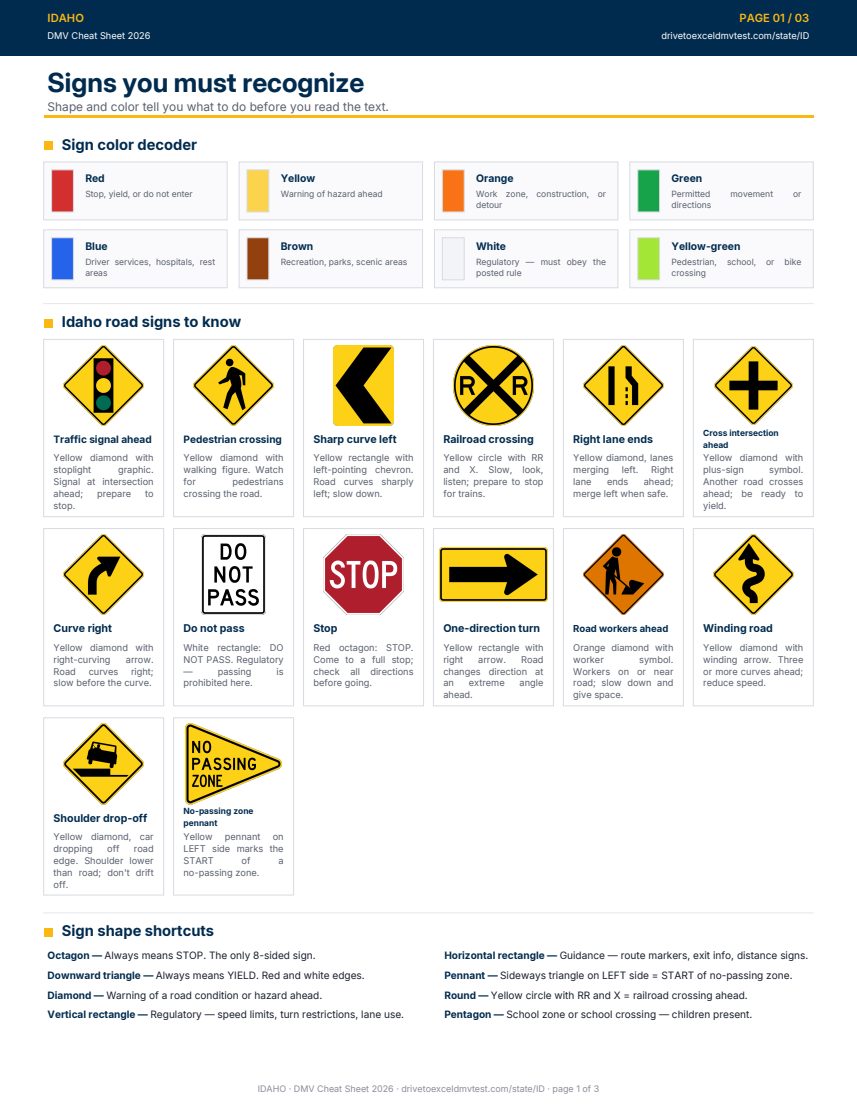
The 3-page PDF below is built to be printed and re-read the morning of your test. Use the Download button to save a copy.
2. Full Idaho study guide
The long-form companion to the cheat sheet: the rules, road signs and key numbers for the knowledge test, explained in plain English.
Idaho ITD-style practice questions, the 2026 passing rules, and a 40-question practice exam you can take right now — no signup, no paywall.
01What you're walking into
The Idaho knowledge test is a required step toward your driver's license, and for applicants under 17 it comes after driver training and the supervised driving period. Idaho's ITD administers a 40-question multiple-choice test, and you must answer 34 of them correctly — that's an 85% pass bar. Come prepared the first time.
- 40-question test, 85% to pass (34/40)Both under-18 and adult applicants take the same 40-question test and need 34 correct. Getting 7 wrong fails you.
- Permit fee: $21.50 totalThe driver training permit, which becomes your supervised instruction permit, costs $21.50 total. That fee includes $6.50 collected in advance for the skills test, and all ITD fees are non-refundable.
- What to bring to the ITD officeBring proof of age and identity (typically a certified birth certificate), proof of Idaho residency (such as a utility bill or lease), your Social Security number, and a parent or guardian to sign as liability signer if you're under 18. Check ITD's document list before you go.
- Driver education required under age 17If you're under 17, you must complete a state-approved driver training program before you can get a driver's license: 30 classroom hours, 6 hours of in-car observation, and 6 hours behind the wheel. You buy your driver training permit before the course starts.
- Failing means paying againEach attempt requires a new fee, and the 85% bar makes preparation time far cheaper than multiple retakes.
02What to study
The handbook covers traffic laws and safety in detail. Nail the number-heavy rules (following distance, signal distance, BAC limits) and you'll have the key facts down before you move on to signs.
- Signal at least 100 feet before a turn, and before every lane changeIdaho law requires signaling for at least the last 100 feet before a turn. On a freeway, or before pulling away from a parked position, signal for at least 5 seconds. A lane change needs a signal too, and the Idaho Driver's Handbook says to start it 100 feet ahead in business or residential areas, or 5 seconds ahead on freeways or highways.
- Stop no closer than 15 feet from railroad tracksStop with at least 15 feet between your vehicle and the nearest rail when a crossing signal is flashing or a gate is lowering. Wait until the signal stops and the crossing is clear before you go.
- 3-second minimum following distanceIdaho's Driver's Handbook calls for a minimum 3-second following gap between your front bumper and the vehicle ahead under normal conditions. By law you may not follow more closely than is reasonable and prudent, so in bad weather, heavy traffic, or behind large vehicles, increase that gap further.
- BAC 0.08% or higher = DUI if you're 21+Drivers 21 and older are legally impaired at a blood alcohol concentration of 0.08% or higher. Below 0.08% you can still be convicted of DUI if drugs or other intoxicating substances impair your driving.
- Headlights required when visibility drops to 500 feet or lessTurn on your headlights any time you cannot see ahead at least 500 feet — fog, rain, dusk, overcast days. Dim to low beam within 500 feet of oncoming traffic and within 200 feet of a vehicle you're following.
- Yield to the right at uncontrolled intersectionsAt an uncontrolled intersection where two vehicles show up simultaneously, the one on the right goes first and the one on the left has to give way.
- Bicycle rights: same rights as drivers, pass with careBicyclists have the same rights as motor vehicle drivers. They must ride as close to the right edge as safety allows, but may take the lane when the road is too narrow to share safely. When passing a bicyclist, move into the left lane if possible, wait for a clear gap in oncoming traffic, and leave as much space as possible.
- Idaho bike-lane rule: no parking on crosswalks or marked bike lanesPark parallel to the curb with your wheels within 18 inches of it. Parking is also prohibited in a marked bicycle lane, on a crosswalk, and within 20 feet of a crosswalk at an intersection.
03Easy-to-confuse rules
These rules are easy to mix up — multi-vehicle intersections, school bus rules, hill parking direction, and BAC framing. Each point below covers one of them, so take your time with each.
- Uncontrolled intersection: left yields to rightAt an intersection with no signs or signals, if two cars arrive at the same time, the car on the left yields to the car on the right. At an uncontrolled T-intersection, a driver who must turn right or left has to stop and/or yield to drivers approaching from the other two directions.
- Left turn: yield to everyone in the intersectionWhen turning left, you must yield to oncoming traffic AND to pedestrians and bicyclists already in the intersection. The green light gives you permission to enter, not to go.
- School bus: stop when the red lights are flashingWhenever a school bus has halted with its red lights flashing and/or its stop arm out, come to a complete stop, whether you are behind the bus or approaching from the front. Do not proceed until the bus moves or the signals are turned off. The one exception: oncoming traffic on a highway of more than three lanes does not have to stop.
- Hill parking: uphill with curb = wheels away from curbParking uphill next to a curb: turn your front wheels AWAY from the curb (to the left). If brakes fail, the car rolls into the curb and stops. Parking downhill: turn wheels TO the right (toward the curb/edge). These two are easy to flip.
- BAC framing: 0.08% is the legal threshold, not a 'safe' levelBeing below 0.08% does not mean you're safe to drive — alcohol still impairs you, and you can be convicted of DUI if drugs or other intoxicating substances impair you. The 0.08% number is the per se limit for drivers 21 and older, not a green light.
- Idaho Stop Law for bicyclistsIdaho's bike law: bicyclists don't have to stop at stop signs, but they must yield to vehicles already at a controlled intersection. Do not assume bikes follow identical rules to cars.
04How to prepare (the 3-loop method)
Idaho's 85% pass bar means you can't afford to wing it. Three focused study loops — reading, drilling, and listening — give you the best shot at clearing 34/40 on your first attempt.
- Loop 1: read the Idaho Driver's Manual end to endStart with the official Idaho Driver's Manual from ITD. Pay extra attention to the numbered rules: distances in feet, seconds, and BAC percentages are key.
- Loop 2: drill the practice questions by categoryWork through the practice questions on this site by category. Take the free 40-question practice exam at least twice until you're consistently hitting 36+ correct.
- Loop 3: listen along on YouTube the night beforeRun our Idaho ITD practice test video in the background while you do something else — Q&A pairs read aloud by two voices. Passive audio review cements the answer patterns before you sleep.
- Sleep beats late-night crammingA rested brain retrieves answers faster under test pressure. Aim for a full night's sleep after your last study session; staying up past midnight to cram costs more than it gains at 85%.
- Study road signs visually, not verballyDrill signs by looking at the shape and color first — octagon = stop, diamond = warning, pentagon = school zone — before reading any caption.
- Read every option before answeringRead every option before you commit. If 'All of the above' is offered, check that every option fits before you choose it.
05After you pass
Idaho's GDL system has real requirements. The Supervised Instruction Permit (SIP) phase requires 50 hours of supervised driving over at least 6 months. After you pass the tests and get your license, a daylight-only restriction applies until you turn 16, and a passenger limit applies for the first 6 months.
- Supervisor must be 21+, licensed, in the front seat beside youEvery supervised drive requires a licensed driver who is at least 21 years old seated in the front passenger seat next to you. A parent in the back seat does not count.
- Hold the SIP for at least 6 months before the road testYou cannot take the driving skills test until you have held your SIP for a minimum of 6 calendar months, regardless of how many hours you've logged.
- Log 50 hours total — at least 10 at nightIdaho requires 50 hours of supervised driving before the skills test. At least 10 of those 50 hours must be driven after dark. A parent or guardian must sign a statement certifying the hours before your license is issued.
- Under-16 rule: daylight driving only (5 AM–10 PM)If you're under 16 with a license, you may drive only between 5:00 a.m. and 10:00 p.m. unless a licensed driver at least 21 years old is sitting beside you, with no one else in the front seat.
- Passenger cap: max 1 unrelated under-17 passenger in the first 6 monthsDuring the first 6 months after your driver's license is issued, if you're under 17, you may carry no more than one passenger under 17 who is not related to you by blood, adoption, or marriage. Family members are exempt.
- Daylight rule ends at 16; passenger limit ends after 6 monthsIdaho's daylight-only rule ends when you turn 16. The one-passenger limit ends 6 months after your license is issued.
Lock it in — you've read it, now test yourself
Reading the Idaho handbook once is rarely enough to pass. A simple plan: go over the cheat sheet, take the free 40-question practice exams until the rules stick, then review anything you missed the night before.
Note: this is a study tool, not an official ITD resource. Always confirm requirements with your state's DMV before scheduling your test.