Georgia DMV Cheat Sheet + Study Guide
Two free artifacts: the printable 3-page PDF cheat sheet and the full written study guide for the Georgia permit test. Read both below, and download the PDF — no signup required.
1. Printable cheat sheet
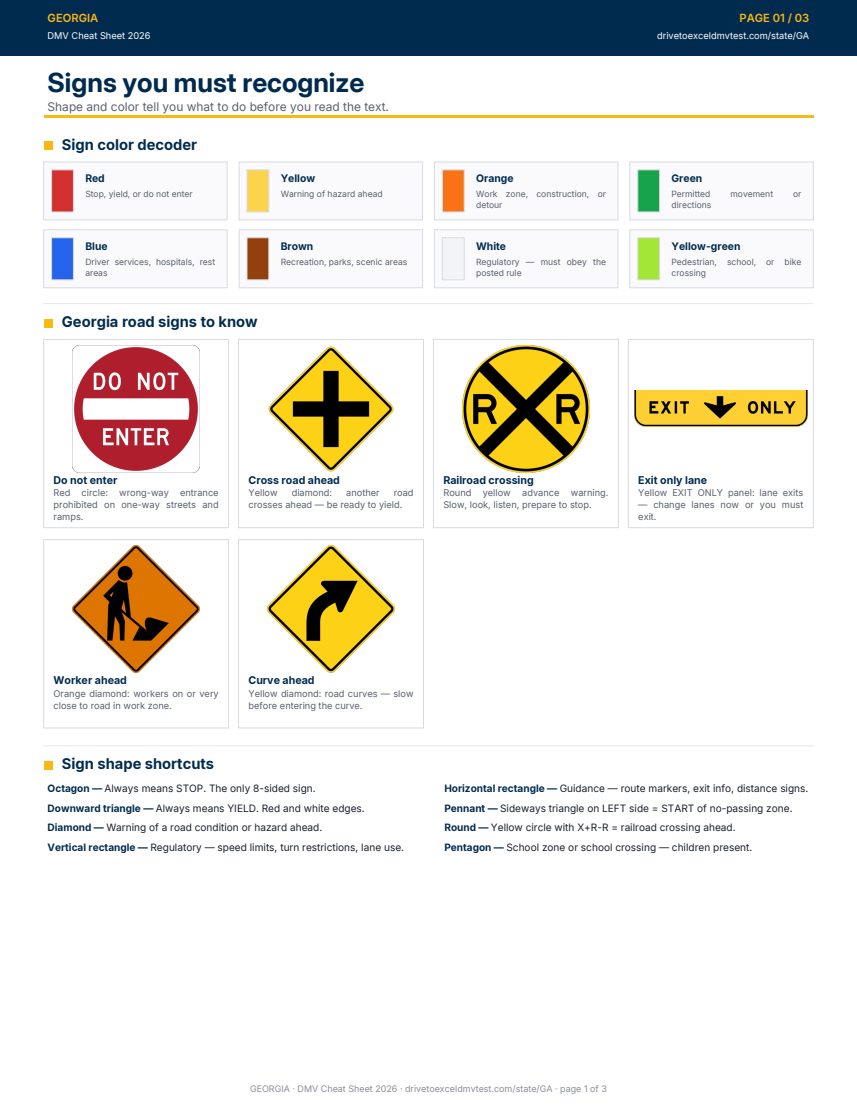
The 3-page PDF below is built to be printed and re-read the morning of your test. Use the Download button to save a copy.
2. Full Georgia study guide
The long-form companion to the cheat sheet: the rules, road signs and key numbers for the knowledge test, explained in plain English.
Georgia DDS-style practice questions, the 2026 passing rules, and a 40-question practice exam you can take right now — no signup, no paywall.
01What you're walking into
The Georgia DDS knowledge test is the gateway between you and a learner's permit. The official study source is the Georgia Department of Driver Services Drivers' Manual. Georgia's test is split into two independent scored sections, and you have to pass both.
- Test structure — two independent sections40 questions total: a 20-question Road Rules section and a 20-question Road Signs section. You must score at least 15 out of 20 (75%) on EACH section independently. Passing one section but not the other means you fail the entire exam.
- Passing score15 of 20 correct on Road Rules AND 15 of 20 correct on Road Signs. You can miss up to 5 per section — but your margin is tight.
- Application fee$10 for a Class CP learner's permit. The permit is valid for 2 years from the date of issuance.
- Bring with youProof of identity, Social Security number, and Georgia residency. Visit a DDS Customer Service Center; the vision test and photo are done in person.
- Under 18? Joshua's Law appliesIf you are 16 or 17, you must complete a DDS-approved 30-hour Driver's Education course before applying for a Class D license. Complete driver ed before you get comfortable behind the wheel — the clock only starts after you hold the permit.
- Why the two-section format mattersGeorgia separates signs and rules — a student who knows the laws cold but blanks on sign shapes can still fail. Give road signs dedicated study time, not just a quick pass.
02What to study
Traffic laws, road signs, and safety make up a large part of the Georgia handbook. Drilling sign shapes and colors first is a smart use of your study time before your test date.
- Road signsSign shapes, colors, and pavement markings. Yellow diamond = warning ahead. Rectangular = regulatory (speed limit). Green with white letters = guide/destination. Orange = work zone. Round yellow = railroad crossing advance warning.
- Right-of-way rulesAt an uncontrolled intersection, yield to the vehicle on your right. When turning left, yield to all oncoming traffic regardless of their speed. Already in a roundabout? You have the right-of-way over entering traffic.
- Signal distanceSignal continuously for an adequate distance before any turn so other drivers have time to react — even if the road appears empty. Georgia law requires a turn signal whenever you turn right or left.
- Railroad crossing stop distanceWhen a train is approaching, your stopping spot should be 15 to 50 feet short of the closest rail. Do not stop on the tracks themselves; wait until you can clear them completely before you go.
- Following distanceUse the 2-second rule: when the vehicle ahead passes a fixed point, you should not reach that same point for at least 2 seconds. Increase the gap in rain, fog, or heavy traffic.
- Speed limitsPosted limits are the maximum under ideal conditions — not a target. Rural interstates: 70 mph. Urban interstates: 65 mph. Adjust down for weather, traffic, and curves.
- Drugs and alcohol — impairmentImpairment begins at a BAC as low as 0.02% — reaction time and coordination are already degraded before you reach the legal limit. Only time reduces the effects of alcohol — coffee and cold showers do not work.
- Chemical test refusalIf an officer suspects DUI, refusing a blood or urine test results in your driving privilege being taken away. Refusal is not an escape route.
- First DUI penaltiesA first conviction in Georgia can bring jail time (up to 12 months), a fine, community service, and license suspension — all together.
03Easy mistakes to avoid
These are rules that are easy to mix up on the Georgia DDS test. The two-section format means a weakness in any one area can end your test even if you're strong everywhere else.
- Three-car right-of-way scenariosAt an uncontrolled intersection, if two vehicles get there together, the driver on the left yields and the one on the right goes first. A roundabout is different: traffic already inside has priority over vehicles entering.
- School bus rules — divided highway exceptionWhen a school bus's red lights are flashing, you may NOT pass in either direction on undivided roads. On a divided highway, traffic on the OPPOSITE side is not required to stop. Know which situation you're in.
- Hill parking — uphill with a curbTurn wheels AWAY from the curb so the curb acts as a stopper if the brakes release.
- Hill parking — downhill, or no curbTurn wheels TOWARD the road edge (toward the curb if present, toward the shoulder if not) so the car rolls away from the travel lane.
- Impairment vs. the legal limitThe legal limit is not a safety threshold — impairment starts at 0.02% BAC, below the adult legal limit. Know the difference: answering '0.08%' to 'when does impairment begin' is wrong.
- 'Always' and 'never' optionsBe careful with absolutes — but in Georgia some are genuine. You must ALWAYS signal before a turn. You may NEVER drive on parking lights only. Read the full explanation, not just the option text.
- Bicycle passingWhen passing a bicyclist, leave at least 3 feet of space. If you can, change to a lane that is not next to the bicyclist; if you can't, slow down before you pass.
04How to prepare (the 3-loop method)
Reading the handbook once may not be enough. Try three loops: read once, drill once, listen once.
- Loop 1 — read the handbookDownload the Georgia Department of Driver Services Drivers' Manual free from dds.georgia.gov. Read it once — don't try to memorize. Pay extra attention to the sign chart and the GDL rules section.
- Loop 2 — drill the practice examsTake the free 40-Q exam below cold. Anything under 30/40 → note the categories you missed and retake. We have multiple distinct exams for Georgia — plenty to expose your weak spots before test day.
- Loop 3 — listen along on YouTubePlay the Georgia Cheat Sheet video the day or two before your test. Hearing the key facts out loud can help them stick.
- Sleep beats crammingMemory consolidates overnight. A full sleep the night before is worth more than two extra hours of late-night reading.
- Study signs visuallyNever read sign descriptions in text only. Look at the actual shape and color. The Road Signs section shows you the sign image — knowing that a pentagon means school zone beats reading 'school zone signs are pentagon-shaped' five times.
- Read every option before pickingRead every option before you answer. Don't stop at the first one that looks right. If 'All of the above' is offered, check that every option fits before you choose it.
05After you pass
Passing the knowledge test gets you a Class CP learner's permit — not a license. Georgia's graduated driver licensing (GDL) rules are strict, especially the first 6 months, and violations can extend your restricted phase.
- Permit supervisionYou must be supervised by a driver at least 21 years old with an unexpired Class C license, sitting next to you and capable of taking control of the vehicle. No solo driving — ever, on a permit.
- Minimum hold timeYou must hold the learner's permit for at least 12 months and 1 day before applying for a Class D license. No shortcuts — the clock starts the day the permit is issued.
- Supervised practice hoursAt least 40 hours total, including a minimum of 6 hours at night. Log them accurately — DDS expects the hours before issuing a Class D license.
- Night curfew (Class D)As long as you hold a Class D license, you may not drive between midnight and 5:00 a.m. There are no exceptions.
- Passenger restrictions — tieredFirst 6 months: zero non-family passengers allowed. Months 7–12: no more than 1 non-family passenger under 21. After 12 months from Class D issuance: up to 3 non-family passengers under 21 allowed.
- When restrictions liftPassenger limits ease in steps: for the first 6 months only immediate family may ride with you; for the next 6 months you may add one passenger under 21 who is not family; after 12 months, up to three. The midnight-to-5 a.m. curfew stays for as long as you hold a Class D license.
Lock it in — you've read it, now test yourself
Reading the Georgia handbook once is rarely enough to pass. A simple plan: go over the cheat sheet, take the free 40-question practice exams until the rules stick, then review anything you missed the night before.
Note: this is a study tool, not an official DDS resource. Always confirm requirements with your state's DMV before scheduling your test.