Florida DMV Cheat Sheet + Study Guide
Two free artifacts: the printable 3-page PDF cheat sheet and the full written study guide for the Florida permit test. Read both below, and download the PDF — no signup required.
1. Printable cheat sheet
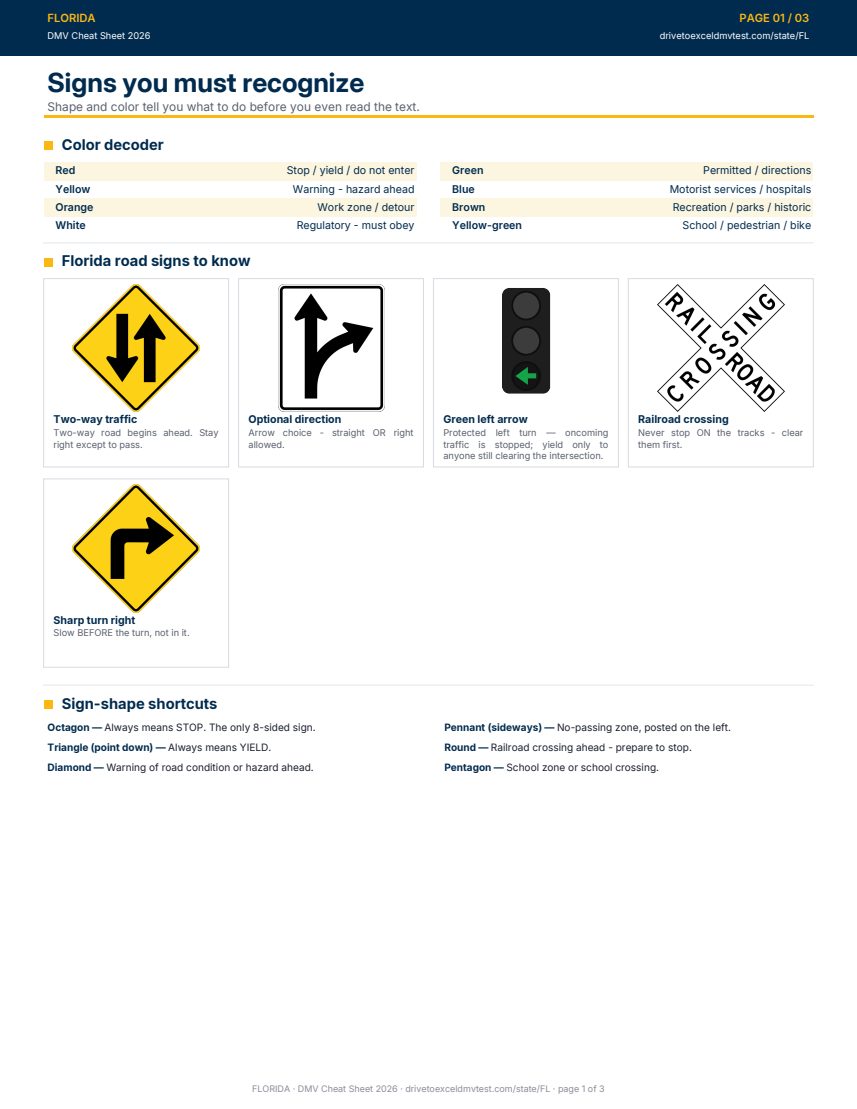
The 3-page PDF below is built to be printed and re-read the morning of your test. Use the Download button to save a copy.
2. Full Florida study guide
The long-form companion to the cheat sheet: the rules, road signs and key numbers for the knowledge test, explained in plain English.
Florida DHSMV-style practice questions, the 2026 passing rules, and a 40-question practice exam you can take right now — no signup, no paywall.
01What you're walking into
The Florida Class E knowledge exam is the gateway between you and a learner's license. Study from the official Florida Driver's Handbook. The exam covers Florida traffic laws, safe driving practices, and identifying traffic controls, with topics like school buses, work zones, and DUI among the rules.
- Class E exam (all ages)50 multiple-choice questions. Pass at 40 correct (80%). Florida uses the same exam for under-18 and adult applicants — no separate versions.
- Application fee$48.00 paid to the DHSMV (or your county Tax Collector's office) when you apply for the Class E learner's license. A $6.25 service fee may apply at tax collector offices.
- Driver-ed course is required firstApplicants under 18 who have never held a license must complete the 6-hour Driver Education Traffic Safety (DETS) course before applying — mandatory since Aug 1, 2025. Applicants 18+ complete the 4-hour Traffic Law and Substance Abuse Education (TLSAE) course instead.
- Bring with youProof of identity, residency, Social Security number, and your DETS or TLSAE completion certificate. Don't forget the certificate.
- You can take the exam online (under 18)Applicants under 18 can take the Class E knowledge exam online through a state-authorized provider. Online testing is not available to applicants 18 and older, who must test in person (at a service center or with an in-person third-party provider).
- Where to focus your studyKnow your traffic controls cold — color, shape, meaning. Also learn work zones, school-bus rules, the Move Over law, and DUI nuance. Memorize signs and signals and that part of the exam is under control.
02What to know for the test
Study the topics in the official Florida handbook. Signs, traffic laws (right-of-way, speed limits, school buses, railroad crossings), and DUI rules are good places to start.
- Road signsShapes, colors, route markers, work-zone orange diamonds, white regulatory rectangles, and the slow-moving-vehicle orange-red triangle. Diamond-shaped placards on trucks mean hazardous materials — those vehicles must stop before crossing railroad tracks.
- Signal distanceSignal continuously for the last 100 feet before any turn, and signal before every lane change too. Florida law requires the signal whenever another vehicle may be affected, so make it a habit every time — even if you don't see anyone around.
- Railroad crossingsStop within 50 feet of the nearest rail, but no closer than 15 feet, when warning signals are flashing. A flashing red light at a crossing requires a complete stop until lights stop flashing and no train is visible.
- Following distanceKeep a minimum 4-second following distance under normal weather and traffic conditions. Add a second per hazard (rain, fog, heavy load).
- BAC limit (21+)0.08% blood alcohol concentration. At or above this is driving under the influence.
- Under-21 BAC ruleZero tolerance — a BAC of 0.02% or higher means an automatic six-month license suspension for drivers under 21, even if you're nowhere near 0.08%.
- Commercial driver BAC0.04% — half the standard adult limit. Don't confuse this with the under-21 rule.
- Chemical test refusalRefusing a breath or blood test means your driver's license is suspended automatically — implied consent applies the moment you drive on a Florida road. Refusing is not an out.
- Speed limits (unless otherwise posted)20 mph in school zones. 30 mph in municipal, business, and residential areas. 55 mph on streets and highways. 70 mph on limited-access highways. School-zone fines are doubled and exceeding the limit by 50+ mph carries a $1,000 first-offense fine.
- Headlight rulesRequired from sunset to sunrise. Dim high beams within 500 feet of an oncoming vehicle, or within 300 feet behind a vehicle you're following (FL Stat. §316.238). High beams are most effective at speeds faster than 25 mph.
03Easy mistakes to avoid
These topics are easy to mix up. It's tempting to assume you know the signs because you see them daily, but the less common ones are easy to miss.
- School bus stop rules — divided vs undividedWhen a school bus has its red lights flashing on a two-way undivided highway, all traffic in BOTH directions must stop. Drivers going the opposite way may skip the stop only when a raised barrier or an unpaved median at least 5 feet wide divides the highway. An illegal pass carries a fine of at least $265, or $1,500 if it causes serious injury or death.
- Three-car right-of-way at uncontrolled intersections'Yield to the right' is the basic rule, but multi-car situations take more care. If a traffic light is out of order, treat it as a four-way stop. Funeral processions and emergency vehicles always get right-of-way.
- Move Over lawWhen passing an emergency vehicle, tow truck, sanitation truck, or utility vehicle stopped on the shoulder with lights flashing, vacate the lane closest to it on a multi-lane road. If you cannot move over safely, slow down to 20 mph below the posted limit. On a two-lane road, slow to 20 mph below the limit.
- Hill parking — downhill (or no curb)Turn your front wheels TOWARD the curb when facing downhill. With no curb, turn them toward the side of the road so the car rolls away from traffic if the brake fails.
- Hill parking — uphill with a curbTurn your front wheels AWAY from the curb when facing uphill — the curb itself becomes the stopper. This is the inverse of the downhill rule, so it is easy to swap them.
- BAC limit vs impairment0.08% is the legal limit, NOT the safety threshold. Impairment starts well below it — and any impairing drug (illegal, prescription, or over-the-counter) can earn you a DUI even if your BAC is zero.
- Absolute-language trapsAbsolute words like 'always' or 'never' deserve a second look. A real example is yielding at all times to a pedestrian who has a white cane or a guide dog. Read every option before you pick.
- Sign-shape confusionPennant-shape no-passing zones, five-sided school-zone signs, the orange-red slow-moving-vehicle triangle (under 25 mph), and round railroad advance-warning signs are easy to confuse. Learn each sign by its image, not just the words.
04How to prepare (the 3-loop method)
Reading the handbook once may not be enough. Try three loops: read once, drill once, listen once. That's it.
- Loop 1 — read the handbook (or this guide)Download the Florida Driver's Handbook free from flhsmv.gov. Read once, don't memorize. This guide compresses the key points — signs, BAC tiers, school-bus rules, hill parking — into bullets you can scan in 15 minutes.
- Loop 2 — drill the practice examsTake the free 40-question exam below cold. Anything under 32/40 → focus on the categories you missed and retake. We have multiple distinct practice exams for Florida, so you can retake after reviewing what you missed.
- Loop 3 — listen along on YouTubePlay our Florida Cheat Sheet video the day or two before your test. Hearing the key facts out loud is a good way to reinforce them.
- Sleep beats crammingMemory consolidates overnight. A full sleep the night before is worth more than two extra hours of late-night reading.
- Study signs visuallyNever learn signs in text only. On the road you see the sign, not a description — shape and color first, words second. Quiz yourself on the picture, not the description.
- Read every option before pickingRead every option before you answer. A wrong answer can look plausible until you compare it with the others and see that a later one is more precise.
05After you pass
Passing the Class E knowledge exam gets you a Florida learner's license — not a full license. The graduated driver license (GDL) rules kick in immediately and Florida runs them mostly through time-of-day curfews rather than passenger restrictions.
- Permit supervisionOn the learner's license you must ALWAYS be accompanied by a licensed driver age 21 or older, seated in the front passenger seat. No solo driving — ever — on the permit.
- Hold-time requirementYou must hold the learner's license for a minimum of 12 months OR until your 18th birthday, whichever comes first, before applying for the Class E road test.
- Supervised practice hoursAt least 50 hours total of supervised driving, 10 of which must be at night, before you can sit for the road test.
- Curfew once licensed at 1616-year-old Class E drivers may drive only between 6 a.m. and 11 p.m. Exceptions: driving to or from work, or with a licensed driver age 21+ in the vehicle.
- Curfew once licensed at 1717-year-old Class E drivers may drive only between 5 a.m. and 1 a.m. Same exceptions: work commute or a 21+ licensed adult in the vehicle.
- Passenger ruleFlorida does not impose a separate age-based passenger restriction on Class E drivers under 18 — the state controls teen-driver risk through the time-of-day curfews above instead.
- When restrictions liftAll GDL curfews lift at age 18. Violations can extend your restriction period or trigger points — accruing 24 or more points within a 36-month window suspends your license.
Lock it in — you've read it, now test yourself
Reading the Florida handbook once is rarely enough to pass. A simple plan: go over the cheat sheet, take the free 40-question practice exams until the rules stick, then review anything you missed the night before.
Note: this is a study tool, not an official DHSMV resource. Always confirm requirements with your state's DMV before scheduling your test.