Washington DC DMV Cheat Sheet + Study Guide
Two free artifacts: the printable 3-page PDF cheat sheet and the full written study guide for the Washington DC permit test. Read both below, and download the PDF — no signup required.
1. Printable cheat sheet
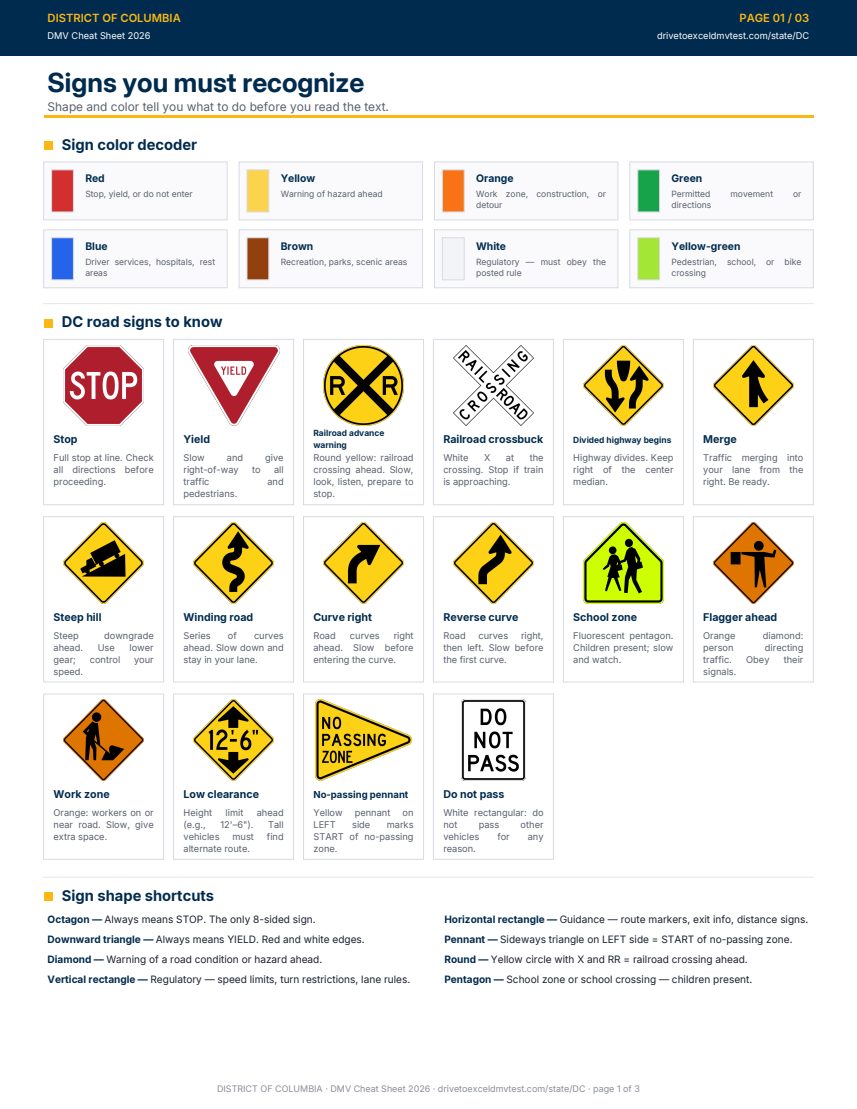
The 3-page PDF below is built to be printed and re-read the morning of your test. Use the Download button to save a copy.
2. Full Washington DC study guide
The long-form companion to the cheat sheet: the rules, road signs and key numbers for the knowledge test, explained in plain English.
Washington DC DMV-style practice questions, the 2026 passing rules, and a 40-question practice exam you can take right now — no signup, no paywall.
01What you're walking into
The DC DMV knowledge test is your gateway to a learner's permit — and it comes in two different versions depending on your age. Knowing the format before you walk in is a real advantage.
- GRAD program exam (ages 16–20)This is the test you take if you're between 16 and 20 and enrolling in DC's Graduated Driver Licensing (GRAD) program.
- Adult exam (age 21+)If you're 21 or older getting your first DC license, you take the standard adult test — not the GRAD version.
- Application fees$20 learner's permit fee + $10 knowledge test fee = $30 total due at the DC DMV office.
- Bring with youProof of identity, DC residency, and your Social Security number. The DC DMV requires these for a REAL ID credential — don't show up without all three. If you don't have a Social Security number, you may qualify for a Limited Purpose credential instead.
- Driver educationDriver-ed is NOT required in DC. The DC DMV explicitly states it is optional but recommended for first-time drivers. You can take the knowledge test without any formal course.
- What to know about the DC testTraffic laws and safety scenarios are central to the DC handbook. Don't over-study signs at the expense of right-of-way and speed rules.
02What to know for the test
Traffic laws, safety scenarios, and road signs are three major areas of the DC handbook. Signs alone won't be enough — you also need right-of-way, speed management, and impairment rules.
- Traffic lawsRight-of-way, turning, passing, lane changes, and school bus rules. The handbook covers traffic laws in detail.
- Safety scenariosHazardous conditions: fog, ice, fatigue, distracted driving, and emergency situations. These call for real decision-making, not just rule recitation.
- Road signsSign shapes, colors, and meanings. Diamond-shaped yellow signs are warnings; downward triangles mean yield; crossbuck signs indicate railroad crossings.
- Signal distanceUnder DC law, your turn signal must be on for at least the final 100 feet before any turn. The DC driver manual says to signal lane changes at least 300 feet ahead, and to signal before pulling away from a curb. Signal even when no one appears to be around.
- Railroad crossingsWith the lights flashing or the gate down, keep your vehicle at least 15 feet back from the closest rail. Under no circumstances should you drive around a gate that is lowering.
- Following distanceIncrease your following distance in rain, snow, or ice. Adjust based on conditions.
- BAC limit (21+)0.08% or higher is illegal. For drivers 21 and older, this is the hard legal line — at or above this BAC you are per se impaired in DC.
- Any alcohol matters under 21ANY amount of alcohol in the blood can impair judgment and physical coordination, even below the legal limit. Don't count on a safe cutoff — any alcohol affects you.
- Chemical test refusalRefusing a breathalyzer or blood test after an arrest means losing your privilege to drive in DC for 12 months (or being required to enroll in the ignition interlock program if you hold a DC license) under DC's implied consent law. Refusing is not a legal workaround — it's an automatic penalty.
- Speed managementUp to the posted limit, it is safest to drive at the average speed of traffic — not a few mph faster or slower than the flow. In school zones and residential areas, obey posted limits.
03Common mistakes that cost the test
These rules are easy to mix up if you only half-remember them. Look each one up and drill it before you go.
- Three-car right-of-way scenariosAt a four-way stop, yield to the car on your right when two vehicles arrive simultaneously. With three cars, the chain of 'yield to the right' still applies.
- School bus — stop and wait it outRed lights flashing on a school bus mean you stop and stay put until the flashing ends and the stop arm retracts. Children appearing to have boarded is not enough to go ahead. A bus on the far side of a divided highway (one with a physical median) is the exception, and you may proceed.
- Hill parking — downhillPoint the front wheels at the curb, or at the road's edge when there is no curb. That way, any roll takes the car away from traffic.
- Hill parking — uphill with a curbTurn your wheels AWAY from the curb. The curb catches the tire if the car rolls. This is the counterintuitive one — easy to mix up with downhill.
- Impairment starts before 0.08%0.08% is the legal threshold, not the point where impairment begins. Any alcohol can affect your judgment and coordination — impairment and illegality are two different bars.
- 'Always' and 'never' rulesSome rules genuinely are absolute — for example, you must ALWAYS signal even when no one is visible. Read every option. Don't auto-eliminate 'always' choices.
- Passing a bicyclistSlow down and give the cyclist as much space as possible. When making a right turn at an intersection, yield to any bicyclist traveling between you and the curb. Crowding a bike is dangerous.
04How to prepare (the 3-loop method)
Reading the handbook once may not be enough. Try three loops: read once, drill once, listen once. That's it.
- Loop 1 — read the handbookDownload the DC DMV Automobile Driver Manual free from dmv.dc.gov. Read it once — don't try to memorize. This guide compresses the key content into bullets so you can review faster.
- Loop 2 — drill the practice examsTake the free 40-Q exam below cold. Anything under 32/40 means drill the categories you missed and retake.
- Loop 3 — listen along on YouTubePlay the DC DMV traffic laws and road signs videos in the background the day before your test. Hearing questions out loud can help patterns stick.
- Sleep beats crammingMemory consolidates overnight. A full night's sleep before the test is worth more than two extra hours of late-night review.
- Study signs visuallyNever read sign descriptions in text only. Look at the actual shape and color, because signs are recognized by sight on the road. Diamond shapes, downward triangles, and crossbucks look different on paper than they sound.
- Read every option before pickingSeveral options can look plausible at first. If you stop at the first one that seems right, you may miss a better answer, so read every option before you choose.
05After you pass
Passing the knowledge test gets you a learner's permit — not a full license. DC's Graduated Driver Licensing (GRAD) program layers on restrictions as you move from learner permit to provisional license to a full license with conditions, and the program ends at 21. The rules are specific and worth knowing before you get behind the wheel.
- Learner permit — supervision requiredYou may only drive with a licensed driver 21 or older seated in the passenger seat. No exceptions. Solo driving on a learner's permit is illegal.
- Learner permit — hours of operationLearner permit holders may only drive between 6:00 am and 9:00 pm. No nighttime driving at all on the learner permit — not with supervision, not ever.
- Provisional license — weeknight curfew (Sep–Jun)Sunday through Thursday: you must be off the road by 10:59 pm. This is the school-year weeknight rule.
- Provisional license — weekend curfew (Sep–Jun)Friday and Saturday: you may drive until 11:59 pm. One hour later than weeknights.
- Summer curfew (Jul–Aug)Every day in July and August: drive until 11:59 pm. The weekend rule applies all week during summer months.
- Passenger restrictionProvisional license holders may carry only one licensed driver age 21 or older, seated beside you, plus passengers who are your siblings or parents. The limit of no more than 2 passengers under age 21 (siblings excepted) applies to the full license with conditions for drivers under 18.
- When restrictions liftCurfew and passenger restrictions end for a full license with conditions when you turn 18; provisional license restrictions stay until you move up to that license. The GRAD program ends when you turn 21 — at that point you are released from the graduated system.
Lock it in — you've read it, now test yourself
Reading the Washington DC handbook once is rarely enough to pass. A simple plan: go over the cheat sheet, take the free 40-question practice exams until the rules stick, then review anything you missed the night before.
Note: this is a study tool, not an official DMV resource. Always confirm requirements with your state's DMV before scheduling your test.