Connecticut DMV Cheat Sheet + Study Guide
Two free artifacts: the printable 3-page PDF cheat sheet and the full written study guide for the Connecticut permit test. Read both below, and download the PDF — no signup required.
1. Printable cheat sheet
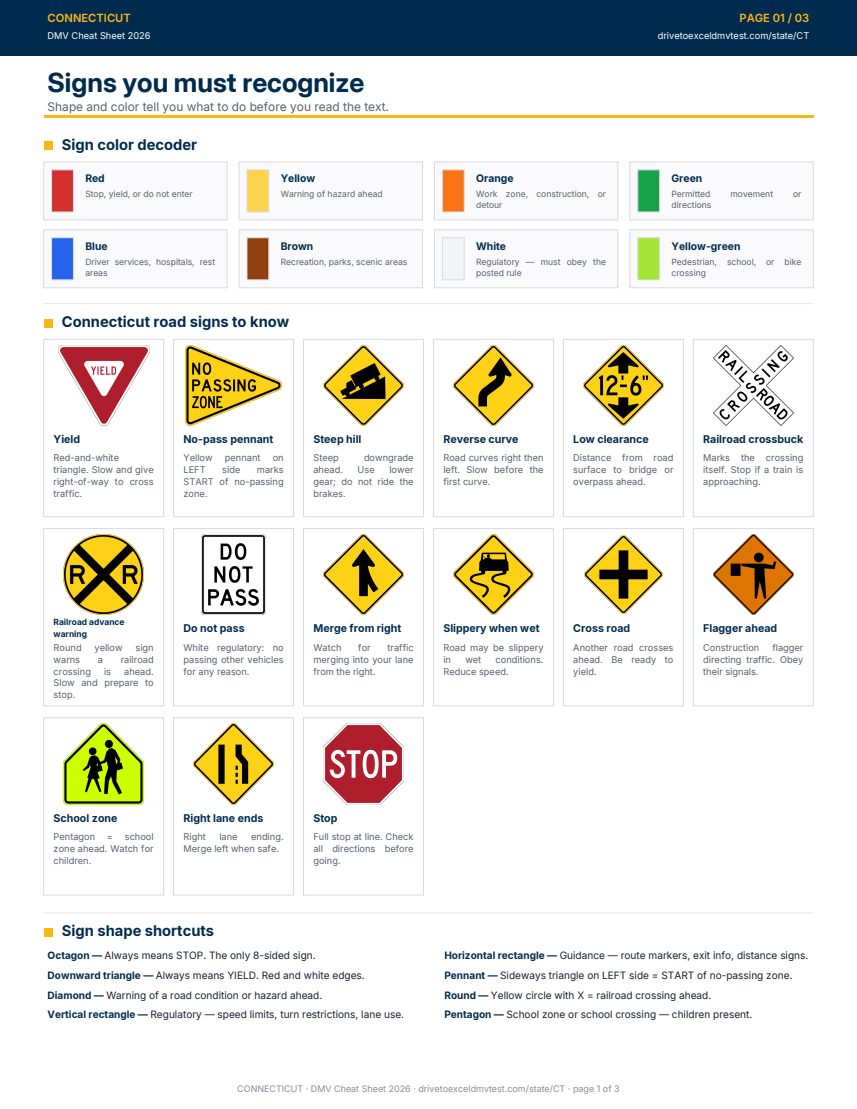
The 3-page PDF below is built to be printed and re-read the morning of your test. Use the Download button to save a copy.
2. Full Connecticut study guide
The long-form companion to the cheat sheet: the rules, road signs and key numbers for the knowledge test, explained in plain English.
Connecticut DMV-style practice questions, the 2026 passing rules, and a 40-question practice exam you can take right now — no signup, no paywall.
01What you're walking into
The Connecticut DMV knowledge test is the gateway between you and a learner's permit. Study the Connecticut Driver's Manual, and know the format and key rules before you walk in — it is a real advantage.
- Under-18 exam25 questions. Pass with 20 correct (80%). Same passing threshold as the adult test.
- Adult exam25 questions. Pass with 20 correct (80%). Connecticut uses the same 25-question format for all applicants.
- Application fee$19 for a learner's permit (Class D), plus a $40 testing fee. Both are paid online when you schedule your test appointment.
- Bring with youProof of identity and Connecticut residency. Check the DMV's current REAL ID document list if you'll also be updating your ID.
- Under 18? Driver ed is required.Connecticut requires applicants age 16 or 17 to complete driver training (a driving school, a high-school program, or home training plus an 8-hour safe driving course) before the road test. The training certificate is required at the road test, not to get the permit.
- Where to focus your studyRight-of-way sequences, school bus rules, and precise curfew/passenger language are easy to mix up. Don't coast on sign knowledge alone.
- 15-minute cheat sheetThe printable Connecticut cheat sheet on this page distills the key rules into a single reference. Print it and read it the night before.
02What to know for the test
Traffic laws, road signs, and vehicle rules are all covered in the Connecticut handbook. Traffic laws make up a large part of it, so right-of-way, school bus, and turning rules are a key study area.
- Road signs & signalsSign shapes, colors, and meanings. Orange backgrounds = construction/maintenance. Pentagonal signs = school zone. A flashing red light is treated like a stop sign.
- Right-of-way & turningWhoever reaches an all-way stop first goes first, so yield to that driver. When two cars arrive simultaneously, the one on the right is entitled to go first, which means you go if the other driver is on your left. Before turning left, yield to every approaching vehicle.
- Signal distance — 100 feetBegin signaling at least 100 feet before any turn. Always signal, whether or not you see other drivers.
- Following distance — 3 to 4 secondsUse a 3–4 second rule for general following and specifically when following motorcyclists. Increase the gap in rain, fog, at night, or behind large vehicles.
- Railroad crossingsStop completely, well behind the gates, and wait for tracks to clear before crossing. Never drive around or under a crossing gate — it is always illegal.
- BAC limit — 21+ drivers: 0.08%Operating with a BAC of 0.08% or higher is illegal for drivers 21 and older.
- Under-21 BAC limit — 0.02%Under 21, it is illegal in Connecticut to drive with a BAC of 0.02% or higher, far below the 0.08% adult limit.
- Chemical test refusalRefuse a breath test on a first DUI arrest and your license is suspended for at least 45 days — plus a mandatory ignition interlock device upon reinstatement.
- Only time reduces BACCoffee, water, food, and fresh air do not lower BAC. Only time works.
03Common mistakes that cost the test
These rules are easy to mix up on a first attempt. Traffic laws are full of detail, so drill these patterns before you go.
- Multi-car right-of-way at uncontrolled intersectionsThree cars arrive at once: yield to the vehicle on your right. Two cars at a four-way stop: the one who arrived first goes. If you arrive at the same time as the car on your left, you have right-of-way. Know these scenarios.
- School bus rules — both directionsStop in both directions when a school bus is loading or unloading with red lights flashing — regardless of which way you're traveling. Exception: if you're on the opposite side of a physically divided highway (divided median), you don't have to stop. Stay stopped until the bus's red lights stop flashing.
- Hill parking — downhill (any road) or uphill without a curbAngle the front wheels right, toward the road's edge. Then if the brake fails, the car drifts onto the shoulder instead of into traffic.
- Hill parking — uphill WITH a curbTurn your wheels away from the curb. The curb acts as a blocker if the car rolls backward.
- Impairment vs. legal limit0.08% is where it becomes criminal — but impairment starts far below that. 'Illegal' and 'affects driving' are two different bars.
- Passenger restrictionsDuring your first 6 months with a license, only a parent, legal guardian, driving instructor, or qualified trainer can ride with you — no friends, no siblings, no other family. Months 7–12: immediate family only. This two-phase structure is easy to mix up.
- 'Always' and 'never' rulesAbsolute words need care, but some rules genuinely are absolute. Backing your vehicle is always dangerous. You may never drive around a railroad gate. Know which 'always/nevers' truly hold.
04How to prepare (the 3-loop method)
Reading the handbook once may not be enough. Try three loops: read once, drill once, listen once. That's it.
- Loop 1 — read the handbookDownload or pick up the Connecticut Driver's Manual from the DMV (portal.ct.gov/dmv). Read it once — don't memorize, just absorb. This guide compresses the key points into bullets.
- Loop 2 — drill the practice examsTake the free 40-Q exam on this page cold. Anything under 32/40 means drill the categories you missed, then retake it.
- Loop 3 — listen along on YouTubePlay a Connecticut DMV practice video the day before your test. Hearing questions and answers out loud can help them stick.
- Sleep beats crammingMemory consolidates overnight. A full night of sleep before the test is worth more than two extra hours of late-night reading.
- Study signs visuallyDon't just read sign descriptions — look at the actual shape, color, and symbol, because that is how you will recognize signs on the road. Orange = construction. Pentagon = school zone.
- Read every option before pickingSeveral options can look plausible at first. Read every option before you pick, even if the first one seems right — slow down.
05After you pass
Passing the knowledge test gets you a learner's permit — not a license. Connecticut's graduated driver licensing (GDL) rules include a two-phase passenger restriction that bars friends entirely for the first six months.
- Permit supervisor requirementYour supervisor must be a licensed driving instructor or a Qualified Trainer: at least 20 years old, licensed for 4+ years, with no suspension during those 4 years. Parents and legal guardians can serve if they meet that standard.
- Minimum permit hold time120 days if you completed driver ed through a commercial or secondary school. 180 days if you trained at home. Adults 18+ must hold the permit for at least 90 days.
- Supervised practice hours40 hours of behind-the-wheel practice driving are required, in any mix of driving-school and parent or trainer instruction. For the 120-day permit hold, at least 8 of those hours must be with a licensed driving school.
- Night driving curfew (until you turn 18)No driving between 11 p.m. and 5 a.m. until you turn 18. Exceptions: school, work, religious activities, and medical necessity.
- Passenger restriction — Phase 1 (first 6 months of license): family/instructor onlyOnly a parent, legal guardian, driving instructor, or qualified trainer (age 20+, 4+ years licensed) may ride with you. No friends. No other family members.
- Passenger restriction — Phase 2 (months 7–12 of license): immediate family onlyImmediate family members are now permitted as passengers. Friends and unrelated passengers are still prohibited until the 12-month mark.
- When restrictions endThe 11 p.m.–5 a.m. curfew lasts until you turn 18. The passenger limits end one year after your license is issued.
Lock it in — you've read it, now test yourself
Reading the Connecticut handbook once is rarely enough to pass. A simple plan: go over the cheat sheet, take the free 40-question practice exams until the rules stick, then review anything you missed the night before.
Note: this is a study tool, not an official DMV resource. Always confirm requirements with your state's DMV before scheduling your test.