Colorado DMV Cheat Sheet + Study Guide
Two free artifacts: the printable 3-page PDF cheat sheet and the full written study guide for the Colorado permit test. Read both below, and download the PDF — no signup required.
1. Printable cheat sheet
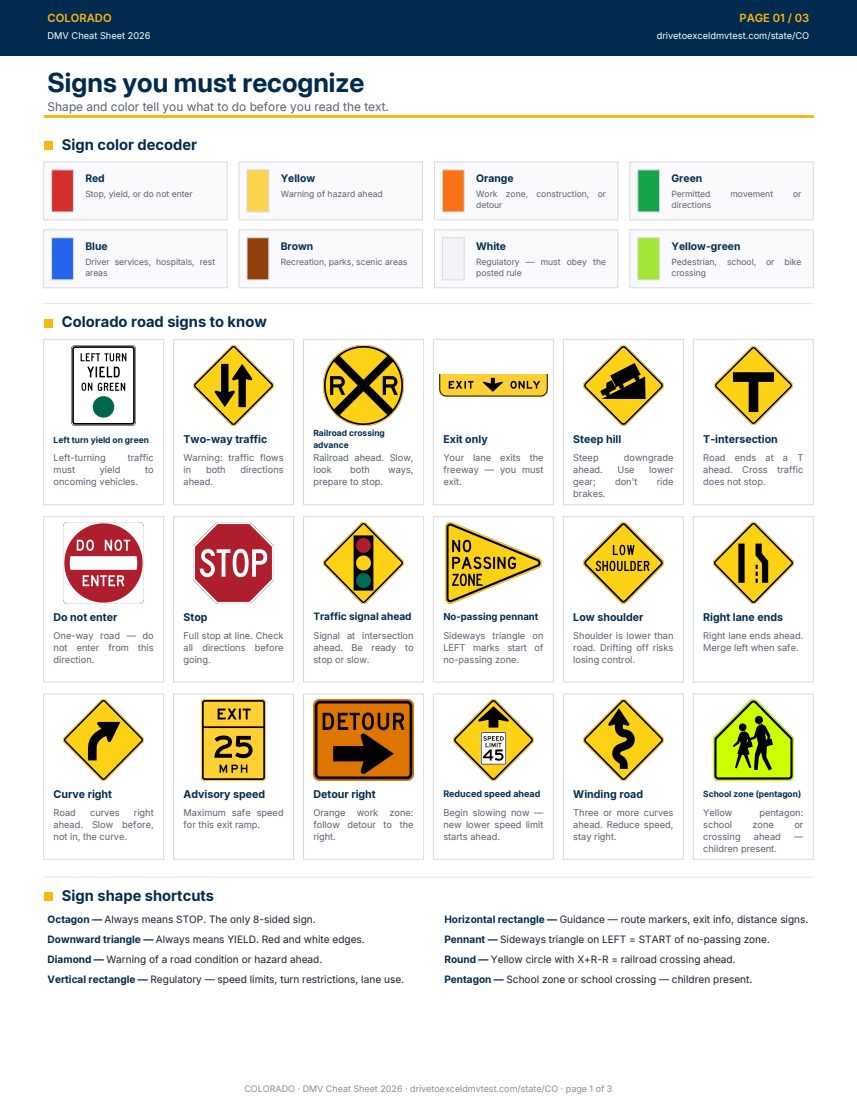
The 3-page PDF below is built to be printed and re-read the morning of your test. Use the Download button to save a copy.
2. Full Colorado study guide
The long-form companion to the cheat sheet: the rules, road signs and key numbers for the knowledge test, explained in plain English.
Colorado DMV-style practice questions, the 2026 passing rules, and a 40-question practice exam you can take right now — no signup, no paywall.
01What you're walking into
The Colorado DMV knowledge test is what stands between you and a learner's permit. The test is based on the Colorado Driver's Manual.
- Under-18 examYou need 80% correct to pass.
- Adult first-time examYou need 80% correct to pass.
- Application feeThe instruction permit fee is $20 (REAL ID) or $23 (standard credential). Pay at the DMV office when you apply.
- Bring with youProof of identity, Colorado residency, and your Social Security number. Schedule an appointment online to avoid waiting.
- Driver education depends on your ageAges 15 to 15½: complete a 30-hour driver education course. Ages 15½ to 16: complete either a 4-hour driver awareness program OR the 30-hour course. At 16+, no formal course is required before testing — but starting Jan. 1, 2027, ages 15–17 must complete the 30-hour course, and ages 18–20 may choose the 30-hour course or the 4-hour program.
- Colorado mountain and DUI rulesColorado sets specific speed rules for mountain and winding highways (20 mph on narrow, winding roads; 40 mph on open mountain highways). Its DUI rules also include a DWAI (Driving While Ability Impaired) tier.
02What to know for the test
The handbook covers traffic laws, safety, road signs and DUI rules in detail. Know these topics well.
- Road signs & signalsSign shapes, colors, meaning of flashing signals, and regulatory vs. warning vs. guide signs. A flashing yellow means proceed with caution; flashing red means full stop.
- Right-of-way & turningAt an uncontrolled intersection, yield to the vehicle on your right. At a four-way stop, the first vehicle to arrive goes first; if two arrive together, yield to the one on your right. When turning left, yield to all oncoming traffic. Emergency vehicles — pull right and stop.
- Signal distanceSignal for at least 100 feet before a turn in urban areas, and at least 200 feet on four-lane highways and other roads with limits over 40 mph. Colorado law requires a signal for every turn and lane change — it is not optional — and the Colorado Driver Handbook also sets these distances for lane changes on urban streets and four-lane highways.
- Railroad crossingsWhen you must stop for a train, stop at the marked stop line; if there is none, stop no closer than 15 feet and no farther than 50 feet from the nearest rail. Never drive around lowered gates — under no circumstances.
- Colorado speed limits20 mph on narrow, winding mountain highways. 40 mph on open mountain highways unless otherwise posted. Don't confuse them.
- BAC limit (21+) — DUI0.08% or higher is per se DUI. Above this level it is illegal to drive regardless of how you feel.
- DWAI tierA BAC above 0.05% but below 0.08% allows a court to infer DWAI — Driving While Ability Impaired — which carries criminal penalties. Don't skip this tier.
- Even small amounts impairEven the smallest amount of alcohol can limit concentration, perception, judgment, and memory. Impairment is a separate concept from the legal limit.
- Drugs and drivingPrescription drugs, over-the-counter drugs, and illegal drugs can all impair driving ability. Read drug labels before driving.
- Curb and hill parkingPark within 12 inches of the curb. On hills, turn wheels away from the curb when parking uphill; turn wheels toward the right when parking downhill.
03Easy-to-mix-up topics
These topics are easy to mix up. Knowing a rule in isolation is one thing; applying it when a second car or a specific road condition is added is another.
- Three-car right-of-way scenarios'Yield to the right' is easy to remember, but easy to misapply when three cars arrive at a four-way stop at the same time. Work through multi-car sequences: each car yields to the car on its right.
- School bus rulesWhen a school bus stops and its red lights are flashing, drivers going in both directions must stop at least 20 feet back. Don't assume the divided-road exception applies unless a median or other physical barrier separates your roadway from the bus.
- Hill parking — uphill with a curbTurn your front wheels away from the curb. The curb acts as a stopper if your brakes fail.
- Hill parking — downhillTurn your wheels to the right — toward the road edge — regardless of whether there is a curb. The car rolls away from traffic if the brake fails.
- Impairment vs. legal limit0.08% is the DUI threshold. Colorado also has DWAI at 0.05–0.07%, and impairment can start below any legal cutoff. Know that these are different things.
- 'Always' and 'never' answer options'Under no circumstances' is correct when the topic is driving around lowered railroad gates. Read carefully — absolutes are sometimes right when the safety rule is genuinely absolute.
- Bicycle passingOn a two-lane road without bike lanes, wait until there is no oncoming traffic before passing a cyclist. Give them sufficient space. Do not squeeze past.
04How to prepare (the 3-loop method)
Reading the handbook once may not be enough. Try three loops: read once, drill once, listen once.
- Loop 1 — read the handbookDownload the Colorado Driver's Manual free from dmv.colorado.gov. Read it once — don't memorize, just absorb. Pay extra attention to the mountain speed limits and the DWAI section.
- Loop 2 — drill the practice examsTake the free 40-Q exam on this page cold. Anything under 32/40 → focus on the categories you missed and retake. Drill the traffic laws.
- Loop 3 — listen along on YouTubePlay our Colorado full practice test the day before your test. It makes a useful last review. Our full test goes through practice questions in Q&A format.
- Sleep beats crammingMemory consolidates overnight. A full sleep the night before outperforms two extra hours of late-night reading. Stop studying by 10 pm.
- Study signs visuallyNever read sign descriptions in text only. Look at the actual shape and color — on the road you see the sign, not a written description.
- Read every option before pickingOn multiple-choice questions, the first option can look correct until you read the rest and find a more complete answer. Always read every choice.
05After you pass
Passing the knowledge test gets you a learner's permit — not a full license. Colorado's graduated driver licensing rules include a passenger restriction that is stricter in the first six months.
- Permit supervisionA licensed driver 21 or older must sit in the front passenger seat whenever you drive on a permit. No exceptions — solo driving on a permit is illegal.
- Permit hold timeYou must hold your permit for a full 12 months before taking the road test — OR until your 18th birthday, whichever comes FIRST. If you get your permit at 17½, you don't have to wait the full 12 months.
- Supervised practice hoursLog at least 50 total hours of supervised driving, including 10 hours at night, before applying for a license.
- Night-driving curfew (first year)During your first 12 months with a provisional license, no driving between midnight and 5:00 a.m. Plan around this — late-night drives require a licensed adult in the car.
- Passenger restriction — first 6 monthsDuring your first 6 months with a license, you may not carry passengers under 21 unless your parent, your guardian or another licensed adult 21 or older is in the vehicle. Immediate family members and medical emergencies are exceptions. Outside those exceptions this is a hard rule, not a guideline.
- Passenger restriction — months 7–12After 6 months, you may carry a maximum of one passenger under 21 (not counting immediate family) until you've held your license for a full year.
- When restrictions liftAll restrictions end at 12 months of licensure OR at age 18 — whichever comes FIRST. Full privileges are automatic at 18 even if you're still in your first year.
Lock it in — you've read it, now test yourself
Reading the Colorado handbook once is rarely enough to pass. A simple plan: go over the cheat sheet, take the free 40-question practice exams until the rules stick, then review anything you missed the night before.
Note: this is a study tool, not an official DMV resource. Always confirm requirements with your state's DMV before scheduling your test.