California DMV Cheat Sheet + Study Guide
Two free artifacts: the printable 3-page PDF cheat sheet and the full written study guide for the California permit test. Read both below, and download the PDF — no signup required.
1. Printable cheat sheet
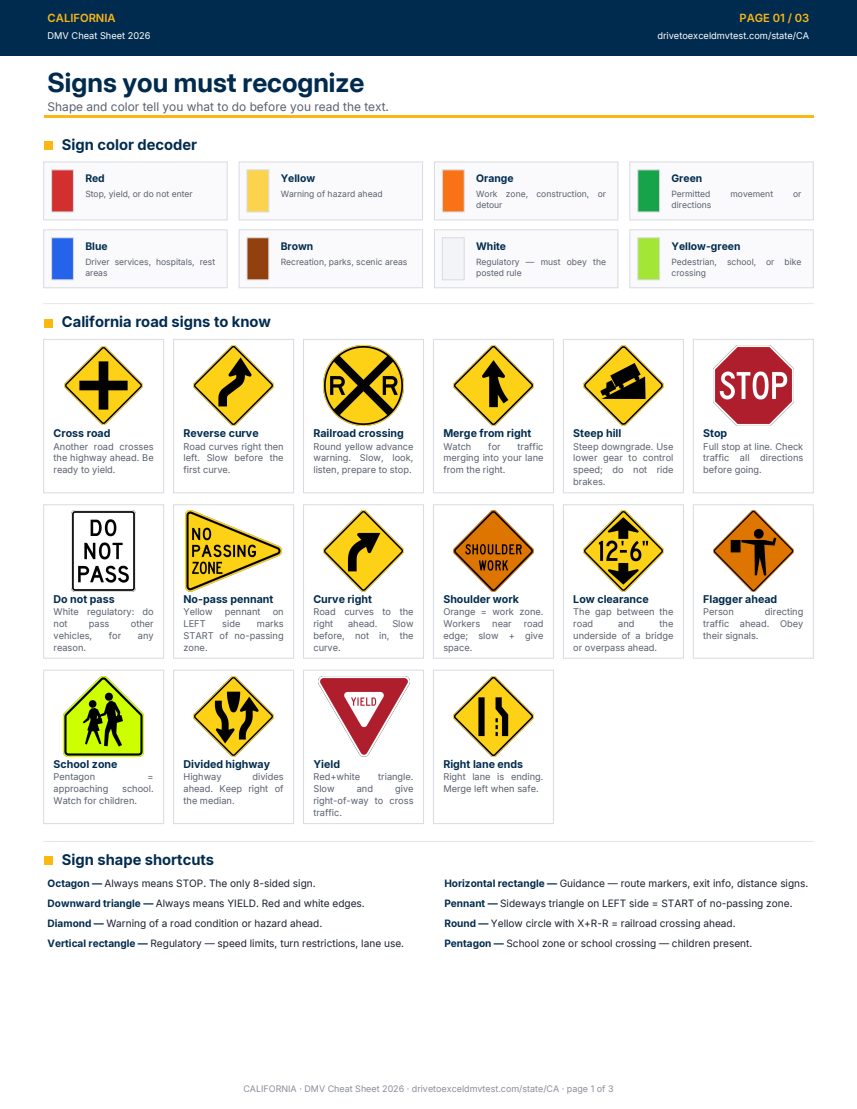
The 3-page PDF below is built to be printed and re-read the morning of your test. Use the Download button to save a copy.
2. Full California study guide
The long-form companion to the cheat sheet: the rules, road signs and key numbers for the knowledge test, explained in plain English.
California DMV-style practice questions, the 2026 passing rules, and a 40-question practice exam you can take right now — no signup, no paywall.
01What you're walking into
The California DMV knowledge test is the gateway between you and a learner's permit. The test is based on the California Driver's Handbook.
- Knowledge testMultiple-choice questions based on the handbook. The DMV's passing score is 80%.
- Application feePay the application fee (check dmv.ca.gov for the current amount). Create a MyDMV account and book an appointment at a field office.
- Bring with youProof of identity, residency, and your Social Security number. Walk-ins are accepted at some offices but expect a long wait.
- Under 17½?You must complete a DMV-approved driver education course before testing.
- What the handbook coversThe handbook covers a lot of ground — sign meanings, BAC rules, parking distances, school-bus laws, freeway etiquette.
02What to know for the test
These are the main topics in the official California handbook. Start with signs, right-of-way, and speed and lane use, then work through the rest.
- Road signs & signalsShapes, colors, route markers, work-zone orange diamonds, white regulatory rectangles. A flashing red light is treated like a stop sign.
- Right-of-way & turningFour-way stops, left turns across oncoming traffic, blind pedestrians with white canes or guide dogs (always yield), and emergency vehicles (pull right + stop).
- Signal distanceSignal at least 100 feet before any turn.
- Railroad crossingsStop at least 15 feet from the nearest rail.
- Following distance3 seconds under normal conditions. Allow more space in rain, snow, or fog.
- BAC limit (21+)0.08%. Anything at or above this is a DUI.
- Under-21 BAC ruleUnder 21, it is illegal in California to drive with a BAC of 0.01% or higher, far below the 0.08% adult limit.
- Chemical test refusalAutomatic 1-year license suspension. Refusing isn't an out.
- Prima facie speed limits25 mph in business/residential, 15 mph in alleys and at railroad crossings when you cannot see 400 ft down the tracks in both directions, 65 mph maximum on most highways.
03Easy-to-mix-up topics
These topics are easy to mix up. If you only have time to drill a few, drill these.
- Three-car right-of-way scenarios'Yield to the right' is easy to remember, but three cars at a four-way stop are easy to get wrong.
- School bus rulesStop in BOTH directions when red lights flash — unless the bus is on the other side of a divided or multilane highway (two or more lanes in each direction), in which case only same-direction traffic stops.
- Hill parking — downhill (or no curb)Turn wheels TOWARD the road edge so the car rolls away from traffic if the brake fails.
- Hill parking — uphill with a curbTurn wheels AWAY from the curb. The curb itself becomes the stopper.
- Impairment vs. legal limit0.08% is the legal BAC, NOT the safety threshold. Impairment starts well below it — know the difference.
- 'Always' / 'never' answer optionsRead these carefully. Absolutes are wrong when a rule has exceptions, but right when the topic is genuinely absolute (always yield to a blind pedestrian with a white cane).
- Bike lanes & sharing the roadWhen turning right across a bike lane, signal early and merge into the bike lane within the last 200 feet before the turn. Bicycles can also legally occupy the traffic lane in many situations.
04How to prepare (the 3-loop method)
Reading the handbook once may not be enough. Try three loops: read once, drill once, listen once.
- Loop 1 — read the handbook (or this guide)Download the California Driver's Handbook free from dmv.ca.gov. Read once, don't memorize. This guide compresses the key points into bullets.
- Loop 2 — drill the practice examsTake the free 40-Q exam below cold. Anything under 32/40 → focus on the categories you missed and retake. Then try the other free practice exams for CA.
- Loop 3 — listen along on YouTubePlay the CA Cheat Sheet video the day or two before your test. It makes a useful last review.
- Sleep beats crammingMemory consolidates overnight. A full sleep the night before is worth more than two extra hours of late-night reading.
- Study signs visuallyNever read sign descriptions in text only. Look at the actual shape and color — on the road you see the sign, not a written description.
- Read every option before pickingPractice questions include plausible wrong answers. The first option can look correct until you read the others and see that a later one is more precise.
05After you pass
Passing the knowledge test gets you a provisional instruction permit — not a full license. California's graduated-license rules kick in immediately and they're strict.
- Permit supervision (under 18)A California-licensed adult driver 25 or older must sit close enough to take control of the vehicle. No solo driving — ever, on a permit.
- Hold-time requirementMinimum 6 months before you can take the road test.
- Supervised practice hoursAt least 50 hours total, including 10 hours at night, before applying for the provisional license.
- Night-driving restriction (first 12 months)Can't drive between 11pm and 5am without a licensed adult 25+ in the car.
- Passenger restriction (first 12 months)Can't carry passengers under 20 unless a licensed adult 25+ is also in the car.
- Restrictions liftAfter 12 months with the provisional license OR turning 18 — whichever comes FIRST (CVC 12814.6). Break the rules and you can lose the license.
Lock it in — you've read it, now test yourself
Reading the California handbook once is rarely enough to pass. A simple plan: go over the cheat sheet, take the free 40-question practice exams until the rules stick, then review anything you missed the night before.
Note: this is a study tool, not an official DMV resource. Always confirm requirements with your state's DMV before scheduling your test.