Arizona DMV Cheat Sheet + Study Guide
Two free artifacts: the printable 3-page PDF cheat sheet and the full written study guide for the Arizona permit test. Read both below, and download the PDF — no signup required.
1. Printable cheat sheet
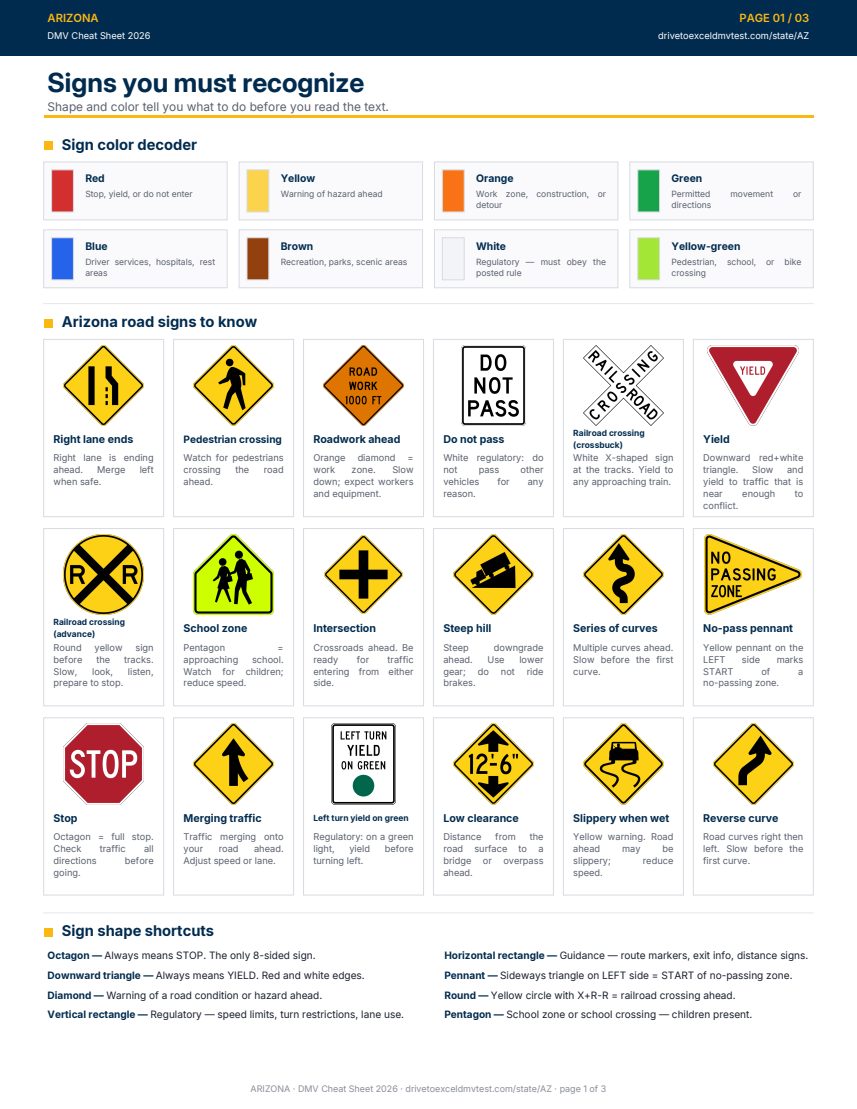
The 3-page PDF below is built to be printed and re-read the morning of your test. Use the Download button to save a copy.
2. Full Arizona study guide
The long-form companion to the cheat sheet: the rules, road signs and key numbers for the knowledge test, explained in plain English.
Arizona MVD-style practice questions, the 2026 passing rules, and a 40-question practice exam you can take right now — no signup, no paywall.
01What you're walking into
The Arizona MVD knowledge test is the gateway between you and a Class G instruction permit. The Arizona Driver License Manual is the official study reference. Adults take it on a touchscreen at an MVD office; teens can take the permit test at home and bring proof to the office to finish up.
- Test length30 multiple-choice questions covering road signs, road rules, and drugs/alcohol. Same length for under-18 and adult first-time applicants.
- Passing score24 of 30 correct (80%). You can miss up to 6 questions and still pass.
- Permit fee$7 for the Class G instruction permit. Bring documents to an MVD office; vision test and photo are done in person.
- Bring with youProof of identity, residency, and your Social Security number. Teens must have a parent or guardian present to sign approval.
- Minimum age15 years 6 months for the Class G graduated instruction permit.
- Driver education is optionalArizona does NOT require a formal driver education course to test. Completing an MVD-approved driver education program satisfies the supervised-practice requirement for the Class G license on its own, but it does not unlock testing earlier.
- Retake rulesThe application fee covers up to 3 attempts at the knowledge test; ask MVD about the current waiting time between attempts. Plan to study between attempts.
02What to study
The points below cover road signs, road rules, and drugs and alcohol. Signs and right-of-way rules are worth learning cold.
- Road signs & signalsRecognize shapes and colors before you read the text: octagon = STOP, downward triangle = YIELD, diamond = warning, pentagon = school zone, round yellow = railroad crossing ahead, pennant on the LEFT = start of no-passing zone. Watch for the slow-moving-vehicle triangle (orange with red border = vehicle going 25 mph or less).
- Right-of-way & turningFour-way stop: first to arrive goes first. Uncontrolled intersection with two cars arriving together: yield to the vehicle on your right. Left turn: yield to all oncoming traffic and any pedestrian in the crosswalk. Pedestrian with white cane or guide dog: stop until they are well away from your path.
- Signal distanceSignal at least 100 feet before beginning any turn. When entering a designated left-turn lane, signal before you arrive at the intersection — not after you are in the lane.
- Parking distancesAt least 15 feet from a fire hydrant. At least 50 feet from a railroad crossing. (Note: 50 feet is a parking distance from a crossing, not a stopping distance from the rail.)
- School zone speed15 mph when approaching a school crossing. The yellow-green pentagonal school-crossing sign means be ready to stop if children are in the crosswalk.
- School bus rulesStop before reaching a school bus that has its red lights flashing, whichever direction you are traveling. The one exception is a divided roadway (separated by a physical barrier, not just painted lines) when the bus is in the opposite lanes. Remain stopped until the bus moves ahead or its flashing lights and stop arm are no longer shown.
- Lane markingsSolid yellow on YOUR side = do not pass. Broken yellow on your side = pass when safe. Double solid yellow = no passing in either direction; cross only to turn left. Broken white between lanes = lane change allowed.
- BAC limitsAdult (21+): 0.08% is illegal per se. Under-21: ANY amount of alcohol can suspend your license — zero tolerance, not a numeric limit.
- Following distanceKnow how to adjust your following distance: increase it on slippery roads, at night, behind a motorcycle, and behind a large truck. When in doubt, leave more space.
- Emergency vehiclesEmergency vehicle approaching with its lights flashing: steer toward the right-hand edge of the roadway and stay stopped until it has gone by. If you are already in an intersection, continue through it, then pull over to the right and stop.
03Common mistakes that cost the test
These rules are easy to mix up. If you only have time to drill a few, start with these.
- Under-21 BAC: 'any amount,' not a numberArizona's under-21 rule is zero tolerance: any amount of alcohol, not a numeric limit like 0.01% or 0.02%. A number can sound reasonable, but it is not the Arizona rule.
- Railroad — parking vs. stopping distanceArizona's PARKING distance from a railroad crossing is 50 feet. Don't confuse it with a stopping distance from the rail, which is a separate rule. Parking closer than 50 feet to a railroad crossing is not allowed.
- Three-car right-of-way scenarios'Yield to the right' is easy to remember, but three cars at an uncontrolled intersection are harder to sort out. Re-read the rule: when arriving at the same time as a vehicle on your right, they go first.
- Hill parking — downhill, no curbTurn your front wheels to the RIGHT, toward the side of the road. If the brake fails, the car drifts away from traffic. Never leave wheels straight on a hill.
- Hill parking — parallel facing downhillTurn wheels sharply toward the side of the road. Same principle as above — the curb (or shoulder) catches the car if it rolls.
- Tire blowout: ease off the gas, don't brakeGrip the wheel tightly, keep the car straight, ease off the gas and let the car slow down until it is almost stopped. Do not apply the brakes; braking or pumping the brakes is the wrong response.
- Rules with no exceptionsSome rules really are absolute: always yield to a pedestrian with a white cane or guide dog; never pass on the right shoulder.
- Low beams in fog — not high beamsUse LOW beams in rain, fog, snow, and at dusk. High beams reflect off fog and rain back at you, reducing visibility.
04How to prepare (the 3-loop method)
A simple plan: read once, drill once, listen once. That's it.
- Loop 1 — read the manualDownload the Arizona Driver License Manual free from azdot.gov. Read once cover to cover; don't try to memorize. This guide compresses the key points into bullets.
- Loop 2 — drill the practice examsTake the free 40-question exam below cold. Anything under 32/40 → focus on the categories you missed and retake. Then work through the other free practice exams until you pass them comfortably.
- Loop 3 — listen along on YouTubePlay the Arizona Cheat Sheet video the day or two before your test. It makes a useful last review.
- Sleep beats crammingMemory consolidates overnight. A full sleep the night before your test is worth more than two extra hours of late-night reading.
- Study signs visuallyNever read sign descriptions in text only. Look at the actual shape and color — shape recognition is the fastest way to learn signs.
- Read every option before pickingRead every option before you commit. A wrong answer can look plausible until you compare it with the others and see that one is more precise.
05After you pass
Passing the knowledge test gets you a Class G instruction permit — not a full license. Arizona's graduated-license rules kick in immediately and stay strict for the first six months after you get your Class G license.
- Permit supervisionA licensed driver 21 or older must be in the front passenger seat any time you drive on your Class G instruction permit. No solo driving on a permit — ever.
- Hold-time requirementYou must hold the Class G permit for 6 months OR until you turn 18 — whichever comes first — before you can take the road test.
- Supervised practice hours — Option 1At least 30 hours of supervised driving practice, including at least 10 hours at night, before applying for the Class G license.
- Driver education alternativesComplete a driver education program approved by MVD (including approved high school programs) and the practice requirement is satisfied on its own. Or complete a defensive driving school or traffic survival school course plus 20 hours of supervised practice, including at least 6 at night, certified by a parent or guardian.
- Night-driving curfew (first 6 months)Can't drive between midnight and 5 a.m. unless a parent or legal guardian (with a Class A/B/C/D license) is in the front seat, OR you're driving directly to/from school, work, a sanctioned religious activity, or a family emergency.
- Passenger restriction (first 6 months)No more than 1 passenger under age 18 — unless those passengers are your siblings, or your parent/guardian is in the front seat.
- Restrictions liftAfter 6 months on your Class G license OR upon turning 18 — whichever comes FIRST (A.R.S. §28-3174). A driver who gets their license at 17 years 9 months is freed at 18, not at the 6-month mark. Break the rules and you can lose the license.
- Insurance is required at all timesArizona law requires liability insurance coverage on any registered vehicle, at all times. Carry proof. Driving without it is a major violation that can suspend your new license.
Lock it in — you've read it, now test yourself
Reading the Arizona handbook once is rarely enough to pass. A simple plan: go over the cheat sheet, take the free 40-question practice exams until the rules stick, then review anything you missed the night before.
Note: this is a study tool, not an official MVD resource. Always confirm requirements with your state's DMV before scheduling your test.