Arkansas DMV Cheat Sheet + Study Guide
Two free artifacts: the printable 3-page PDF cheat sheet and the full written study guide for the Arkansas permit test. Read both below, and download the PDF — no signup required.
1. Printable cheat sheet
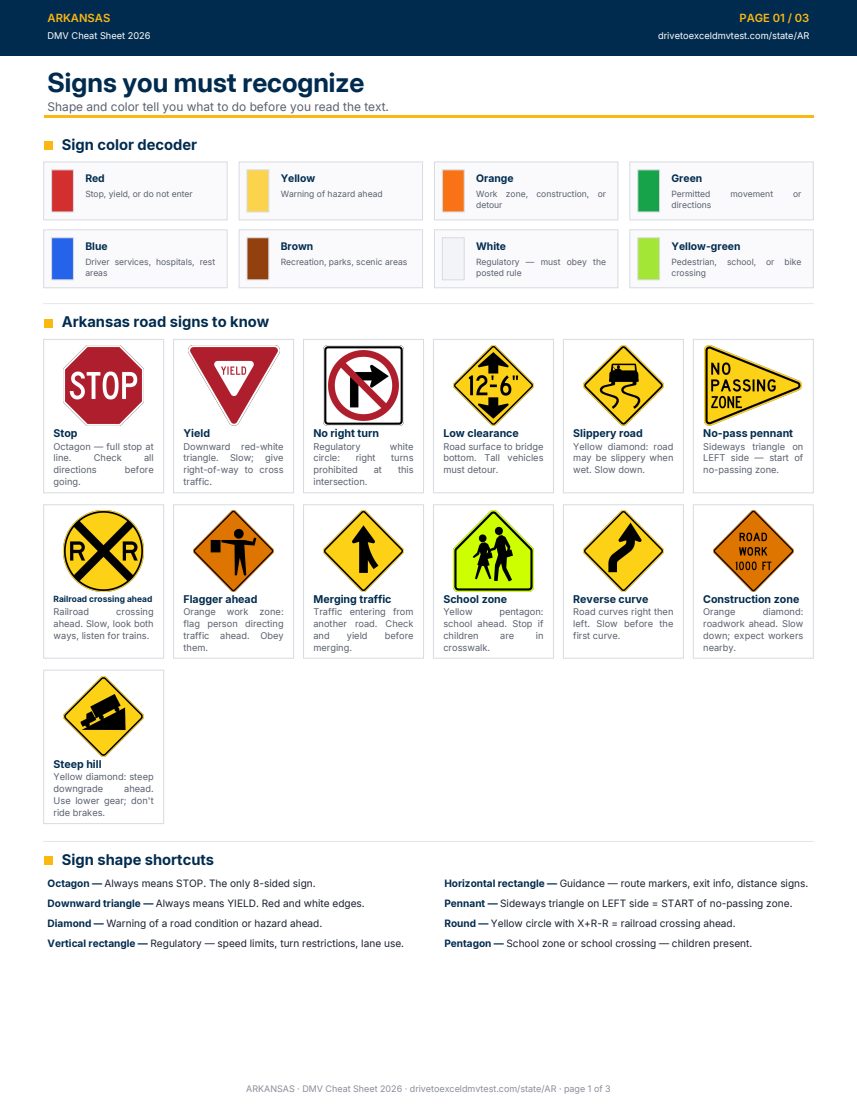
The 3-page PDF below is built to be printed and re-read the morning of your test. Use the Download button to save a copy.
2. Full Arkansas study guide
The long-form companion to the cheat sheet: the rules, road signs and key numbers for the knowledge test, explained in plain English.
Arkansas DFA-OMV-style practice questions, the 2026 passing rules, and a 40-question practice exam you can take right now — no signup, no paywall.
01What you're walking into
The Arkansas knowledge test is given by the Arkansas State Police (the license itself is issued afterward by the Department of Finance and Administration) and is the required step before you can hold a learner's permit. It's 25 questions for all applicants — teen or adult.
- Knowledge test (all ages)25 questions. You need 20 correct (80%) to pass. The same test format applies whether you're 16 or 36.
- Test and license feesThe knowledge test has a $5 exam fee per written exam. It is added to the cost of your license and collected by the Department of Finance and Administration. Learner's and intermediate license fees are prorated, so check with the DFA for the current amount.
- What to bringUnder 18: the original or certified U.S. birth certificate (a U.S. passport cannot replace it), plus a parent or legal guardian's signature or a completed ASP-33 form. Age 18 or older: two primary identity documents, or one primary plus one secondary. Check the Arkansas State Police ID checklists before you go; a missing document means a second trip.
- Driver educationNOT required by Arkansas law. Completing a driver's ed course is entirely optional. This is a genuine advantage: you don't have to wait for or pay for a class before testing.
- Why AR can still trip you upThe test is only 25 questions, so every miss costs 4 points. Six wrong answers and you're below 80%. Thin margins punish gaps in traffic law and road sign knowledge harder than longer tests do.
- Study guideThe official reference is the Arkansas Driver's License Study Guide, available free from the Arkansas State Police. This page compresses the key content into the sections below.
02What to study
The handbook covers traffic laws in detail. The points below cover traffic laws, safety, road signs, and drugs and alcohol.
- Road signsSign colors and shapes — orange diamonds for work zones, white rectangles for regulations, yellow for warnings. Flashing yellow: slow and proceed with caution. Flashing red: treat as a stop sign.
- Right-of-way and yieldingAt a yield sign, slow and give way to cross traffic close enough to be a hazard — you don't always have to stop, but you must yield. At a four-way stop, the first vehicle to arrive goes first; ties go to the driver on the right.
- Left-turn ruleDrivers turning left must yield to oncoming traffic. No exceptions unless a signal gives you a protected green arrow.
- Following distanceUse the 2-second rule under normal conditions. On slippery roads, increase that gap — there is no specific second count, but more than normal is required.
- Railroad crossingsIf crossing gates are lowered and lights flash, stop — do not go around or under the gate. After a train passes, wait for signal lights to stop flashing AND check for a second train before crossing.
- BAC limit (21 and older)0.08% or higher is illegal. At that level, DWI applies regardless of whether you feel impaired.
- Under-21 BAC ruleUnder 21, it is illegal in Arkansas to drive with a BAC of 0.02% or higher, far below the 0.08% adult limit.
- BAC of 0.02%Even at 0.02% — well below the legal limit — your driving can already be affected. Impairment begins before you're legally drunk.
- Chemical test refusalRefusing an alcohol test means you may lose your license. This is implied consent — by driving in Arkansas you have already agreed to submit.
- Speed limitsAlways obey posted limits. Maximum posted speed should only be driven under ideal conditions — not in rain, at night, or in heavy traffic.
03Common mistakes that cost the test
These rules are easy to mix up. Right-of-way edge cases, school bus rules, and hill parking are worth a second look, even if you think you already know the answers.
- Three-car right-of-way at four-way stops'Yield to the right' is easy to remember, but three cars arriving at once is harder to sort out. The rule is: first to arrive goes first; ties go to the driver on the right.
- School bus — stop in BOTH directionsWhen a school bus is stopped with red lights flashing and the stop arm extended, you must stop regardless of your direction of travel — unless you are on the other side of a median 20 feet or more wide. Slowing to 25 mph or changing lanes is not acceptable.
- Hill parking — downhill (any road)Turn wheels TOWARD the side of the road (right). If the brake fails, the car rolls away from traffic and into the curb.
- Hill parking — uphill WITH a curbTurn wheels AWAY from the curb. The curb catches the tire if the car rolls back.
- Impairment vs. the legal limitThe legal Arkansas BAC limit is 0.08%, but even a lower BAC can affect judgment and coordination. Being impaired is not the same as being 'over the limit.'
- Blind pedestrians — no exceptionsSome rules really are absolute. In Arkansas you must always give way to a pedestrian who uses a white cane or a guide dog, whatever the situation.
- Bicycle lane and sharing rulesBicycles on the road are legally treated as vehicles, not hazards. When a child is on a bicycle near your vehicle, expect the unexpected — not that they're in full control.
04How to prepare (the 3-loop method)
Use three loops: read the handbook once, drill the practice exams, then listen along on YouTube. With only 25 questions on the exam, there is little room for error.
- Loop 1 — read the handbookDownload the Arkansas Driver's License Study Guide free from the Arkansas State Police website (dps.arkansas.gov). Read it through once without trying to memorize. This guide highlights the key points in the sections above.
- Loop 2 — drill the practice examsTake the free 40-Q exam below cold. Review every wrong answer category, then retake the exam to drill the topics you missed.
- Loop 3 — listen along on YouTubeArkansas Traffic Laws and Road Signs videos are on the DriveToExcel YouTube channel. Play them in the background the day before your test. Hearing questions spoken out loud locks them faster than re-reading.
- Sleep beats crammingMemory consolidates overnight. A full night's sleep before your test is worth more than two extra hours of late-night studying.
- Study signs visuallyNever just read the description of a sign. Look at the actual shape, color, and symbol, because that is how you will recognize it on the road.
- Read every option before pickingRead every option before you answer. Don't stop at the first one that looks right.
05After you pass
Passing the knowledge test gets you a learner's permit — not a license. Arkansas's Graduated Driver Licensing (GDL) program has no mandated practice hours, but the six-month rule and intermediate restrictions still matter.
- Permit supervision ruleWhile on a learner's permit, you must be accompanied by a licensed driver who is at least 21 years old. No solo driving — ever, on a permit.
- Six-month ruleSupervised driving (a licensed driver 21 or older beside you) continues until 6 months after your permit was issued and you are at least 16 with the driving test passed. To be issued a learner's or intermediate license you must also have had no serious accident or serious traffic violation in the previous 6 months.
- Supervised practice hoursArkansas does NOT mandate a specific number of supervised hours, and there is no legal requirement to log or certify any hours. Still, practice with a licensed adult driver as much as you can before your skills test.
- Night driving curfew (intermediate license)Intermediate license holders (ages 16–17) cannot drive between 11:00 PM and 4:00 AM — unless accompanied by a licensed driver 21 or older, driving to or from a school activity, church activity or job, or driving because of an emergency.
- Passenger restriction (intermediate license)Cannot have more than one unrelated passenger under 21 in the vehicle (a sibling, step-sibling or child living in your household does not count) — unless accompanied by a licensed driver who is 21 or older in the front passenger seat.
- When restrictions liftAt 18, an intermediate license can be renewed as a regular, unrestricted license only if you had no serious accident or serious traffic violation in the 12 months before your 18th birthday. Otherwise it renews as another intermediate license for two years.
Lock it in — you've read it, now test yourself
Reading the Arkansas handbook once is rarely enough to pass. A simple plan: go over the cheat sheet, take the free 40-question practice exams until the rules stick, then review anything you missed the night before.
Note: this is a study tool, not an official DFA resource. Always confirm requirements with your state's DMV before scheduling your test.