Alaska DMV Cheat Sheet + Study Guide
Two free artifacts: the printable 3-page PDF cheat sheet and the full written study guide for the Alaska permit test. Read both below, and download the PDF — no signup required.
1. Printable cheat sheet
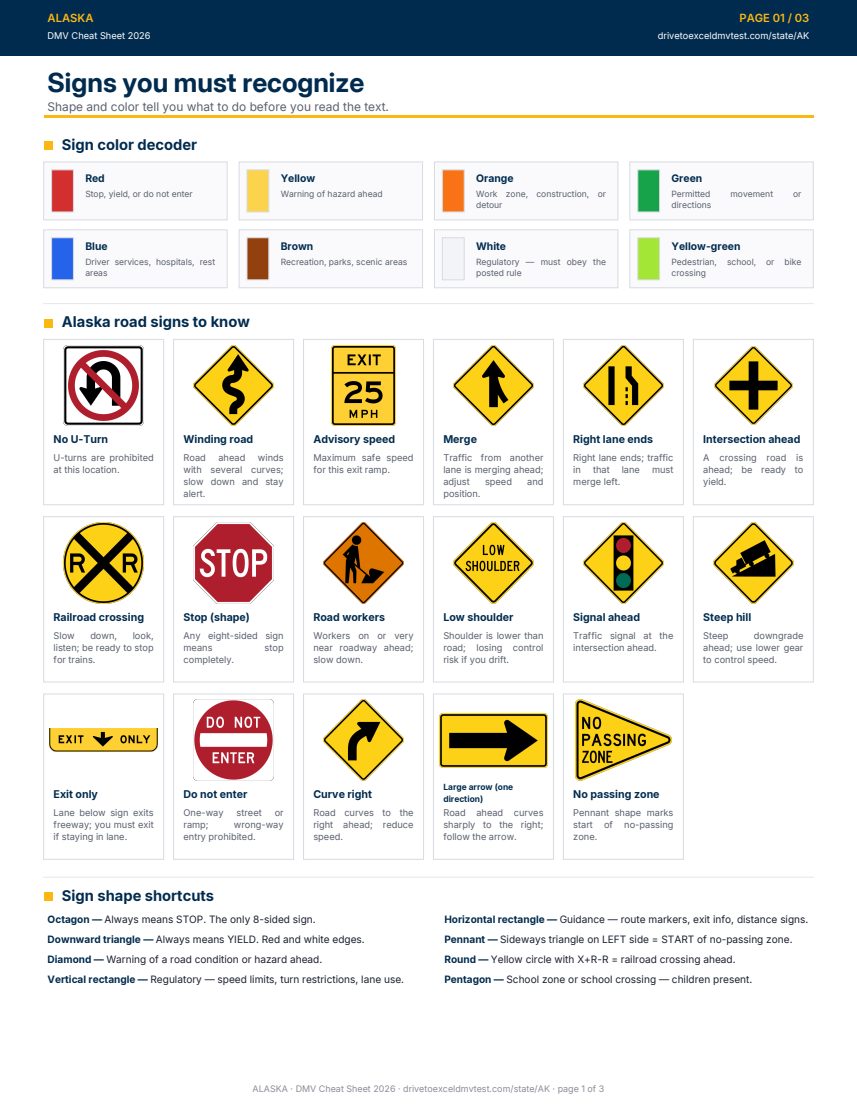
The 3-page PDF below is built to be printed and re-read the morning of your test. Use the Download button to save a copy.
2. Full Alaska study guide
The long-form companion to the cheat sheet: the rules, road signs and key numbers for the knowledge test, explained in plain English.
Alaska DMV-style practice questions, the 2026 passing rules, and a 40-question practice exam you can take right now — no signup, no paywall.
01What you're walking into
The Alaska DMV knowledge test is the gateway between you and a learner's permit. It's 20 questions, so every careless answer counts. If you fail, you can retake it the following day.
- Test length20 questions, 80% pass score — you must get at least 16 right. Miss 5 and you fail.
- One test for all agesSame 20-question test applies to first-time adult drivers and under-18 applicants — Alaska does not have a separate youth exam.
- Permit fee$15. Bring your Social Security number (the card itself isn't required), proof of Alaska residency (utility bill, lease), and proof of your date of birth and lawful presence, such as a birth certificate.
- Driver's educationDriver's education is NOT required by the state of Alaska — anyone who turns 14 can apply for a permit without completing a formal course.
- Minimum permit ageMinimum permit age is 14. High school freshmen can hold Alaska instruction permits.
- Study the handbookStudy the current AK Driver Manual, available free online at dmv.alaska.gov.
- Where to focusWith only 20 questions, every answer counts. Knowing road signs and traffic laws cold is a good way to work toward the 16 correct answers you need.
02What to study
Traffic laws, safety and road signs are a large part of the Alaska handbook. Get those three down first, then fill in the rest.
- Road signsPractice with the sign image itself — you need to know what a sign means, not just its name.
- Traffic lawsThe handbook covers traffic laws in detail. Right-of-way, turning rules, passing, and signals are the places to focus.
- Uncontrolled intersections and right-of-wayWhen two drivers arrive together, the one on your right goes ahead of you. At a four-way stop, whoever arrives first goes first, and if arrivals are simultaneous, you yield to the right.
- Signal distanceYou must signal at least 100 feet before turning, and signal before every lane change.
- Following distanceUse a four-second gap under ideal conditions, as the Alaska Driver Manual recommends (the legal minimum is two seconds), and increase it any time conditions are less than ideal.
- Railroad crossingsStop no closer than 15 feet from the nearest rail when signals are flashing.
- Speed limits55 mph on most Alaska roadways unless posted; 20 mph in school zones. Unless a different limit is posted, business districts are 20 mph, residential districts 25 mph, and alleys 15 mph.
- BAC limit0.08% or higher is per-se DUI — you are presumed impaired by law.
- Chemical test refusalRefusing a breath or blood test results in a DUI charge AND a separate Refusal charge, 10 points on your license, and license revocation — each treated as an independent criminal offense.
- DUI convictionA DUI conviction means your license is revoked for a minimum of 90 days.
- Bicycle passingSlow down, wait for a clear gap, then pass leaving plenty of space.
03Common mistakes that cost the test
These are patterns that are easy to mix up. On a short test like Alaska's, one wrong answer can swing a pass to a fail.
- Cars arriving togetherAt an uncontrolled intersection, when two cars arrive simultaneously, the car on the right goes first — not the car moving faster or the one whose driver honks.
- School bus, divided highwayIf a school bus is stopped with its lights flashing on the other side of a divided highway, you can keep driving. On an undivided two-lane road, you have to stop fully and wait for the flashing to end.
- Hill parking, facing downhillPoint your front wheels at the curb or shoulder, so that if the brakes fail the vehicle rolls away from traffic.
- Hill parking — uphill with curbTurn wheels away from the curb (to the left). If brakes fail, the curb catches the tire before the car enters traffic.
- Impairment vs. legal limitOnly time reduces BAC — not coffee, exercise, or cold showers. Feeling 'okay to drive' is not a legal defense once BAC hits 0.08%.
- 'Always' / 'never' ruleDon't dismiss answers with 'always' or 'never' automatically — read the whole question. Absolute rules like stopping for a loading school bus have exceptions, such as the opposite side of a divided highway.
- Bicycle passingHonking at a cyclist, driving in the bike lane, or rushing past are all wrong. Slow down, wait for a clear gap, and pass with room.
04How to prepare (the 3-loop method)
Reading alone is rarely enough. A simple routine works: read once, drill once, listen once. That's it.
- Loop 1 — Read the handbookWork through the current AK Driver Manual cover to cover. Pay extra attention to road sign shapes and colors and the numeric rules: 100 ft signal, 4-second follow, 15-ft railroad stop, 55 mph default.
- Loop 2 — Drill practice examsCycle through every free practice exam at least once. Track which categories you miss — right-of-way scenarios and DUI consequences are easy to mix up.
- Loop 3 — Listen along on YouTubeRun our Alaska DMV practice videos in the background while commuting or doing chores. Passive repetition helps the rules stick before test day.
- Sleep beats crammingA full night of sleep before the test is worth more than another hour of drilling at midnight. Memory consolidation happens during sleep.
- Study signs visuallyDrill signs by looking at the shape and color, not the label. You need to recognize what a sign means from sight, not just its name.
- Read every optionRead every option before you answer. A close-but-wrong option can sit right next to the correct one, so don't stop after the first two choices.
05After you pass
Passing the 20-question knowledge test gets you an instruction permit — not a license — and you must hold the permit for at least six months before the DMV can issue you a provisional license.
- Permit supervisorYour supervisor must be a licensed driver at least 21 years old with at least 1 year of experience in the type of vehicle you're driving, seated in the front passenger seat at all times.
- Permit minimum holdYou must hold the permit for a minimum of 6 months before the DMV can issue you a provisional license.
- Supervised hoursA parent, guardian, or employer must certify at least 40 hours of driving experience, including at least 10 hours in progressively challenging conditions such as night driving or bad weather.
- Night curfew (provisional)You may not drive between 1:00 AM and 5:00 AM unless accompanied by a licensed 21+ driver, or driving to/from employment.
- Passenger restrictionFor as long as you hold the provisional license (a minimum of six months, and up to age 18), you may not carry passengers under age 21, except your own siblings.
- When restrictions lift — FIRST to occur winsRestrictions end when you turn 18, or earlier if you go to the DMV and have them removed — whichever happens first. Removal is not automatic: you need six months on the provisional license with no traffic-law convictions (or alcohol/drug convictions) and a new parental consent. A 17-year-old with a clean record can shed restrictions before their 18th birthday.
Lock it in — you've read it, now test yourself
Reading the Alaska handbook once is rarely enough to pass. A simple plan: go over the cheat sheet, take the free 40-question practice exams until the rules stick, then review anything you missed the night before.
Note: this is a study tool, not an official DMV resource. Always confirm requirements with your state's DMV before scheduling your test.