Turning Rules Explained: Right Turns, Left Turns and Right on Red
These are about the path your car takes through a turn, not about who goes first. Where you start the turn and where you finish it are tested on the written exam and watched closely on the road test.
1. Turning Right
You are turning right at the intersection ahead.
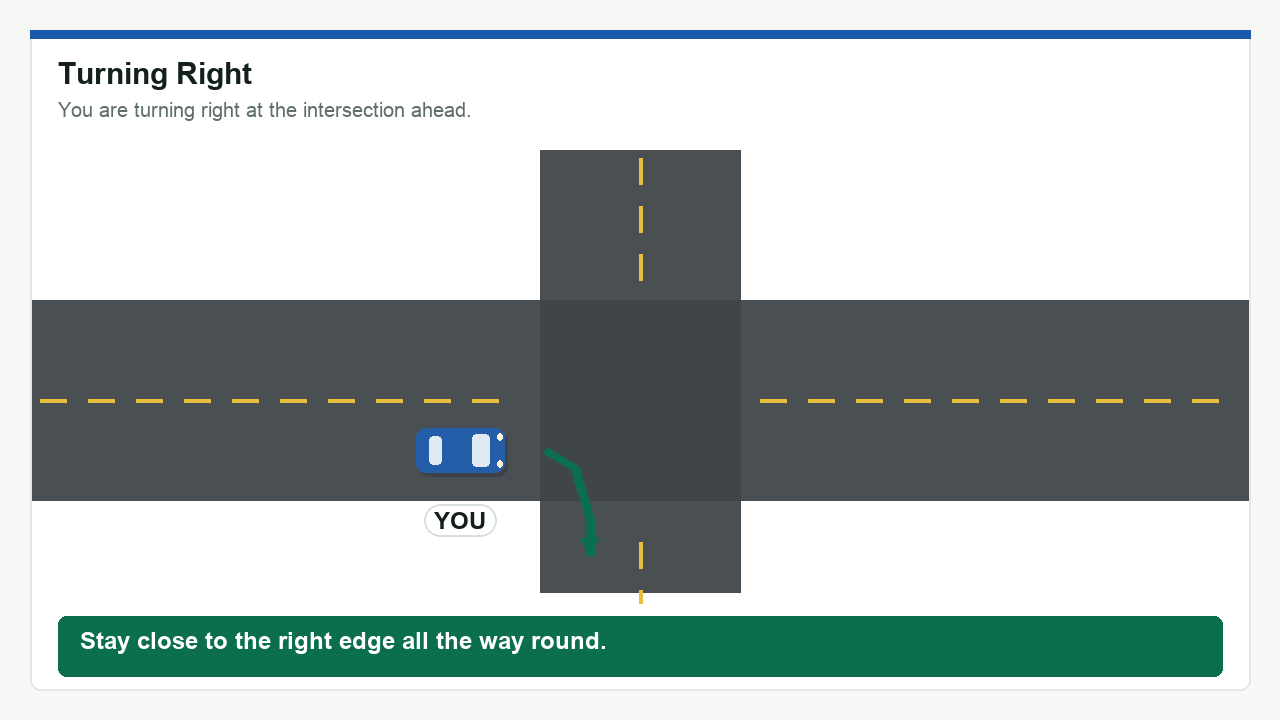
You are turning right at an intersection. Where should your vehicle be as you make the turn?
The rule
As close as practical to the right edge of the road.
Start the turn from as close to the right edge as is practical and stay close to it all the way round. Swinging left before turning right invites the driver behind to pass you on the right, exactly where you are about to go, and on a narrow street it puts your car into oncoming traffic.
Answers people get wrong
- In the middle of the road, to give yourself room.
- Swung out to the left first, then around.
- It does not matter as long as you signal.
2. Turning Left
You are turning left at the intersection ahead.
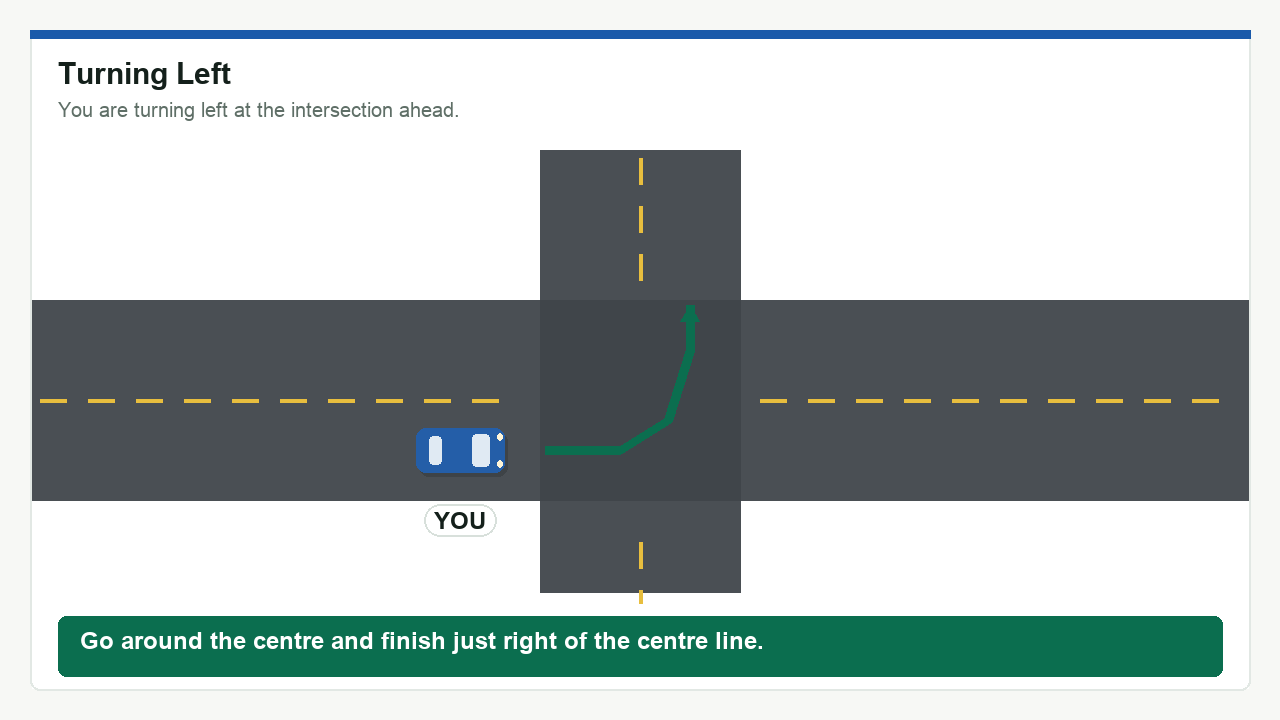
You are turning left at an intersection onto a two-way road. What is the correct path through the junction?
The rule
Go around the center of the intersection and finish in the lane just right of the center line.
Drive far enough into the intersection that you turn around its center, then finish in the lane immediately to the right of the center line of the road you are entering. Cutting the corner puts you into the oncoming lane of that road, which is where a driver waiting to turn out of it will not be looking.
Answers people get wrong
- Cut the corner to save time.
- Finish in whichever lane is emptiest.
- Finish in the far lane, then move over.
3. Right Turn on Red
The light is red and a crosswalk crosses your path.
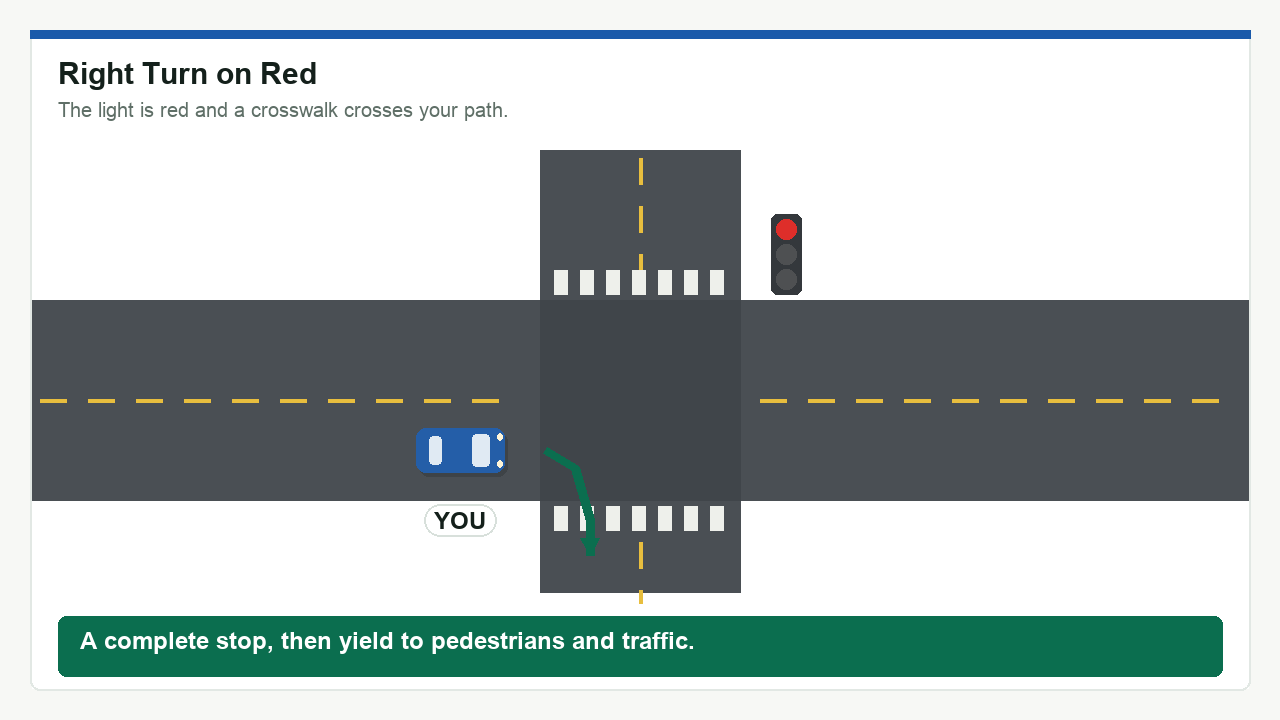
Where a right turn on a red light is permitted, what must you do before turning?
The rule
Come to a complete stop, then yield to pedestrians and cross traffic.
A right turn on red is a stop first, then a turn. Come to a complete stop behind the stop line, yield to anyone in the crosswalk and to traffic already in the intersection, and only then go. Rolling through is the most common way this is done wrong. Some states and many individual junctions forbid the turn entirely, so a NO TURN ON RED sign always wins.
Answers people get wrong
- Slow down and turn if the way looks clear.
- Turn immediately, since a red light does not apply to right turns.
- Wait for the light to turn green.
4. Turning Across Two Lanes
A car is coming the other way as you wait to turn left.
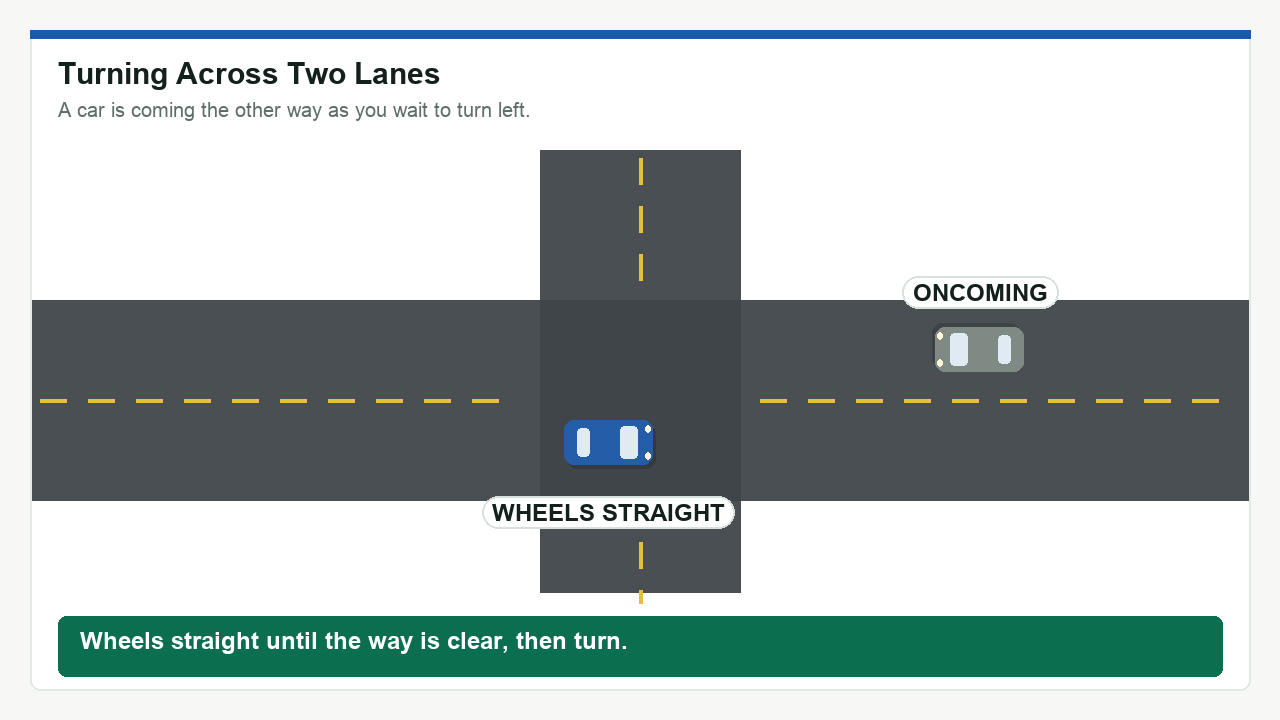
You are stopped inside the intersection waiting to turn left while an oncoming car goes through. How should your wheels be pointed?
The rule
Straight ahead until it is clear to turn.
Keep your wheels pointed straight ahead while you wait. If your wheels are already turned left and someone hits you from behind, you are pushed into the oncoming lane and into the traffic you were waiting for. Turn the wheel only once you have started moving.
Answers people get wrong
- Turned left, so you are ready to go.
- Turned slightly right to make the turn wider.
- It makes no difference.
Is this the same in every state?
The shape of a correct turn is the same everywhere. Whether right on red is allowed at a particular junction is not: it is allowed after a full stop in most places, but some cities ban it outright and any NO TURN ON RED sign overrides it.
See which rules are the same everywhere, and which ones differ
Prefer to watch? This guide as a video on YouTube.
Written by Drive To Excel DMV, an independent study site not affiliated with any state DMV. Always confirm requirements with your state's DMV.