School Buses, Move Over, Passing and Hill Parking — Explained with Diagrams
Four rules that learners often half-remember. Each one is drawn as a diagram so you can see where every vehicle is before you read the answer.
1. Stopped School Bus
Red lights flashing, stop arm out, on an undivided road.
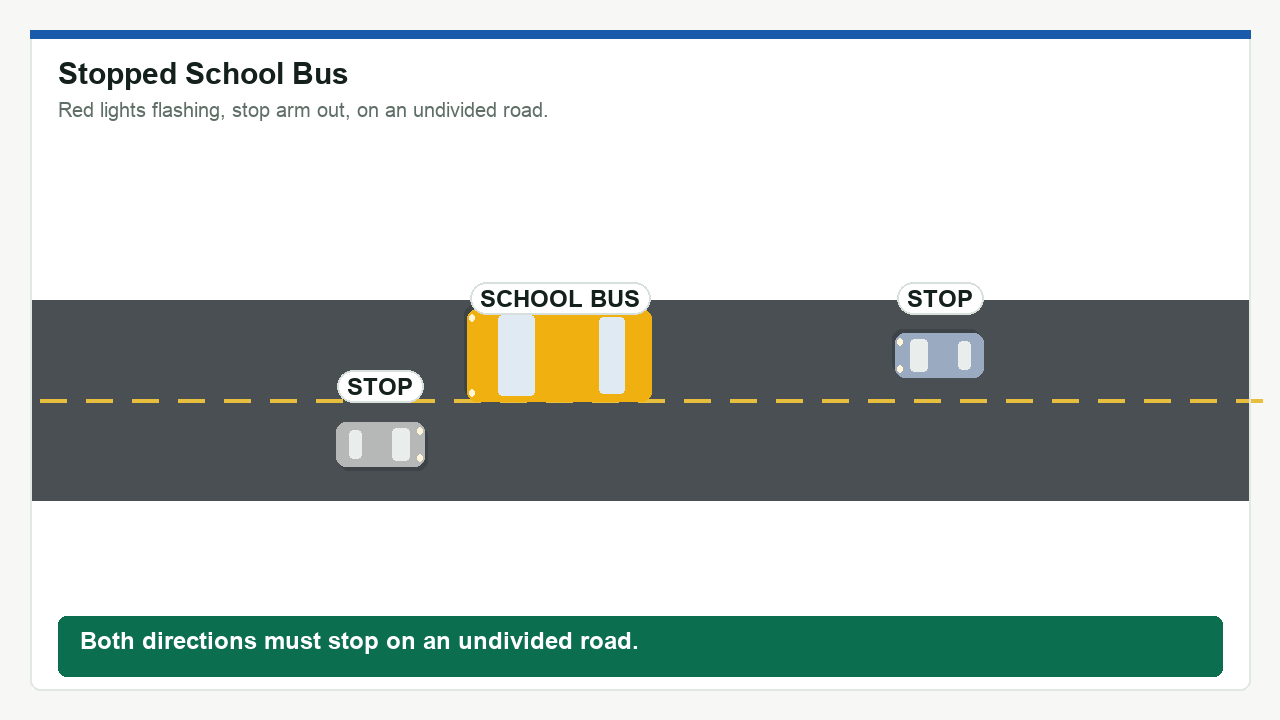
A school bus ahead has stopped with its red lights flashing and its stop arm out on an undivided road. Who must stop?
The rule
Traffic in both directions.
Flashing red lights and an extended stop arm mean children are getting on or off. On an undivided road, traffic in both directions must stop and stay stopped until the lights stop flashing and the arm folds away. Changing lanes does not make it safe.
Answers people get wrong
- Only traffic behind the bus.
- Only oncoming traffic.
- Nobody, if you pass slowly.
2. Move Over
An emergency vehicle is stopped on the shoulder, lights flashing.
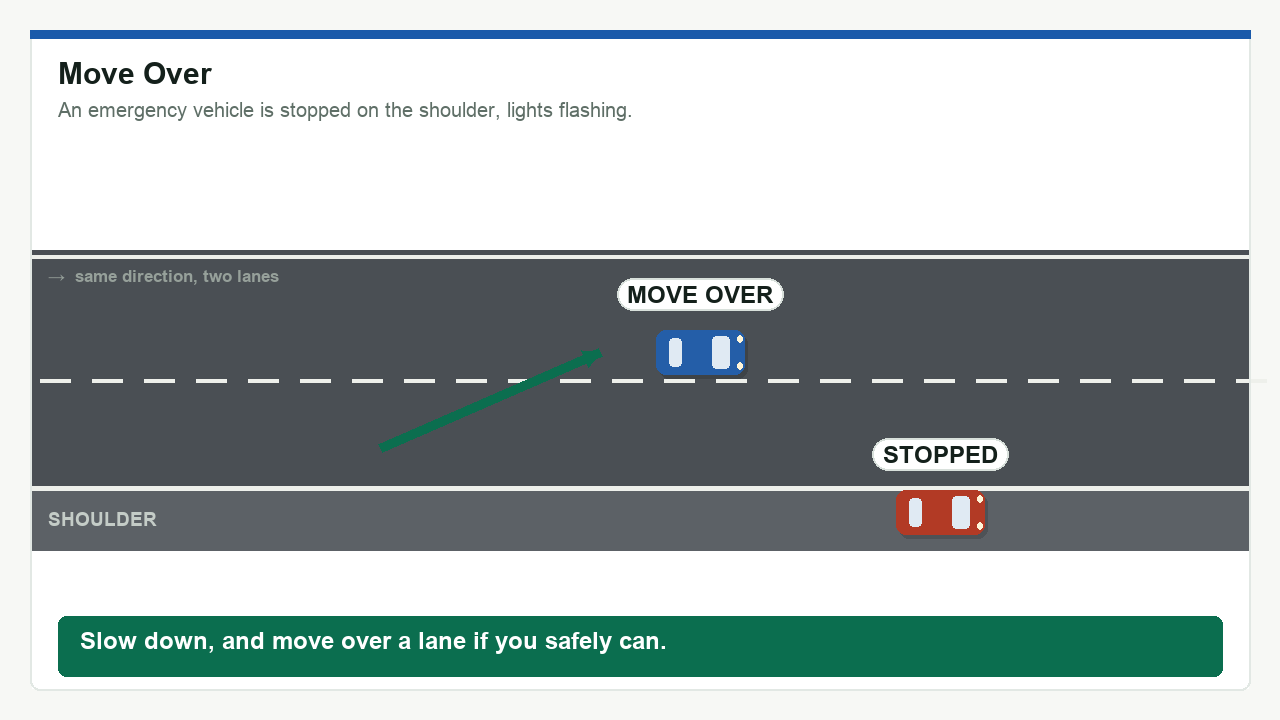
You are approaching an emergency vehicle stopped on the shoulder with its lights flashing. What must you do?
The rule
Slow down, and change lanes away from it if you can do so safely.
Move-over rules require you to slow down and, where it is safe, move a lane away from any emergency vehicle, tow truck or roadside assistance vehicle stopped with its lights flashing, so that people working at the roadside are not passed closely at speed.
Answers people get wrong
- Maintain your speed and stay in your lane.
- Stop completely until it moves.
- Sound your horn as you pass.
3. Passing on a Two-Lane Road
A solid yellow line runs along your side.
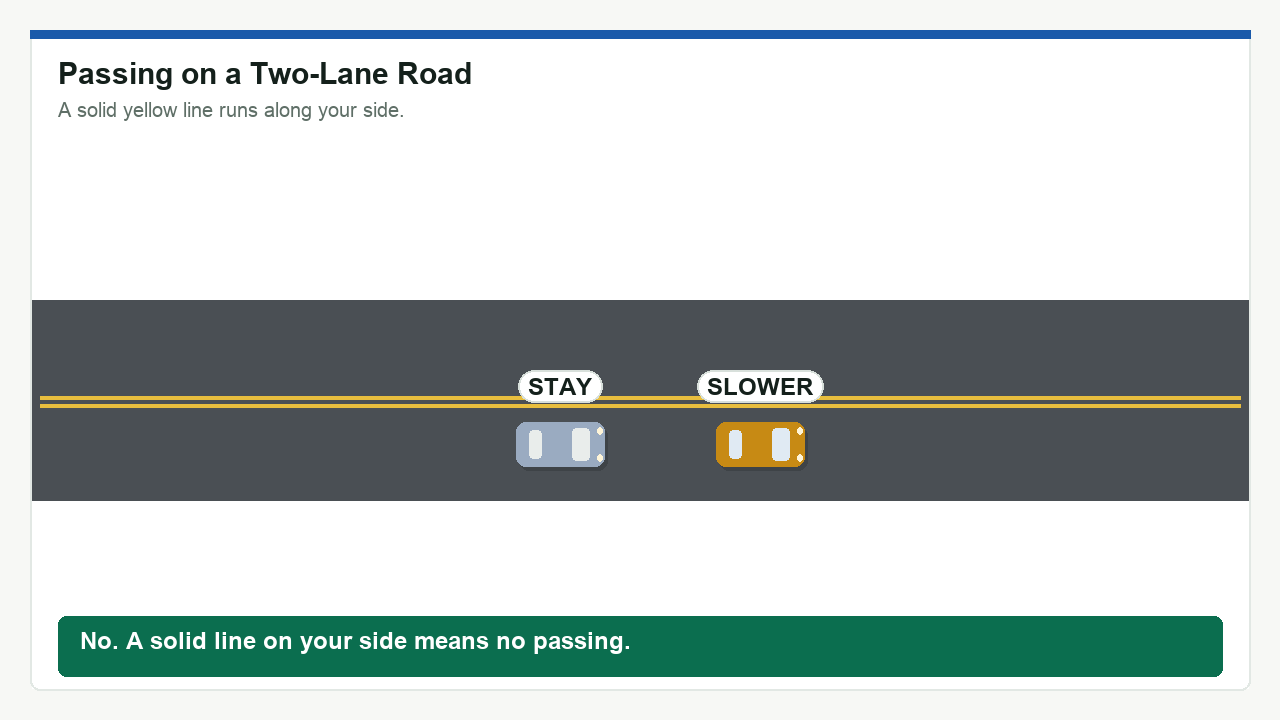
You are behind a slower vehicle and a solid yellow line runs along your side of the center. May you cross it to pass?
The rule
No, a solid line on your side means passing is not permitted.
A solid yellow line on your side of the center means passing is not permitted there. It is used where your view is too short to pass safely, such as on hills and curves and approaching intersections. Wait for a broken line on your side.
Answers people get wrong
- Yes, if the road ahead looks clear.
- Yes, if the other vehicle is under the limit.
- Yes, as long as you return quickly.
4. Parking Facing Uphill
You are parked at a curb on a slope.
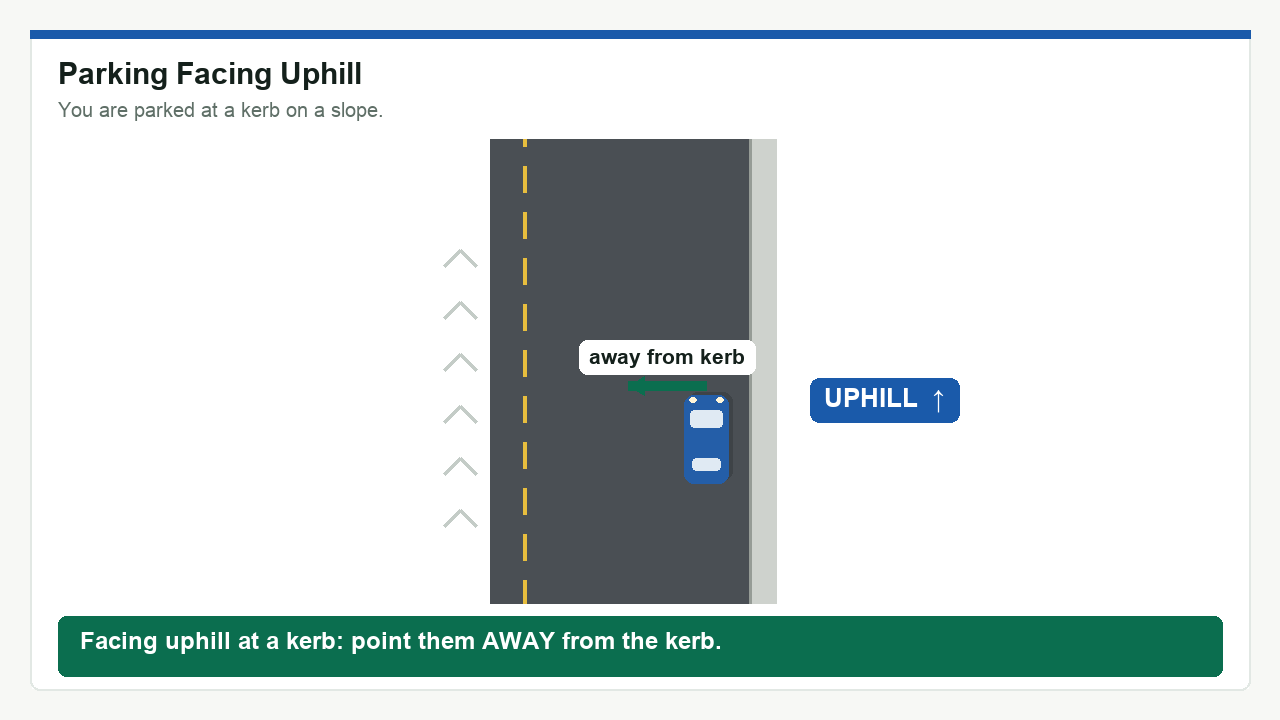
You are parked facing uphill next to a curb. Which way should your front wheels point?
The rule
Away from the curb.
Facing uphill at a curb, point the wheels away from it and let the car roll back slightly so a rear edge of the front tire rests against the curb. If the brakes let go the curb blocks the wheel. Facing downhill it is the opposite: point them toward the curb.
Answers people get wrong
- Straight ahead.
- Toward the curb.
- It does not matter if the handbrake is on.
Is this the same in every state?
The core rules here apply everywhere, but the details are state law. How far back you must stop for a school bus, whether you must stop when the bus is across a divided highway, and exactly which vehicles a move-over law covers all differ between states. Check your own state's handbook for the numbers.
See which rules are the same everywhere, and which ones differ
Prefer to watch? This guide as a video on YouTube.
Written by Drive To Excel DMV, an independent study site not affiliated with any state DMV. Always confirm requirements with your state's DMV.