Railroad Crossings Explained: Crossbucks, Gates, Flashing Lights and Second Trains
Railroad crossing questions are few on the permit test but they carry the highest stakes of anything on it. A train cannot swerve and needs a very long distance to stop, so every rule here comes down to one idea: the train always has the right of way, and you never put your vehicle where a train could reach it.
1. Crossbuck, No Gates
A crossbuck and no lights. Nothing is flashing.
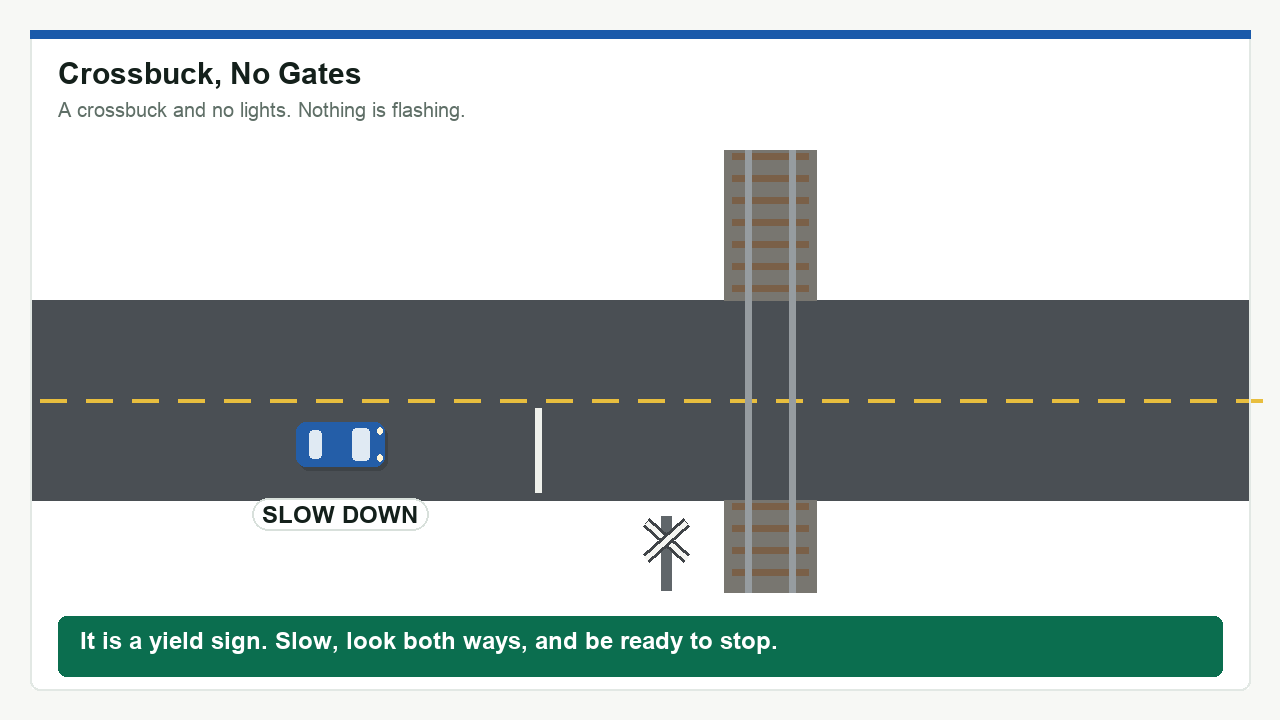
You approach a railroad crossing marked only with a crossbuck. There are no gates and no flashing lights. What does the crossbuck require?
The rule
It is a yield sign: slow down, look and listen, and stop if a train is coming.
A crossbuck is a yield sign. It does not require you to stop every time, but it does require you to slow down, look and listen in both directions, and be prepared to stop. Trains cannot swerve and cannot stop quickly, so at a crossing the train always has the right of way.
Answers people get wrong
- Nothing, you may drive straight across.
- You must always come to a complete stop.
- You must sound your horn before crossing.
2. Gates Down, Lights Flashing
The gate is across your lane and the red lights are lit.
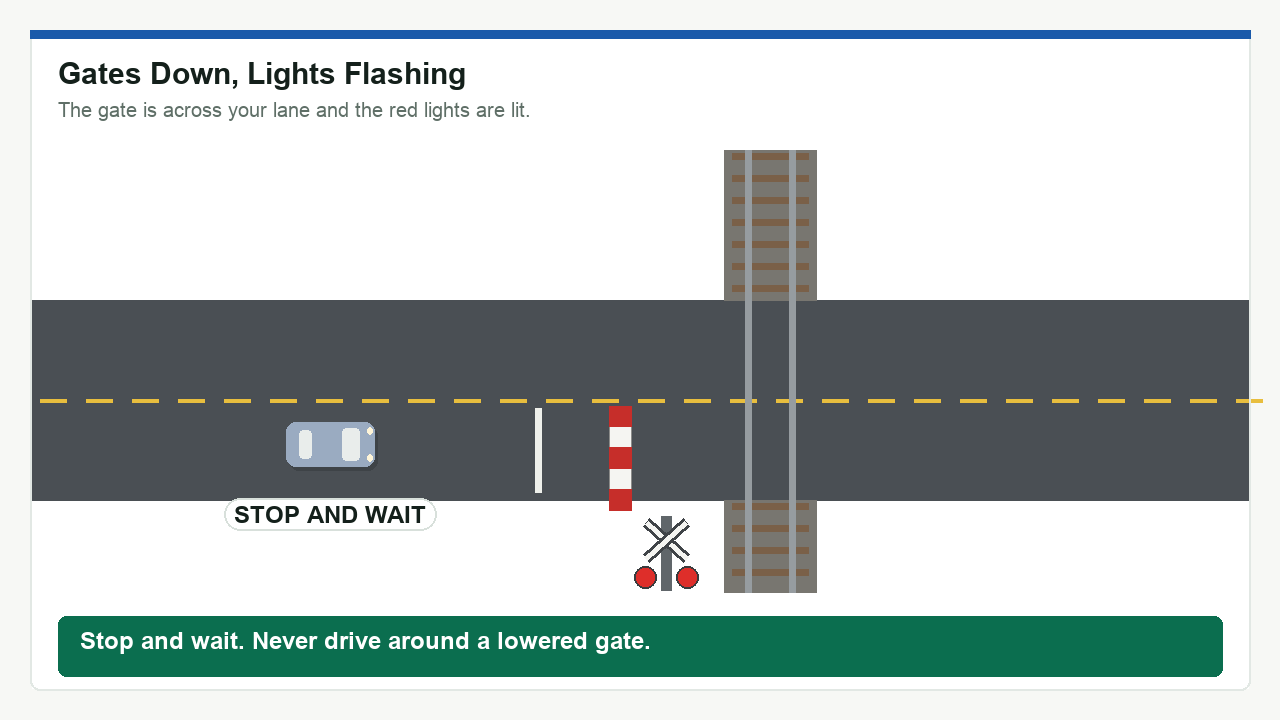
You reach a railroad crossing where the red lights are flashing and the gate is down across your lane. What may you do?
The rule
Stop, and wait until the gate lifts and the lights stop flashing.
Stop before the stop line and wait. Driving around a lowered gate is illegal in every state and is how most crossing deaths happen: the gate is down because a train is coming, and a train can be much closer and much faster than it looks. Wait for the gate to lift and the lights to stop.
Answers people get wrong
- Drive around the gate if you cannot see a train.
- Cross slowly if the gate is only partly down.
- Reverse and take another route immediately.
3. A Train Has Just Passed
The train has cleared, but the lights are still flashing.
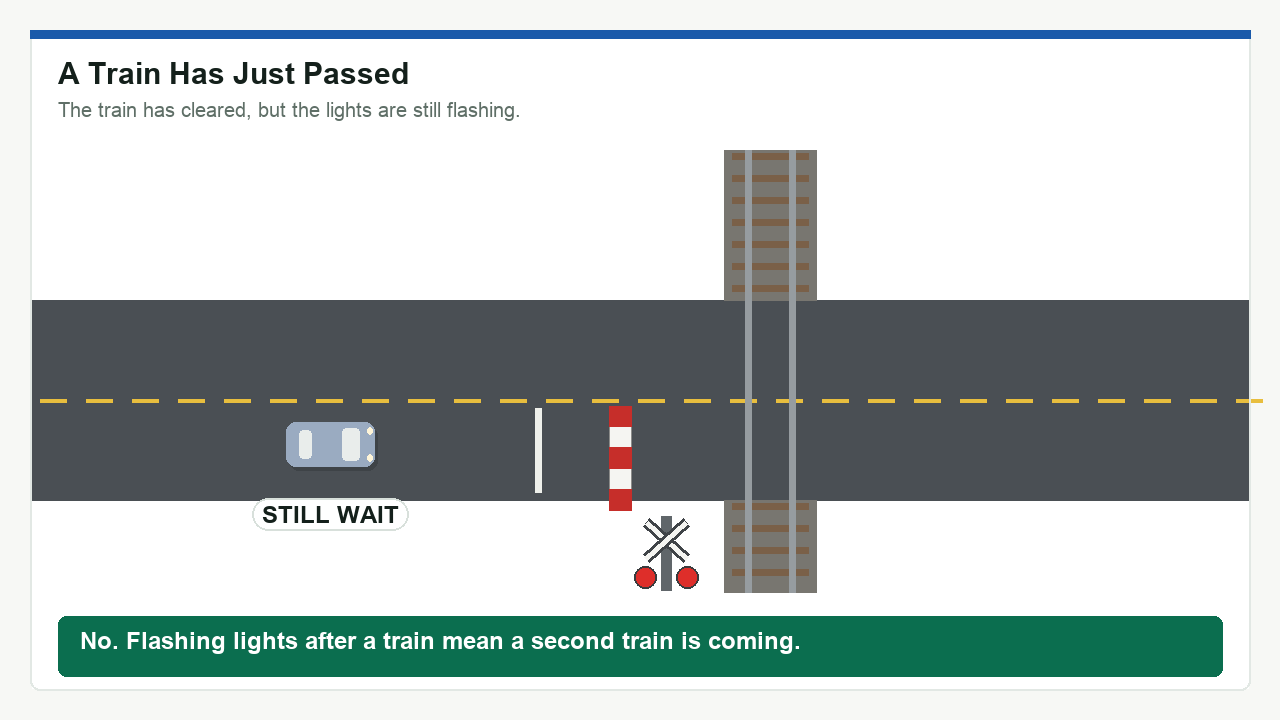
A train has just passed the crossing, but the red lights are still flashing and the gates have not lifted. What should you do?
The rule
Wait until the lights stop flashing and the gates lift.
If the lights are still flashing after a train has passed, the crossing is still active, and the usual reason is a second train coming the other way on another track. The first train hides it and its noise covers the sound. Wait until the lights stop and the gates lift, however clear the track looks.
Answers people get wrong
- Cross as soon as the train has passed.
- Cross if you looked and the track is clear.
- Sound your horn and cross slowly.
4. Traffic Backed Up Beyond the Tracks
Nothing is flashing, but the road ahead is full.
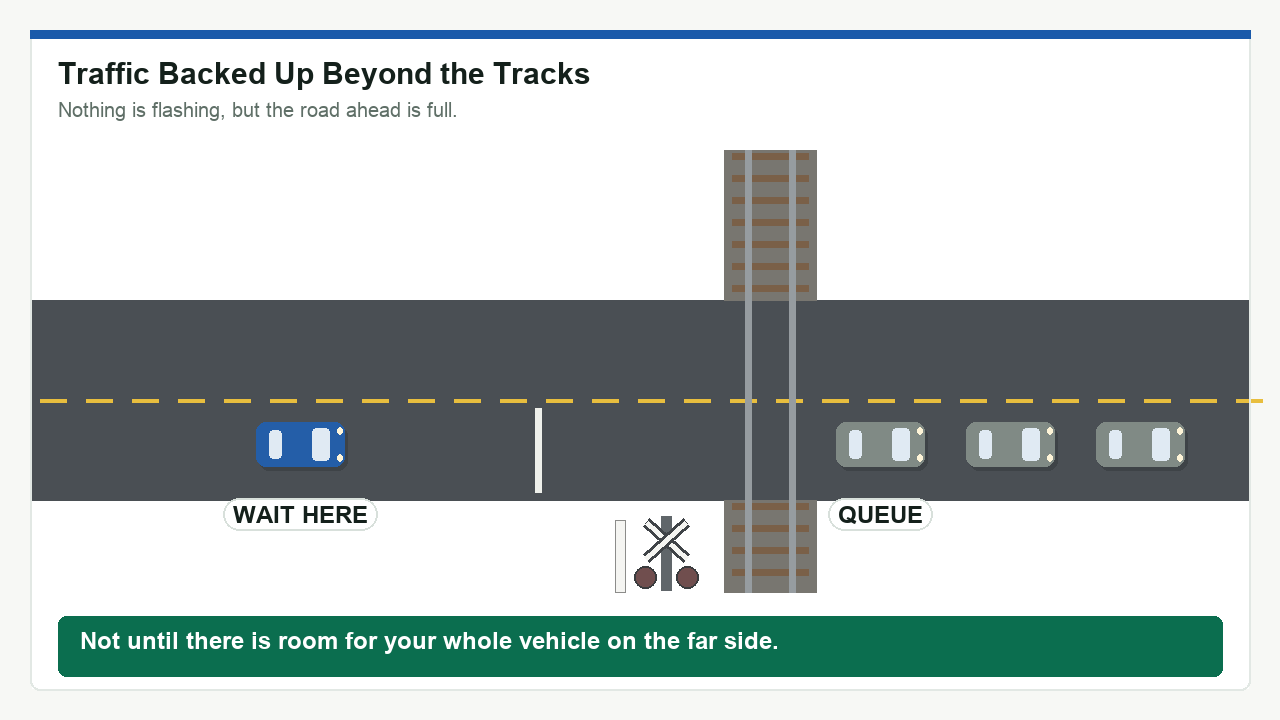
No lights are flashing at the crossing, but traffic ahead is stopped and the queue reaches back towards the tracks. Should you start across?
The rule
No, wait until there is room for your whole vehicle on the far side.
Never start across a railroad crossing unless there is room for your entire vehicle on the other side. A crossing with no train now can have one in under a minute, and a vehicle stopped on the tracks has nowhere to go. If you do end up stuck on the tracks, get everyone out and away from the vehicle immediately, then call the number on the blue emergency sign at the crossing.
Answers people get wrong
- Yes, there is no train coming.
- Yes, as long as you cross quickly.
- Yes, and stop on the tracks if the queue does not move.
Is this the same in every state?
The meaning of the crossbuck, the flashing lights and the gates is federal, so it is the same everywhere. How far back you must stop is state law and varies, so check your handbook for the distance. If your vehicle ever stalls on the tracks, get everyone out and well away from it, then call the number on the blue emergency sign at the crossing.
See which rules are the same everywhere, and which ones differ
Prefer to watch? This guide as a video on YouTube.
Written by Drive To Excel DMV, an independent study site not affiliated with any state DMV. Always confirm requirements with your state's DMV.