Highway Merging Explained: On-Ramps, Acceleration Lanes and Letting Others In
Merging is where the rule and the technique seem to point in different directions. Traffic already on the freeway has the right of way, but yielding does not mean stopping, and it does not mean merging far slower than the lane you are joining. These four situations walk through it from both sides.
1. Entering the Freeway
You are on the on-ramp. Traffic is flowing in the right lane.
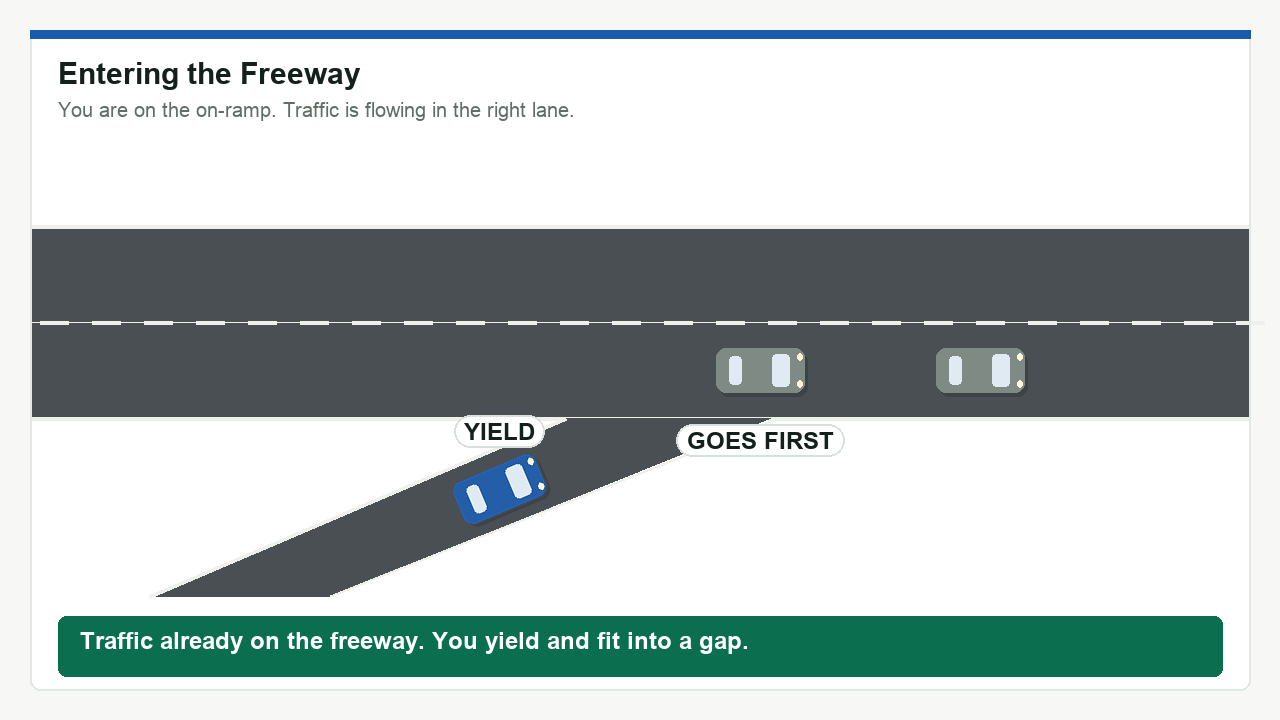
You are on an on-ramp entering a freeway. Traffic is already flowing in the right lane. Who has the right of way?
The rule
Traffic already on the freeway.
Traffic already on the freeway has the right of way. Merging drivers must yield and fit into a gap. That does not mean stopping at the end of the ramp, which is one of the most dangerous things you can do on an entrance ramp. It means using the ramp to find a gap and match the speed of the lane you are joining.
Answers people get wrong
- You do, because you are entering.
- Whoever is going faster.
- Neither, take turns one at a time.
2. The Acceleration Lane
The ramp straightens out alongside the freeway.
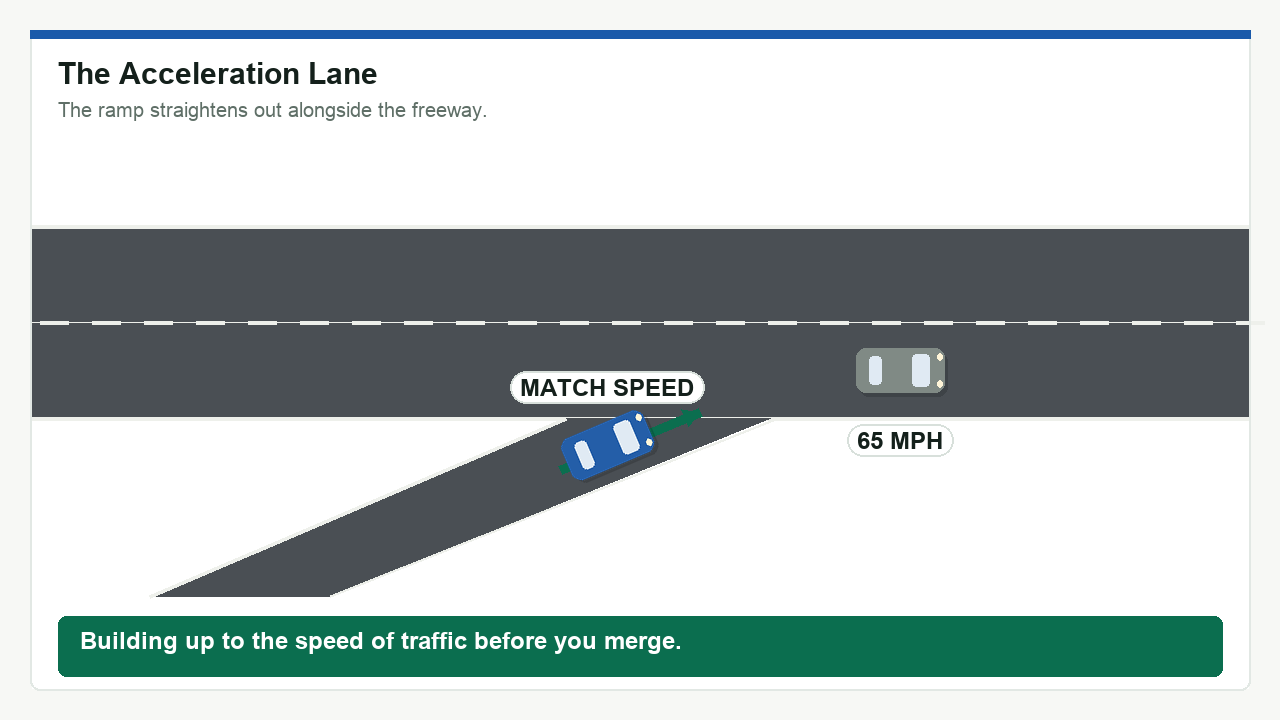
You are on the acceleration lane of an entrance ramp and freeway traffic is moving much faster than you are. What should you do?
The rule
Use the ramp to build up to the speed of traffic, then merge.
The acceleration lane exists so you can reach the speed of traffic before you join it. Merging far slower than the lane you are entering forces everyone behind to brake and is a common cause of freeway collisions. Stopping at the end of a ramp is worse still, because you then have no room left to accelerate.
Answers people get wrong
- Stop at the end of the ramp and wait for a gap.
- Merge immediately at your current speed.
- Drive on the shoulder until a gap appears.
3. Before You Move Over
You have a gap. The lane is clear in your mirror.
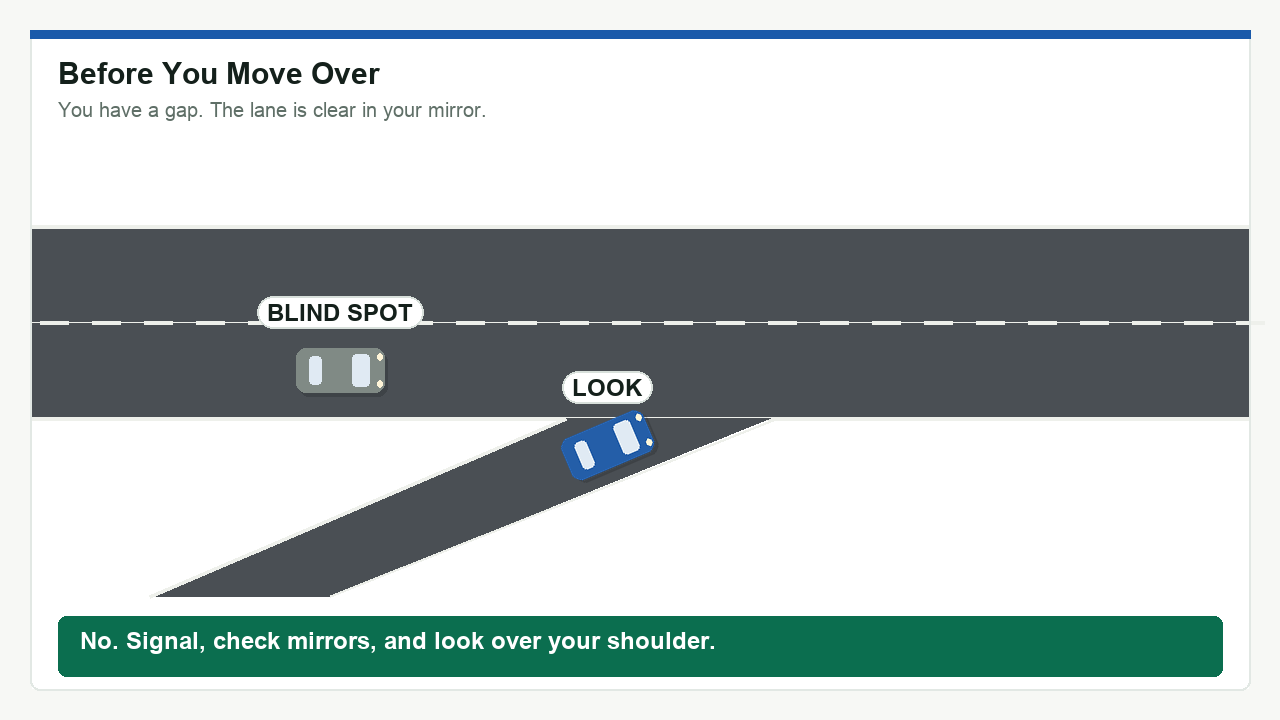
You are about to merge onto the freeway and your mirrors show the lane is clear. What else must you do before you move over?
The rule
Signal, then turn your head and check your blind spot.
Mirrors do not show everything. Every vehicle has a blind spot large enough to hide another car, and on a merge the vehicle you cannot see is often exactly where you are heading. Signal your intention, check your mirrors, then turn your head and look before you move. The horn and the headlights are not a substitute.
Answers people get wrong
- Nothing, clear mirrors are enough.
- Sound your horn to warn other drivers.
- Flash your headlights and merge quickly.
4. Someone Is Merging Into You
You are on the freeway. A car is coming down the ramp.
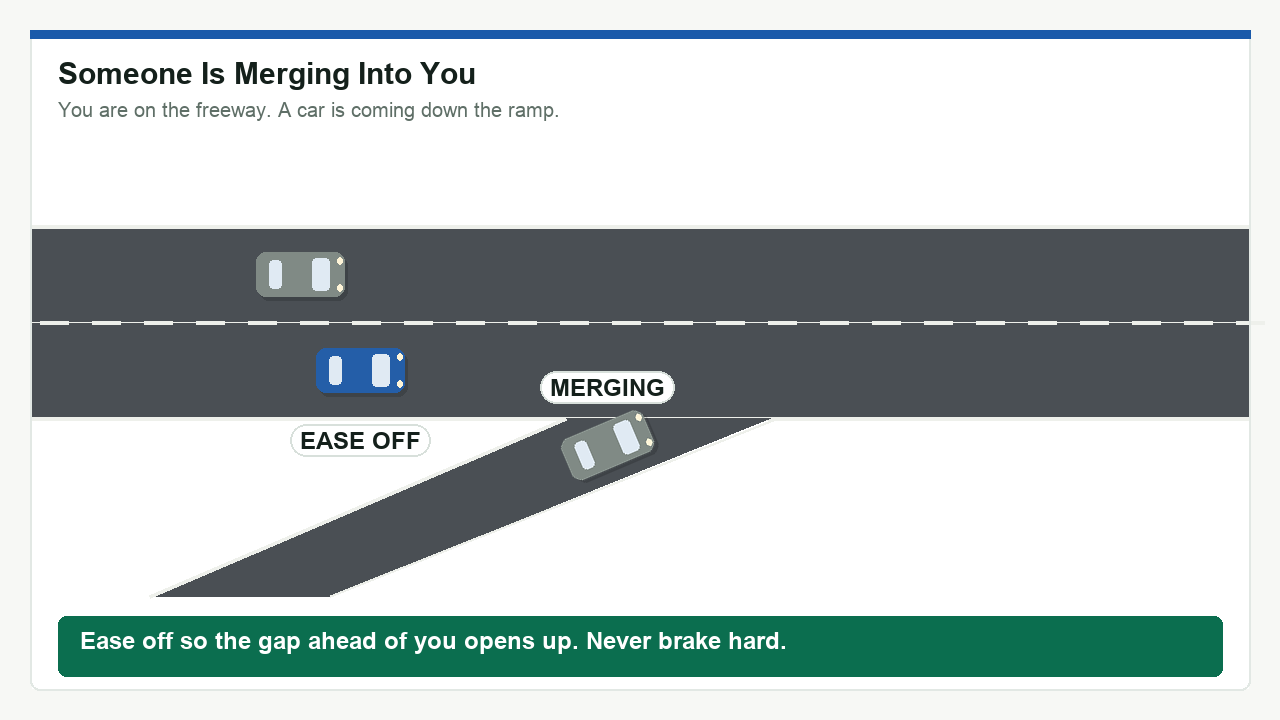
You are driving in the right lane of a freeway and a car is coming down an entrance ramp. The left lane is occupied so you cannot move over. What should you do?
The rule
Adjust your speed smoothly to open a gap for them.
Merging traffic must yield, but a courteous driver still makes room. If the next lane is clear, move over. If it is not, ease off the accelerator so the space ahead of you opens up for them. Braking hard is the wrong answer even though it feels helpful, because the driver behind you is not expecting it and cannot see why you did it.
Answers people get wrong
- Speed up so they have to merge behind you.
- Brake hard to let them in.
- Hold your speed and position, it is their job to yield.
Is this the same in every state?
These rules are the same in every state. Ramp lengths and freeway speed limits are set locally, so no distances or speeds are quoted here.
See which rules are the same everywhere, and which ones differ
Prefer to watch? This guide as a video on YouTube.
Written by Drive To Excel DMV, an independent study site not affiliated with any state DMV. Always confirm requirements with your state's DMV.